
A long-standing mystery about cell membrane behavior may finally be resolved.
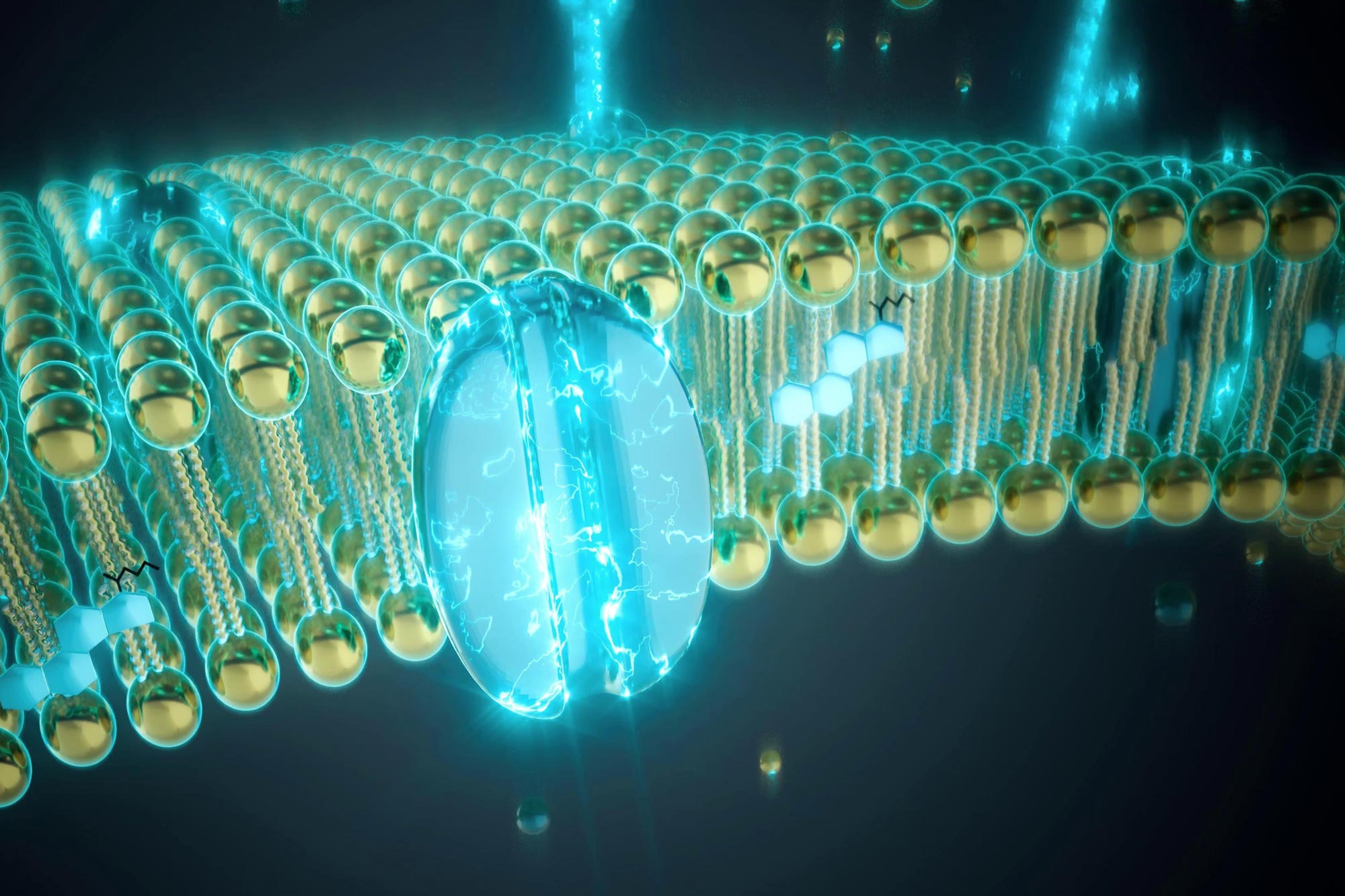
Cell membranes are the thin, flexible skins that surround living cells. They protect what is inside, control what gets in and out, and can even shape how a cell behaves.
For a long time, though, membranes have also seemed oddly unpredictable. Results from well-known experiments did not line up with a basic expectation in physics: if you change a structure, its physical properties should change too.
Physicist Rana Ashkar and her team found a way to make those contradictions snap into focus by changing the scale of the question. When they studied membranes at the nanoscale, a realm measured in billionths of a meter, the apparent chaos started to look like order. At that level, they could see shared biophysical rules that membranes have been following all along.
The work, published in Nature Communications, points toward new ways to think about disease intervention, drug delivery, artificial cell technologies, and what comes next in membrane biophysics.
Composition-shifting superheroes
Cell membranes are built mainly from fatty molecules known as lipids. These molecules are not static. Membranes can rapidly adjust their lipid makeup in response to environmental changes, sometimes within hours, adapting to shifts in diet, pressure, or temperature. This ability, called homeostasis, allows cells to maintain stable internal conditions even when the outside environment changes.
Scientists have tried to explain this adaptability using a core principle of physics, which holds that a structure’s composition should determine its physical properties.
That idea seems straightforward. The ingredients of a material should shape how it behaves.
However, biological membranes did not appear to follow that rule.
The inconsistency became especially clear in experiments involving cholesterol. Researchers added cholesterol to model cell membranes to alter their structure and then measured whether properties such as flexibility or elasticity changed. The findings were inconsistent. Some membranes became stiffer, while others showed little to no difference.
It’s not the type of lipid but how you pack it
“It caused a dilemma in the field,” Ashkar said. “Somehow cholesterol changed the structure of some membranes but not their elastic properties.”
Many scientists assumed that different lipid types must respond to cholesterol in distinct ways. Ashkar questioned that explanation. Rather than focusing only on lipid identity, she shifted attention to how earlier studies had measured membrane mechanics. Most previous experiments relied on large-scale measurements. Her team decided to investigate the problem at a much finer resolution.
Using neutron scattering and X-ray techniques, the researchers discovered that elasticity depends less on the specific kind of lipid and more on how tightly the lipids are arranged within the membrane.
Some lipids naturally resist being compressed, while others can be packed closely together. The density of this packing turned out to be the key factor controlling membrane flexibility. Flexibility, in turn, plays an essential role in maintaining cell health and survival.
To strengthen their conclusions, Ashkar’s group worked with Michael Brown’s lab at the University of Arizona and Milka Doktorova’s lab at Stockholm University. Nuclear resonance experiments and computational modeling conducted by these collaborators confirmed the same physical principles identified by Ashkar’s team.
“Membranes can have remarkable compositional complexity, but what really matters in determining or predicting their elasticity is how packed they are,” said Ashkar. “And that is a very, very powerful design principle that cells seem to follow and that we can now apply in engineering lifelike artificial cells.”
Reference: “Cholesterol modulates membrane elasticity via unified biophysical laws” by Teshani Kumarage, Sudipta Gupta, Nicholas B. Morris, Fathima T. Doole, Haden L. Scott, Laura-Roxana Stingaciu, Sai Venkatesh Pingali, John Katsaras, George Khelashvili, Milka Doktorova, Michael F. Brown and Rana Ashkar, 31 July 2025, Nature Communications.
DOI: 10.1038/s41467-025-62106-0
Never miss a breakthrough: Join the SciTechDaily newsletter.
Follow us on Google and Google News.