

University of Innsbruck Researchers Have Identified the Genetic Origin of Our Senses
Researchers from the University of Innsbruck have determined the genetic origin of our senses. The findings reveal that vertebrate cranial Sensory Ganglia arise from a genetic program shared with their closest living relatives, tunicates.
It’s definitely beneficial to have a head. This may seem obvious, yet evolution underwent a long journey to test it: Invertebrates dominated the waters at first when animal life began to emerge. Although they already had head features, vertebrates ultimately succeeded because they developed a new, superior head. This “new head” enabled a widespread spatial dispersion and multiplication of sensory cells, leading to a much-improved perception of the surroundings. This was also crucial for the evolution of a predatory lifestyle.
Cranial Sensory Ganglia are critical for transmitting external sensations to the vertebrate brain. You can think of them as nerve nodes that are spread throughout the brain and collect information from the sensory organs. The precise process by which these ganglia were created was unknown to scientists up until this point. These questions have finally been resolved by a study that was published in Nature on May 18, 2022.
Prototype of the Vertebrates
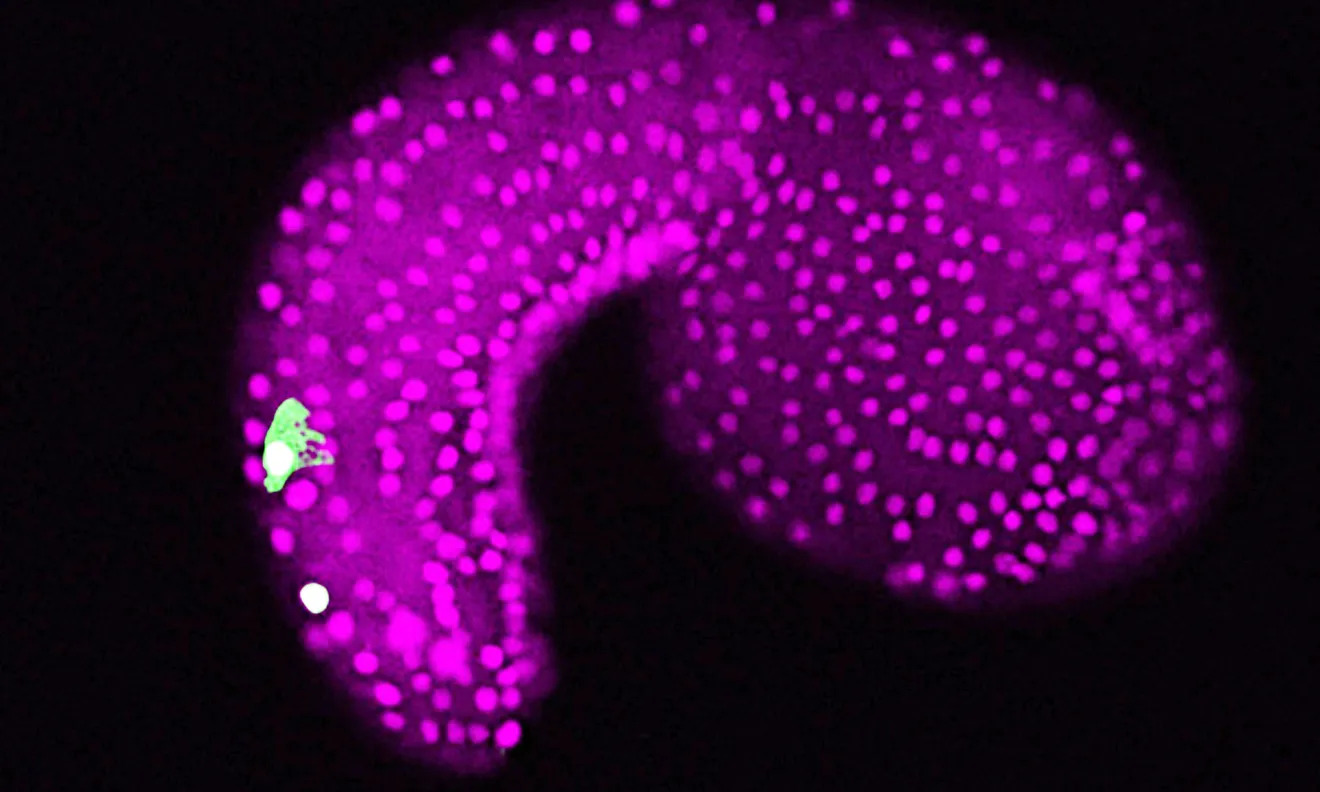
The research group of Ute Rothbächer from the Institute of Zoology at the University of Innsbruck was decisively involved in the last phase of the project, an international collaboration of several institutions, conceived by the University of Oxford. Their findings show that the Cranial Sensory Ganglia of vertebrates emerge from a genetic program that is also found in their closest living relatives, the tunicates. In tunicate larvae, certain sensory neurons, called Bipolar Tail Neurons, are located in the tail region. These process external stimuli, but are also responsible for the animal’s movement. In both animal subphyla, the respective structures are formed by the gene Hmx.
“Tunicates are like an evolutionary prototype for vertebrates,” Rothbächer explains. “There is a large anatomical gap between the adults of these subphyla, as they are adapted to ecological niches. This complicates research on their evolution. Common structures and mechanisms can only be identified at the embryonic stage – our common ancestor was probably very similar to a tunicate larva.”
The study’s model organisms were the lamprey, a primitive fish that resembles an eel and is often referred to as a ‘living fossil,’ and the tunicate Ciona intestinalis, which is surrounded by a yellowish, tubular mantle that protects the animal and filters food.
The Conserved Gene
Alessandro Pennati, a doctoral student in Rothbächer’s research group, provided decisive data on the function of the gene Hmx in Ciona. He applied the gene technology CRISPR-Cas9 to selectively knock out genetic sequences, while the method of transient transgenesis was used to over-express genes.
The researchers found that Hmx controls the development of Bipolar Tail Neurons in tunicates, whereas in vertebrates, it does so for Cranial Sensory Ganglia. Surprisingly, lamprey Hmx gene segments inserted into Ciona DNA were similarly active as Ciona’s own Hmx.
“Hmx has been shown to be a central gene that has been conserved across evolution. It has retained its original function and structure and was probably found in this form in the common ancestor of vertebrates and tunicates,” Pennati explains. Cranial Sensory Ganglia and Bipolar Tail Neurons thus have the same evolutionary origin, Hmx was probably crucially involved in the formation of highly specialized head sensory organs in vertebrates.
Reference: “Hmx gene conservation identifies the origin of vertebrate cranial ganglia” by Vasileios Papadogiannis, Alessandro Pennati, Hugo J. Parker, Ute Rothbächer, Cedric Patthey, Marianne E. Bronner, and Sebastian M. Shimeld, 18 May 2022, Nature.
DOI: 10.1038/s41586-022-04742-w
Never miss a breakthrough: Join the SciTechDaily newsletter.
Follow us on Google and Google News.