
Quantum materials can behave in surprising ways when many tiny spins act together, producing effects that don’t exist in single particles.
In condensed matter physics, some of the most surprising behavior appears only when many quantum particles interact as a group. Individual quantum spins can behave predictably on their own, but when they influence one another, entirely new effects emerge. Explaining how these spins interact collectively is a core goal of modern physics because it helps scientists understand the deeper rules governing quantum matter.
One of the most influential collective effects is the Kondo effect, which describes how localized spins interact with mobile electrons. This interaction plays a key role in shaping the behavior of many quantum materials.
Why the Kondo Effect Is Hard to Isolate
Studying the Kondo effect in real materials is challenging because electrons do more than just carry spin. They also move through the material and occupy different orbitals, bringing additional charge and motion into the system. When all of these factors overlap, it becomes difficult to pinpoint which effects come specifically from spin interactions and which come from everything else.
To overcome this complexity, physicists have long relied on simplified theoretical models. One of the most important is the Kondo necklace model, introduced in 1977 by Sebastian Doniach. This model strips away electron motion and orbital effects, focusing only on interacting spins. For decades, it has served as a powerful idea for exploring new quantum states, even though no one had managed to fully realize it in an experiment.
A Longstanding Question About Spin Size
A major unresolved issue has been whether the Kondo effect behaves differently depending on the size of the localized spin. If true, this would have broad implications for the study of quantum materials and how their properties can be controlled.
That question has now been addressed by a research team led by Associate Professor Hironori Yamaguchi of the Graduate School of Science at Osaka Metropolitan University. The researchers created a new version of the Kondo necklace using a carefully engineered organic inorganic hybrid material made from organic radicals and nickel ions. Their success relied on RaX-D, a molecular design framework that allows precise control over crystal structure and magnetic interactions.
From Nonmagnetic to Magnetic Order
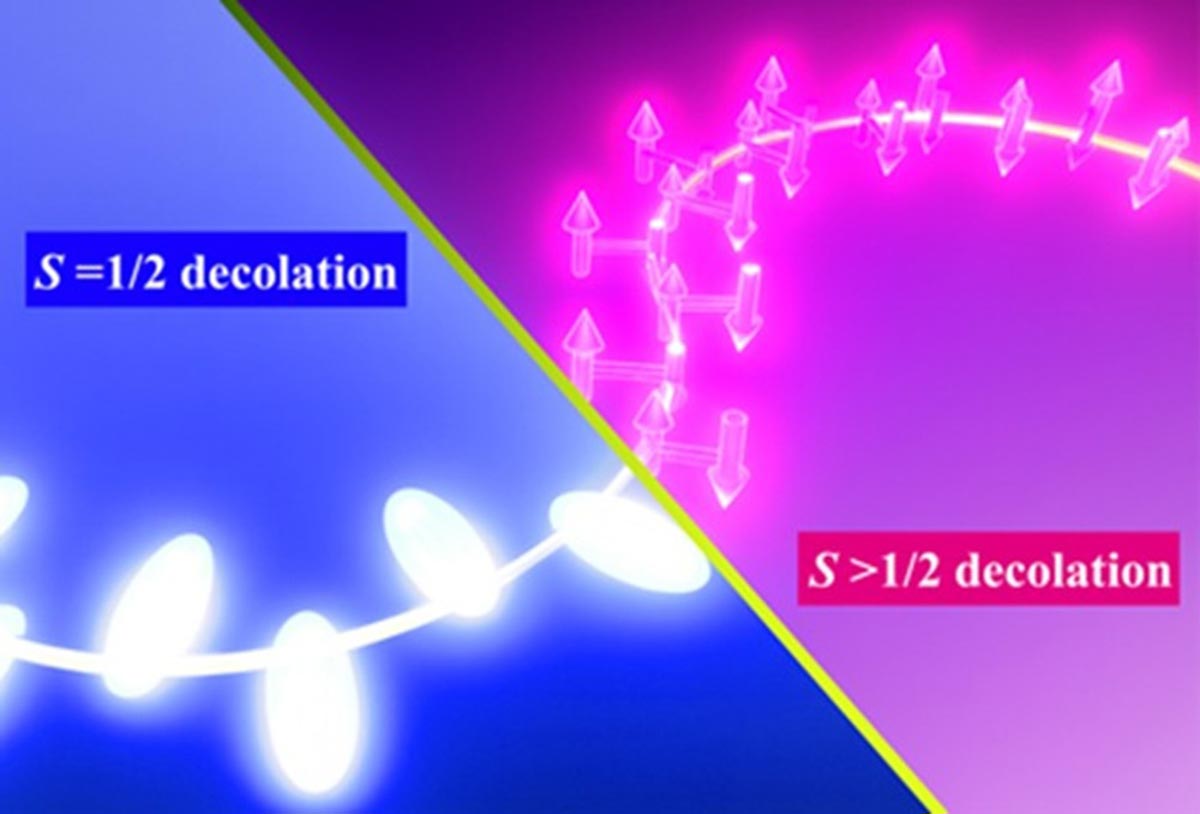
The team had previously realized a spin-1/2 Kondo necklace. In their latest work, they extended this approach to a system where the localized spin (decollated spin) increases from 1/2 to 1. Measurements of thermodynamic properties showed a clear phase transition, revealing the emergence of an ordered magnetic state.
Further quantum analysis explained why this happens. The Kondo coupling creates an effective magnetic interaction between spin-1 moments, which stabilizes long range magnetic order across the system.
Rethinking a Core Assumption in Physics
For many years, the Kondo effect was thought to mainly suppress magnetism by pairing spins into singlets, a maximally entangled state with zero total spin. The new results challenge that idea. When the localized spin exceeds 1/2, the same Kondo interaction no longer weakens magnetism. Instead, it actively supports magnetic order.
By directly comparing spin-1/2 and spin-1 systems within a clean, spin-only platform, the researchers uncovered a clear quantum boundary. In spin-1/2 systems, the Kondo effect always produces local singlets. In spin-1 and higher systems, it promotes stable magnetic order.
This marks the first direct experimental proof that the fundamental role of the Kondo effect depends on spin size.
Implications for Quantum Materials and Technology
“The discovery of a quantum principle dependent on spin size in the Kondo effect opens up a whole new area of research in quantum materials,” Yamaguchi said. “The ability to switch quantum states between nonmagnetic and magnetic regimes by controlling the spin size represents a powerful design strategy for next-generation quantum materials.”
Showing that the Kondo effect can operate in opposite ways depending on spin size offers a new lens for understanding quantum matter. It also provides a foundation for designing spin-based quantum devices.
Being able to control whether a Kondo lattice becomes magnetic or non-magnetic is especially important for future quantum technologies. It could allow scientists to tune properties such as entanglement, magnetic noise, and quantum critical behavior. The researchers believe their findings will guide the creation of new quantum materials and may eventually contribute to advances in quantum information devices and quantum computing.
Reference: “Emergence of Kondo-assisted Néel order in a Kondo necklace model” by Hironori Yamaguchi, Shunsuke C. Furuya, Yu Tominaga, Takanori Kida, Koji Araki and Masayuki Hagiwara, 19 January 2026, Communications Materials.
DOI: 10.1038/s43246-025-01027-3
Never miss a breakthrough: Join the SciTechDaily newsletter.
Follow us on Google and Google News.
3 Comments
In condensed matter physics, some of the most surprising behavior appears only when many quantum particles interact as a group. Individual quantum spins can behave predictably on their own, but when they influence one another, entirely new effects emerge. Explaining how these spins interact collectively is a core goal of modern physics because it helps scientists understand the deeper rules governing quantum matter.
VERY GOOD.
Please ask the researchers to think deeply: How do you understand quantum particles? Is quantum particle related to topological spin?
Matter as the Topological Child of Space.
Within the Topological Vortex Theory (TVT) framework, the question of the origin of objects in space finds a naturalistic answer:
1)Matter is not foreign but a product of topological phase transitions of space’s own fundamental physical property (superfluidity) under specific conditions [5, 6];
2)The diversity of objects stems from the diverse configurations of topological defects (vortices, knots, linked rings, etc.) [4];
3)This process is entirely described by mathematically rigorous topological invariants and nonlinear dynamics, requiring no introduction of supernatural assumptions.
This picture not only dispels the mystery of material origin but also provides a new perspective of matter-spacetime unity: the universe we inhabit may be a vast quantum superfluid, wherein all things—from elementary particles to galaxies—are its ripples, vortices, and knots. This is both poetic and mathematically rigorous.
TVT is still under development, and its specific mathematical formulation and experimental verification require further research. However, its core idea—space is physical, and matter is its topological excitation—already provides a solid and elegant scientific path for understanding the origin of all things.
——Excerpted from https://t.pineal.cn/blogs/6255/A-Mathematical-and-Physical-Analysis-On-the-Origin-of-Objects.
B Memo 2601_252052,260438_ Source 1. Reinterpretation 【】
Source 1.
https://scitechdaily.com/scientists-found-a-hidden-switch-inside-quantum-matter/
1.
_Scientists have discovered a hidden switch inside quantum matter.
_When quantum spins interact, they can produce collective behaviors that defy classical intuition. In a newly developed Kondo necklace material, researchers discovered that the famous Kondo effect manifests in opposite ways depending on the spin size.
ㅡa1.【
>>>msbase.msoss.qpeoms’s Collective System. 2105.
_Quantum matter behaves in surprising ways when countless tiny spins interact together, producing effects that do not exist in single particles.
_The most striking phenomena in condensed matter physics only appear when countless quantum particles interact collectively. Individual quantum spins exhibit predictable behavior on their own, but when they interact with one another, completely new effects emerge.
>>>The system is a collective interaction. 2108. The main idea is that msbase/qpeoms(1) = n.
>>>However, if msbase/qpeoms(banc), complex spacetime interactions transform non-collectivity into independence and singularity. 2121.
These phenomena can stretch, shrink, twist, compress, and more. They are also influenced by their surroundings. They collapse, explode, or stop. 2117.
】
_Explaining how these spins collectively interact is a central goal of modern physics, because it allows scientists to understand the deeper laws that govern quantum matter.
_One of the most influential collective effects is the Kondo effect, which describes how localized spins interact with moving electrons. This interaction plays a key role in shaping the behavior of many quantum materials.
1-1. Why It’s Difficult to Isolate and Analyze the Kondo Effect
Studying the Kondo effect in real materials is challenging. Electrons don’t simply carry spin; they occupy various orbitals as they move through the material, imparting additional charge and momentum to the system. When all these factors overlap, it becomes difficult to clearly distinguish which effects arise from spin interactions and which from other factors.
1-2.
To overcome this complexity, physicists have long relied on simplified theoretical models. One of the most important is the Kondo necklace model, proposed by Sebastian Doniach in 1977.
This model eliminates the effects of electron motion and orbital motion and focuses solely on the interacting spins. While this model has been a powerful tool for exploring novel quantum states for decades, it has not yet been fully experimentally demonstrated.
The magnitude of the spin has a critical impact on how the system behaves. When the spin is 1/2, the fully quantum spins pair and cancel each other out, preventing magnetism.
1-3.
_When the spin is greater than 1/2, the larger spins do not completely cancel each other out, and the remaining spins interact with each other to form a magnetic order.
2. Long-standing Questions about Spin Size
_One of the major unresolved questions is whether the Kondo effect operates differently depending on the size of the localized spin. If so, this would have far-reaching implications for the study of quantum materials and how to control their properties.
ㅡa2【 msbase was also interpreted as a path for electromagnetic waves. In this case, electrons are arranged in order of spin size. 2601260404.
This could be a Kondo necklace. 0405.
】
_A research team led by Associate Professor Hironori Yamaguchi of the Osaka Metropolitan Graduate School of Science has provided an answer to this question. The team created a new version of the Kondo necklace using a precisely engineered organic-inorganic hybrid material composed of organic radicals and nickel ions.
This success was achieved thanks to RaX-D, a molecular design framework that allows for precise control of crystal structure and magnetic interactions.
2-2. From Non-Magnetic to Magnetic Order
This research team previously demonstrated spin-1/2 Kondo necklaces. In this latest study, they extended this approach to systems where the local spin (isolated spin) increases from 1/2 to 1.
Thermodynamic measurements observed a clear phase transition, indicating the emergence of an ordered magnetic state.
Quantum mechanical analysis explained why this phenomenon occurs. Kondo coupling creates effective magnetic interactions between spin-1 moments, stabilizing long-range magnetic order throughout the system.
—a2. [Long-range msbase of magnetic spin. The tip of the Kondo necklace is nk2. 0408.
Ai Summary (Kondo necklace: In the model, “spin” refers to a continuous structure of “spin-1/2 pairs” in which the localized spin of magnetic impurities in a metal and the surrounding conduction electrons are coupled through quantum mechanical interactions.)
>>>>The continuity of msbase occurs when the electron spins form a Kondo necklace. Hmm. 0419. The reason they exhibit continuity stems from the unit 1, 1/2, and 1/n spins (nqvixer) of the quantum state of qpeoms. 0421.
】
2-2. Rethinking the Core Assumptions of Physics
_For a long time, the Kondo effect was thought to suppress magnetism by pairing spins into a singlet (a maximally entangled state with a total spin of 0). However, new research findings challenge this conventional wisdom.
_When the localized spin exceeds 1/2, the same Kondo interaction no longer weakens magnetism but rather actively maintains magnetic order.
ㅡb2.【This explains why msbase has size and tries to form magic sums in groups. 1/2 qpeoms are likely to be localized spins that cancel out to 0, but as units of 1 are accumulated, a size ordering gradually develops, and group order becomes necessary for example 1. 0434.
example1.spin.kondo_effect 1/2
01000000
00000100
00000001
00010000
example1.msbase4.Kondo necklace
01100716
15080902
14051203
04110613
>>>1) Quantum Order in QPEOMs
_The researchers discovered a clear quantum boundary by directly comparing spin 1/2 and spin 1 systems within a clean, spin-only platform. In spin 1/2 systems, the Kondo effect always creates a localized singlet state. In contrast, in systems with spin 1 or higher, it promotes stable magnetic order.
>>2) Multispin Order in msbase
_This is the first direct experimental evidence showing that the fundamental role of the Kondo effect depends on spin size.
<<<<< Ai Summary (Kondo Necklace with Spin-1 or Higher: When the spin is greater than 1, the spin does not completely cancel out and remains, strengthening magnetic order. This overturns the conventional wisdom that the "Kondo effect = magnetic cancellation," revealing a "new quantum boundary" where the spin transitions from non-magnetism to magnetism as the spin magnitude increases from 1/2 to 1.)
】
2. Implications for Quantum Materials and Technology
_Professor Yamaguchi stated, "The discovery of quantum principles that vary with spin magnitude in the Kondo effect has opened up a completely new field of study in quantum materials." He added, "The ability to switch quantum states between non-magnetic and magnetic states by controlling spin magnitude could be a powerful strategy for designing next-generation quantum materials."
_The demonstration that the Kondo effect can operate in opposite directions depending on spin magnitude offers a new perspective on understanding quantum materials. It also provides a foundation for designing spin-based quantum devices.
2-1. Controlling whether the Kondo lattice is magnetic or non-magnetic is particularly important for future quantum technologies.
This will allow scientists to manipulate properties such as quantum entanglement, magnetic noise, and quantum criticality.
The researchers expect that these findings will contribute to the development of new quantum materials and ultimately contribute to advancements in quantum information devices and quantum computing.