
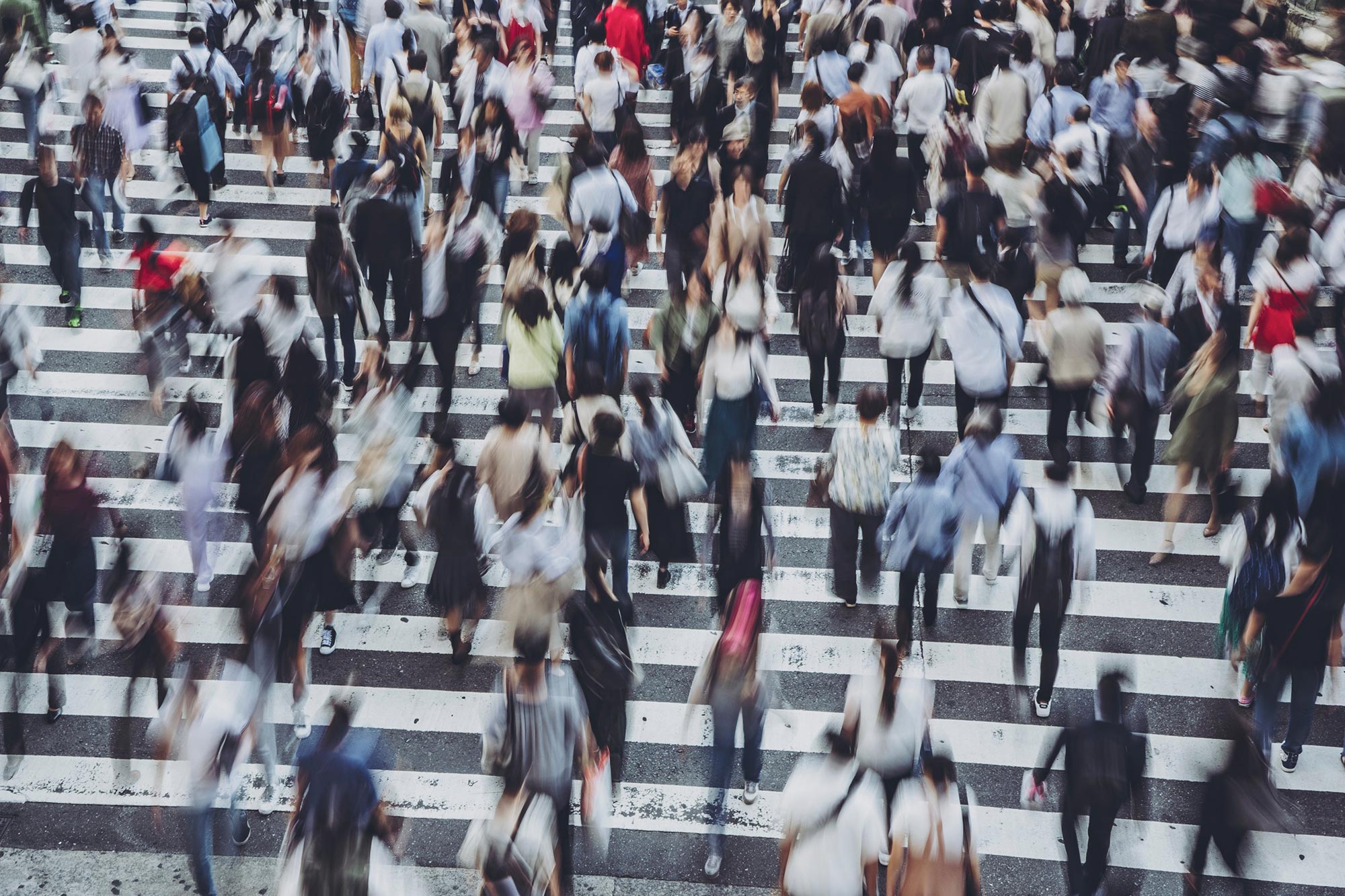
In the ebb and flow of crowded crosswalks, a surprising pattern emerges: people can naturally form neat lanes of movement. But what flips the switch from graceful organization to chaotic weaving?
An international team of researchers has pinpointed a specific tipping point: when pedestrians deviate more than 13 degrees from their path, order collapses. Backed by math, experiments, and real-world testing, this discovery could revolutionize how cities manage foot traffic.
From Flow to Frenzy: What Disrupts Pedestrian Order?
Pedestrian crossings often reveal how naturally people can organize themselves. As individuals move in opposite directions, they tend to form neat, self-organized lanes, smoothly passing one another without collisions. But at times, that flow breaks down: people weave unpredictably, and the crossing becomes chaotic.
Now, a team of mathematicians from the University of Bath in the UK and MIT in the US, led by Professor Tim Rogers and Dr. Karol Bacik, has uncovered why this happens. Their findings could help city planners design crossings and other public spaces that reduce crowding and improve both safety and efficiency.
Critical Angle Discovered: 13 Degrees of Disruption
In a new study published today (March 24) in Proceedings of the National Academy of Sciences, the researchers identified the tipping point where organized pedestrian flow collapses into disorder. They found that if the variation in walking direction exceeds a critical threshold – specifically, an angle of 13 degrees – crowd order quickly breaks down.
When it comes to pedestrian crossings, this could be achieved by limiting the width of a crossing or considering where a crossing is placed, so pedestrians are less tempted to veer off track towards nearby destinations. Professor Rogers said: “In this study, we set out to discover why some pedestrian crowds can spontaneously organize into neat flowing lanes, while others remain chaotic and disordered. Our new theory gives us a way to predict what kind of spaces encourage efficient use, and what are the conditions for order to break down.”

From whiteboard to road crossing
The researchers made their discovery through both mathematical and experimental work. They considered a common scenario in which pedestrians navigate a busy pedestrian crossing. They analyzed the scenario through mathematical simulations, considering the many angles at which individuals may cross and the dodging maneuvers they may make as they attempt to reach their destinations while avoiding bumping into other pedestrians along the way.
The team also carried out controlled crowd experiments and studied how real participants walked through a crowd to reach certain locations.
The Physics of Pedestrians: Lanes, Grains, and Crowd Behavior
Professor Rogers, an expert in the mathematics of collective behavior, and Dr. Bacik have been investigating the behavior the complex fluid-like behavior of pedestrian crowds for the past four years. In 2023, they explored ‘lane formation’, a phenomenon by which particles, grain and people have been observed to spontaneously form lanes, moving in single file when forced to cross a region from two opposite directions. In that work, the team identified the mechanism by which such lanes form.
Essentially, the researchers found that as soon as something in a crowd starts to look like a lane, individuals around that fledgling lane either join up, or are forced to either side of it, walking parallel to the original lane, which others can follow. In this way, a crowd can spontaneously organize into regular, structured lanes.
Lane Change: A Mathematical Trigger for Disorder
For their new study, the team set out to identify a key transition in crowd flow: When do pedestrians switch from orderly, lane-like traffic, to a disorganized, messy flow? They first probed the question mathematically, with an equation that is typically used to describe fluid flow, in terms of the average motion of many individual molecules.
Based on their calculations, the researchers found that pedestrians are more likely to form lanes when pedestrians from opposite directions walk relatively straight across a road. This order largely holds until people start veering across at more extreme angles, of 13 degrees or higher. Then, the equation predicts that the pedestrian flow is likely to be disordered, with few to no lanes forming.
Putting the Theory to the Test: Gym Experiments Reveal the Tipping Point
Curious to see whether the maths bore out in reality, the researchers carried out experiments in a gymnasium, where they recorded the movements of pedestrians using an overhead camera. In these experiments, the team assigned volunteers various start and end positions along opposite sides of a simulated pedestrian crossing and tasked them to walk across the crossing to their target location without bumping into anyone. The experiment was repeated many times, on each occasion with volunteers assuming a different start and end position. This way, the researchers were able to gather visual data of multiple crowd flows, with pedestrians taking many different crossing angles.
These experiments showed that the transition from ordered to disordered flow occurred close to the value predicted by the theory. That is, when people tended to veer more than a critical angle from straight ahead, the pedestrian flow tipped into disorder, with little lane formation. What’s more, the researchers found that the more disorder there is in a crowd, the slower it moves.
Real-World Potential: From Labs to City Streets
Next, the team would like to test their predictions on real-world crowds, such as people navigating busy pedestrian thoroughfares in busy cities.
Dr. Bacik said: “Our work could provide some simple guidelines for anyone designing a public space, if the aim is to have safe and efficient pedestrian flow. So far, we’ve focused on the simplest scenarios where people cross the road, but if we take into account the specifics of a given city, our model can make tailored predictions of how people will behave.”
Reference: “Order–disorder transition in multidirectional crowds” by Karol A. Bacik, Grzegorz Sobota, Bogdan S. Bacik and Tim Rogers, 24 March 2025, Proceedings of the National Academy of Sciences.
DOI: 10.1073/pnas.2420697122
The study’s authors also include Grzegorz Sobota and Bogdan Bacik of the Academy of Physical Education in Katowice, Poland.
Never miss a breakthrough: Join the SciTechDaily newsletter.
Follow us on Google and Google News.
3 Comments
First world problems.
Or… people could just learn to walk on the right.
Is it really this hard?
Did they study Japanese pedestrian traffic. They use a scramble method of crossing at some crosswalks and have no problems staying in control. Maybe it the way people are trained by their society