
Mapping the Brain’s Memory Hub
Australian scientists have created the most detailed map ever of the communication links between the hippocampus, the brain’s memory control center, and the rest of the brain, potentially revolutionizing our understanding of human memory.
“We were surprised to find fewer connections between the hippocampus and frontal cortical areas, and more connections with early visual processing areas than we expected to see,” said Dr. Marshall Dalton, a Research Fellow in the School of Psychology at the University of Sydney. “Although, this makes sense considering the hippocampus plays an important role not only in memory but also imagination and our ability to construct mental images in our mind’s eye.”
Located within the brain, the hippocampus is a complex structure that resembles a seahorse. It is essential for the brain and plays a crucial role in memory formation as well as the transfer of memories from short-term to long-term storage. In addition to these functions, the hippocampus also plays a role in navigation, the ability to imagine future or fictitious experiences, the creation of mental imagery, and even in visual perception and decision-making.
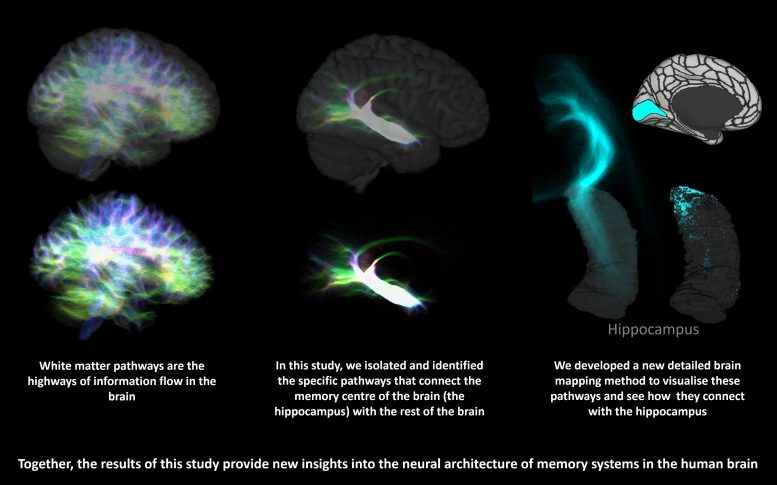
To generate their map, the team – led by Dr. Dalton and including Dr. Arkiev D’Souza, Dr. Jinglei Lv, and Professor Fernando Calamante from the University of Sydney’s Brain and Mind Centre – relied on MRI scans from a neuroimaging database created for the Human Connectome Project (HCP), a research consortium led by the U.S. National Institutes of Health.
They processed the existing HCP data using tailored techniques that they developed. This allowed them to follow the connections from all corners of the brain to their termination points in the hippocampus – something that had never been accomplished before in the human brain.
Most Detailed Map to Date
“What we’ve done is take a much more detailed look at the white matter pathways, which are essentially the highways of communication between different areas of the brain,” said Dr Dalton. “And we developed a new approach that allowed us to map how the hippocampus connects with the cortical mantle, the outer layer of the brain, but in a very detailed way.
“What we’ve created is a highly detailed map of white matter pathways connecting the hippocampus with the rest of the brain. It’s essentially a roadmap of brain regions that directly connect with the hippocampus and support its important role in memory formation.”
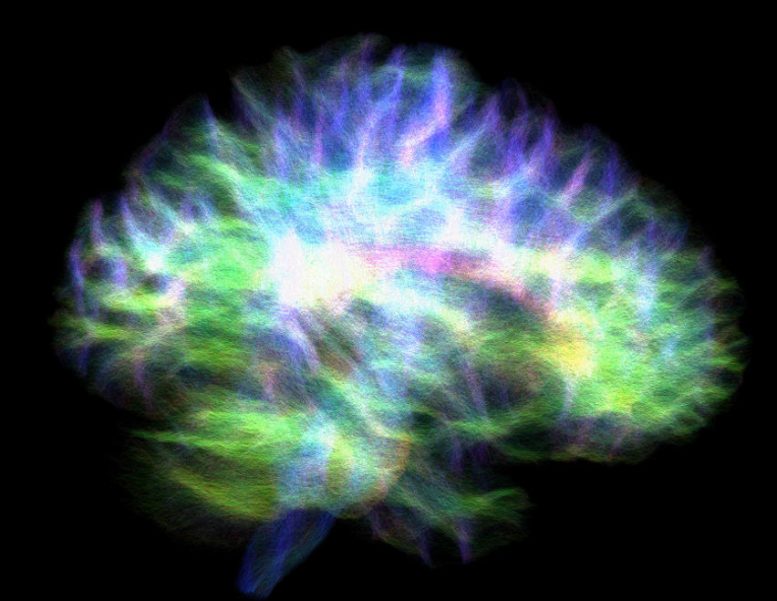
Technical limitations inherent to previous MRI investigations of the human hippocampus meant it was only possible to visualize its connections in very broad terms. “But we have now developed a tailored method that allows us to confirm where within the hippocampus different cortical areas are connecting. And that hasn’t been done before in a living human brain,” said Dr. Dalton.
Unexpected Results
The team was delighted their results largely aligned with data from previous studies overseas over the past few decades, which had relied on post-mortem studies of primate brains. However, the University of Sydney team found that the number of connections between the hippocampus and some brain areas was either much lower (in the case of frontal cortical areas) or higher (in the case of visual processing areas) than expected.
This could indicate that although some pathways were conserved as humans evolved, human brains may also have developed unique patterns of connectivity different from other primates. Further research is needed to tease this apart in more detail.
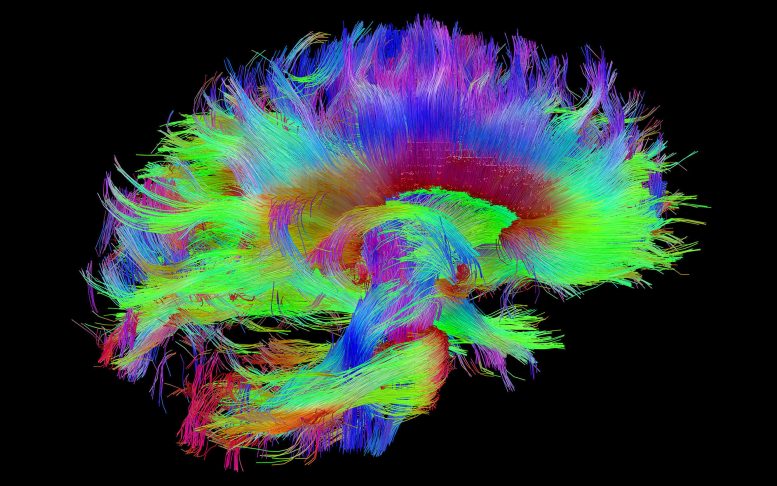
A mass of white matter tracts in the human brain. Credit: USC Stevens Neuroimaging and Informatics Institute
These differences in connectivity may just be a limitation of the MRI technique – or it could be real. They may, for example, help explain why some of our primate cousins – especially chimpanzees – are better at some memory tasks than humans, especially those relying on short-term memory. Chimpanzees have bested humans at cognitive tasks involving a form of mathematics known as game theory, which relies on short-term memory, pattern recognition, and rapid visual assessment.
“Although we have achieved this high-resolution mapping of the human hippocampus, the tract-tracing method conducted on non-human primates – which can see down to the cellular level – is able to see more connections than can be discerned with an MRI,” mused Dr. Dalton.
“Or it could be that the human hippocampus really does have a smaller number of connections with frontal areas than we expect, and greater connectivity with visual areas of the brain. As the neocortex expanded, perhaps humans evolved different patterns of connectivity to facilitate human-specific memory and visualization functions which, in turn, may underpin human creativity.
“It’s a bit of a puzzle – we just don’t know. But we love puzzles and will keep investigating.”
Reference: “New insights into anatomical connectivity along the anterior–posterior axis of the human hippocampus using in vivo quantitative fibre tracking” by Marshall A. Dalton, Arkiev D’Souza, Jinglei Lv, Fernando Calamante, 8 November 2022, eLife.
DOI: 10.7554/eLife.76143
The study was funded by the National Health and Medical Research Council and the Australian Research Council.
Never miss a breakthrough: Join the SciTechDaily newsletter.
Follow us on Google and Google News.
2 Comments
good
What I’d be curious to know, is how this could differ for folks with various conditions…
We know some people don’t have an inner monologue or don’t have internal visuals
We know some people do get immersed in reading books and how that lights up various regions of the brain
We know stroke survivors have a multitude of brain changes
We know there are brain changes to long term space exposure
It makes me wonder how those different groups, or others like alzheimer’s or even coma patients…
How would their memory different from those in the study
How does memory work along the lines when given various familiar stimulus
Makes me wonder all kinds of stuff