
Researchers have identified a molecular mechanism that helps explain why exercise remains so effective in maintaining muscle health with age.
Scientists have identified a molecular switch that may help explain one of the biggest benefits of exercise as people grow older: the ability to keep muscles repairing themselves.
A research team at Duke-NUS Medical School, working with Singapore General Hospital and Cardiff University, found that physical activity can restore a key internal balance in aging muscle cells. Their results, published in the Proceedings of the National Academy of Sciences (PNAS), offer a clearer picture of why muscle strength declines with age and why exercise can help slow that process.
Why Muscle Health Declines With Age
Muscle loss is often treated as an inevitable part of getting older, but its effects reach far beyond reduced strength. Weaker muscles can make falls more likely, lengthen recovery after illness or injury, and disrupt blood sugar control because muscle tissue plays a major role in how the body uses glucose. That makes muscle health important not only for mobility, but also for long-term metabolic health and independence.
A key player in muscle health is a pathway called mTORC1, which controls protein production and tissue maintenance. As muscles age, this pathway can become overactive. It favors building new proteins while slowing the removal of damaged ones. Over time, these damaged proteins accumulate, placing stress on muscle cells and contributing to weakness. Until now, the cause of this imbalance was not well understood.
A Key Genetic Driver Identified
The researchers identified a gene called DEAF1 as a major factor behind this disruption. As DEAF1 levels rise in aging muscles, they push mTORC1 into overactivity, interfering with normal protein turnover and accelerating muscle deterioration.
Under normal conditions, DEAF1 is regulated by proteins known as FOXOs. However, FOXO activity decreases with age, allowing DEAF1 to increase unchecked. This shift reduces the muscle’s ability to repair itself and promotes decline.
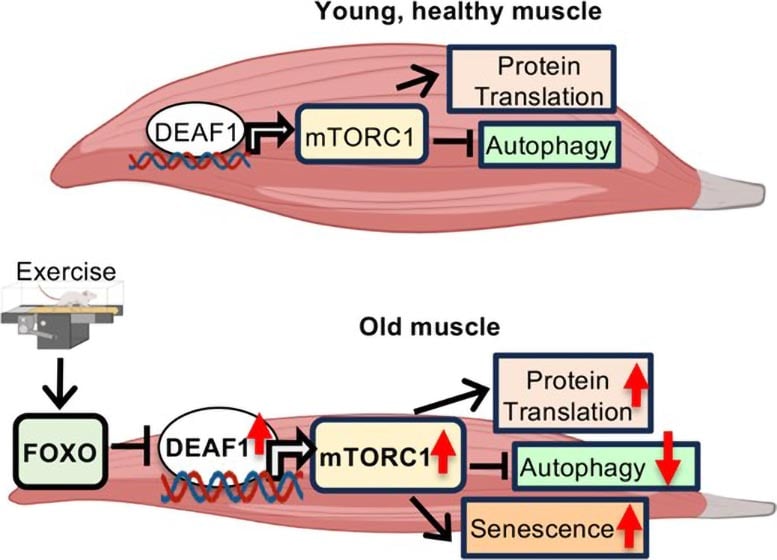
The study also showed that exercise can restore this balance, but only if the regulatory system is still functioning properly.
Assistant Professor Tang Hong-Wen from the Cancer and Stem Cell Biology Programme at Duke-NUS, the study’s lead author, said: “Exercise can reverse this process, correcting the imbalance. Physical activity activates certain proteins which lower DEAF1 levels, bringing the growth pathway back into balance. This allows ageing muscles to clear out damaged proteins, rebuild themselves properly, and help them stay stronger and more resilient.”
Why Exercise Doesn’t Work Equally for Everyone
The researchers found that when DEAF1 levels remain too high or FOXO activity drops too far, which can happen in older muscles, exercise alone may not fully restore repair processes. This may explain why some older adults do not experience the same benefits from physical activity as others. It also highlights the importance of understanding the underlying biology alongside lifestyle changes.
To confirm their results, the team conducted experiments in fruit flies and older mice. In both cases, higher DEAF1 levels caused rapid muscle weakness. Reducing DEAF1 restored protein balance and improved muscle strength, showing that its role is conserved across species.
Implications Beyond Ageing
The findings may extend beyond aging. DEAF1 also affects muscle stem cells, which are essential for tissue repair and regeneration. These cells naturally decline over time, and when DEAF1 is unbalanced, recovery becomes even slower.
This research could also benefit people recovering from illness, surgery, or chronic conditions such as cancer. Targeting DEAF1 may help replicate some of the molecular effects of exercise, supporting muscle health even when physical activity is limited.
Priscillia Choy Sze Mun, a research assistant with the Cancer and Stem Cell Biology Programme at Duke-NUS and the study’s first author, said: “Exercise tells muscles to ‘clean up and reset’. Lowering DEAF1 helps older muscles regain strength and balance, almost like hitting the rewind button. With millions of older adults at risk of muscle decline, understanding DEAF1 could lead to new ways to protect muscles and improve quality of life.”
Professor Patrick Tan, Senior Vice-Dean for Research at Duke-NUS, added: “This study helps explain, at a molecular level, why aging muscles lose their ability to repair themselves and why exercise can restore that balance in some individuals. By identifying DEAF1 as a key regulator in this process, these findings may lead to new ways in which the benefits of exercise can be brought to societies with rapidly aging populations.”
Reference: “Exercise suppresses DEAF1 to normalize mTORC1 activity and reverse muscle aging” by Sze Mun Choy, Kah Yong Goh, Wen Xing Lee, Weiyi Jiang, Qian Gou, Priya D. Gopal Krishnan, Shi Chee Ong, Kenon Chua, Nathan Harmston and Hong-Wen Tang, 24 November 2025, Proceedings of the National Academy of Sciences.
DOI: 10.1073/pnas.2508893122
This work was supported by Singapore Ministry of Education (2022-MOET1-0004, FY2025-MOET1-0004), Diana Koh Innovative Cancer Research Award (Duke-NUS-DKICRA/2024/0001), National Academy of Medicine (MOH-001189-00), and the Singapore Ministry of Health through the National Medical Research Council (NMRC) Office, MOH Holdings Pte Ltd under the NMRC (MOH-001208-00, MOH-001885-00, MOH-001831-00). Authors Qian Gou and Priya D Gopal Krishnan were supported by the Khoo Postdoctoral Fellowship (Duke-NUS-KPFA/2025/0078; Duke-NUS-KPFA/2024/0075).
Never miss a breakthrough: Join the SciTechDaily newsletter.
Follow us on Google and Google News.
8 Comments
Useless study. Show some proof that some participants have actually benefited.
I am 93 years old and have been living a lifestyle that allowed me to maintain fitness and stay active. I’d like to compare my experience to your findings.
You just came here to brag then. If it offers some insight to get some of us going, thats enough for me. You can still try it more to assist in your cognitive health.
I agree completely.
Only a troll would make such an observation.
Quality of life can not easily measured. Actually, research studies on ppl are sketchy because of the poor compliance and variability of behaviours.
Caged rats entire lives can be controlled in minute detail, which makes a study finding more valid.
I don’t condone such studies, my point is clarity is difficult due to behavioural variables.
Interesting
93 fit and active is boast worthy. Most people that are 93 just seem like they are waiting to die.
Benefited from what? This study identified the molecular mechanism. Which can now lead to further study on reactivating that mechanism in older people and other applications. Your experience is pointless. What would be compared is your molecular makeup.
Thinking outside the box is the goal for better health and for future growth there is no age limit. We can all learn on how to do better in this LIFE TIME ONLY ITS PROVEN THAT IT REALLY WORKS AT LEAST 90 PERCENT of the time the 10 PERCENT IT MAY NOTWORK BECAUSE WE ARE ALL MADE DIFFERENT. Work together solves problems. Unless you like causing problems
I doubt a 93 y/o guy is actively browing the internet and leaving such comments. Just a troll.