
Close Menu
    Facebook X (Twitter) Instagram
    SciTechDaily
    • Biology
    • Chemistry
    • Earth
    • Health
    • Physics
    • Science
    • Space
    • Technology
    Facebook X (Twitter) Pinterest YouTube RSS
    SciTechDaily
    Home»Science»Scientists in New York City Use Pheromones to Track Rats
    Science

    Scientists in New York City Use Pheromones to Track Rats

    By Oxford University Press USASeptember 16, 2019No Comments3 Mins Read
    Facebook Twitter Pinterest Telegram LinkedIn WhatsApp Email Reddit
    Share
    Facebook Twitter LinkedIn Pinterest Telegram Email Reddit

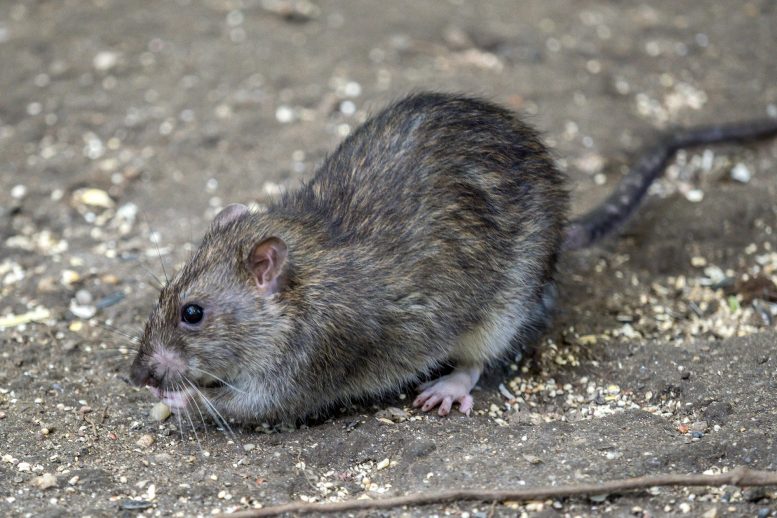
    Rat

    A new paper published September 17, 2019, in The Journal of Urban Ecology, published by Oxford University Press, finds that rats can be baited to, or repelled from, locations using pheromones found in the scents of other rats.

    Rats cost the world’s economy more than $300 billion a year. In addition to causing fines and business closures, rats spread disease, start fires, and disable motor vehicles. In Manhattan alone, rodent activity has been found in 23% of all restaurants. Despite these impacts, little is known about the behavior of urban rats, whose behaviors differ from that of laboratory rats. This lack of information is due to several factors, including the difficulty of releasing pest animals back into cities after capturing and identifying them, the reluctance of property owners to provide access to researchers, and rat control programs.

    Over a one-year period, researchers trapped and implanted microchips in city rats in a waste recycling center in Brooklyn, New York. To overcome issues in using GPS to track movement in dense urban environments, they utilized radio-frequency identification sensors. Male and female scents were then placed on, or near, these sensors and replaced every two weeks. To determine whether risk impacted the findings, researchers positioned these devices in sheltered, safe areas that rats were familiar with and also in riskier, open environments where rats were vulnerable to predation.

    Rats reacted differently to male and female scents. In general, when rats responded to sensors with male scents, the risk was unimportant. Rats briefly visited male scents equally in exposed and sheltered areas, and then stayed away. Female scents, however, were visited significantly more often than male scents (0.2 visits/day compared to 5.02 visits/day). This implies that attractants may be more useful near sheltered areas while deterrent scents may be more useful in exposed areas where animals are vulnerable to predators. These findings address a knowledge gap about the rat-scent preference that could assist in urban wildlife management tools, such as the deployment of baits or immuno-contraceptives.

    “Context is everything. If we can pinpoint the scents and contexts that are most useful, then we increase our chances of creating novel control tools, but further research is needed under a broad range of conditions”

    The team at Fordham University, Columbia University and Arrow Exterminators Inc. has identified the primary reasons holding back scent-based control tools. They argue they need greater access to urban properties if they are to make scents useful in the war against rats.

    Reference: “Differential responses by urban brown rats (Rattus norvegicus) toward male or female-produced scents in sheltered and high-risk presentations” by Michael H Parsons, Michael A Deutsch, Dani Dumitriu and Jason Munshi-South, 17 September 2019, The Journal of Urban Ecology.
    DOI: 10.1093/jue/juz009

    Never miss a breakthrough: Join the SciTechDaily newsletter.
    Follow us on Google and Google News.

    Rats University of Oxford
    Share. Facebook Twitter Pinterest LinkedIn Email Reddit

    Related Articles

    Unprecedented Discovery: Archive of Ancient Human Brains Challenges History

    Disconnected Discoveries: The Remote Work Innovation Paradox

    The Primordial Brew: How Ancient Seas Molded Life on Earth

    Researchers Successfully Extract Ancient DNA From 2,900-Year-Old Clay Brick

    Decoding a 200-Year-Old Mystery: Research Sheds New Light on the Evolution of Animals

    The Early Roots of the Gender Pay Gap – New Study Reveals the Impact of Job Search Behaviors

    Rare Reptiles in Peril: The Surprising Extinction Risk for Unusual Turtles and Crocodiles

    Scientists Solve 200-Year-Old Biodiversity Mystery Through Analysis of Over 400,000 Fossils

    Decoding the Past – Scientists Uncover the Origin of Mysterious Giant Extinct Marine Reptile Graveyard

    Leave A Reply Cancel Reply

    • Facebook
    • Twitter
    • Pinterest
    • YouTube

    Don't Miss a Discovery

    Subscribe for the Latest in Science & Tech!

    Trending News

    New Pill Lowers Stubborn Blood Pressure and Protects the Kidneys

    Humans May Have Hidden Regenerative Powers, New Study Suggests

    Scientists Just Solved the Mystery of Why Crabs Walk Sideways

    Doctors Are Surprised by What This Vaccine Is Doing to the Heart

    This Popular Supplement May Boost Your Brain, Not Just Your Muscles

    Scientists Say This Simple Supplement May Actually Reverse Heart Disease

    Warming Oceans Could Trigger a Dangerous Methane Surge

    This Simple Movement Could Be Secretly Cleaning Your Brain

    Follow SciTechDaily
    • Facebook
    • Twitter
    • YouTube
    • Pinterest
    • Newsletter
    • RSS
    SciTech News
    • Biology News
    • Chemistry News
    • Earth News
    • Health News
    • Physics News
    • Science News
    • Space News
    • Technology News
    Recent Posts
    • Astronomers Stunned by Ancient Galaxy With No Spin
    • Physicists May Be on the Verge of Discovering “New Physics” at CERN
    • AI Learns To Work Backward and Reveal Hidden Forces in Nature
    • Scientists Warn of Rising Male Childlessness As Global Fertility Changes
    • New Discovery Challenges Decades-Old Theory of DNA Damage and Aging
    Copyright © 1998 - 2026 SciTechDaily. All Rights Reserved.
    • Science News
    • About
    • Contact
    • Editorial Board
    • Privacy Policy
    • Terms of Use

    Type above and press Enter to search. Press Esc to cancel.