
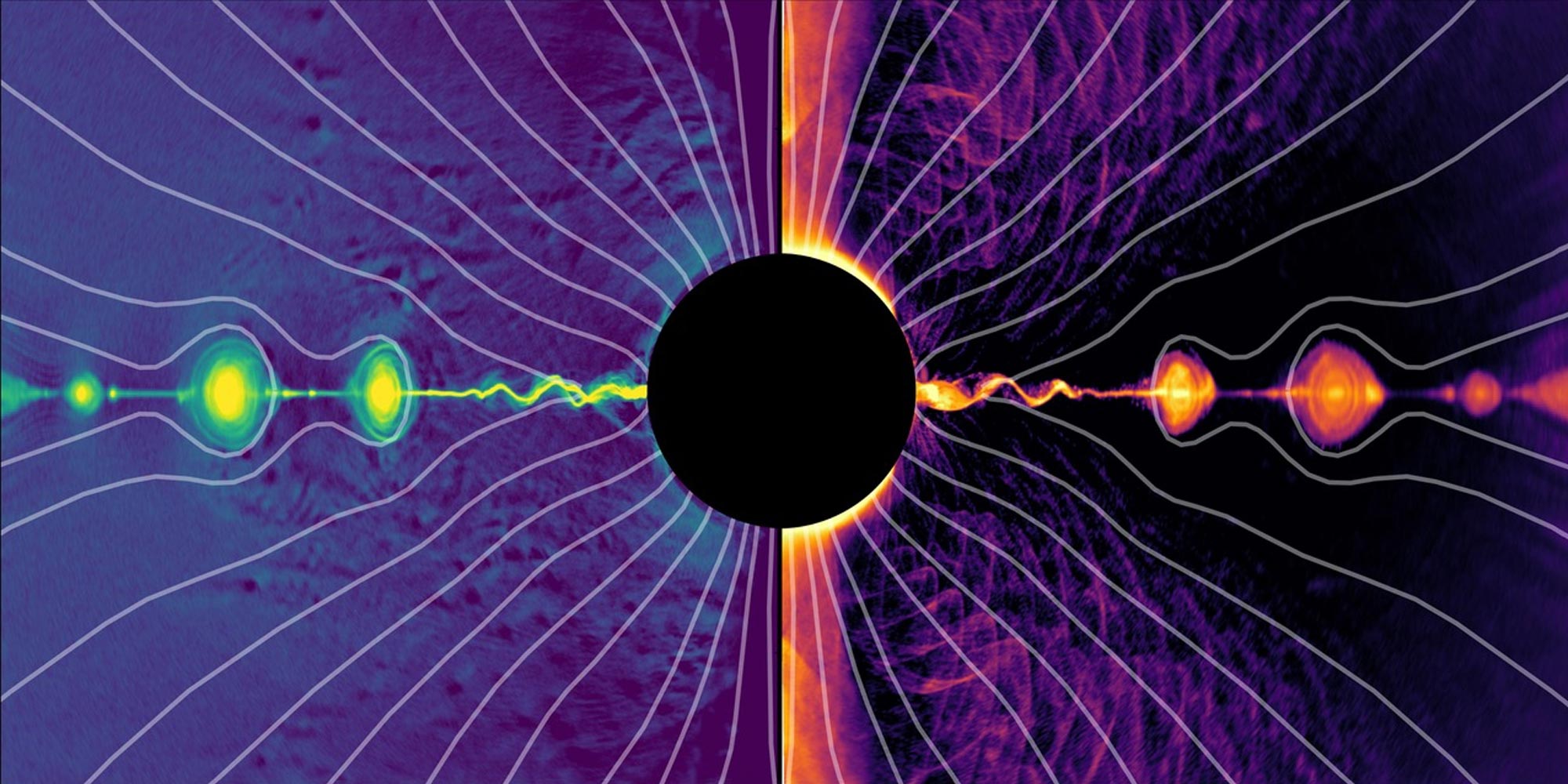
Astronomers studying the supermassive black hole M87*, a behemoth six and a half billion times the mass of the Sun, have uncovered a new way these cosmic monsters unleash their power.
Using cutting-edge simulations, scientists at Goethe University Frankfurt revealed that not just magnetic fields, but a process called magnetic reconnection, helps extract energy from a spinning black hole to launch jets of matter stretching thousands of light-years. These immense cosmic beams, moving at nearly light speed, scatter energy and matter across galaxies, shaping their evolution.
From a “Nebula Without Stars” to a Giant Galaxy
For nearly 200 years, astronomers were uncertain about the true nature of the bright object in the constellation Virgo that Charles Messier recorded in 1784 as “87: Nebula without stars.” What appeared to be a fuzzy patch of light was later revealed to be an enormous galaxy. When a mysterious jet of light was spotted coming from its center in 1918, scientists had no idea what could be producing it.
At the core of this massive galaxy, now known as M87, lies the supermassive black hole M87*, containing about six and a half billion times the mass of the Sun. This black hole spins rapidly, and its rotation powers a stream of charged particles that shoots out at nearly the speed of light, stretching some 5,000 light-years into space. Similar jets are seen around other rotating black holes, helping to scatter energy and matter throughout the universe and shape the growth of galaxies.
Cracking the Code of Black Hole Power
A research team from Goethe University Frankfurt, led by Prof. Luciano Rezzolla, has developed a new computational tool called the Frankfurt particle-in-cell code for black hole spacetimes (FPIC). This simulation code precisely models how a spinning black hole transforms its rotational energy into a powerful jet. The researchers discovered that, in addition to the well-known Blandford–Znajek mechanism, long thought to explain how black holes extract rotational energy through magnetic fields, another key process also plays a role: magnetic reconnection. In this phenomenon, magnetic field lines snap and reconnect, converting magnetic energy into heat, radiation, and bursts of plasma.
Using the FPIC code, the team simulated the behavior of countless charged particles and extreme electromagnetic fields influenced by the intense gravity surrounding the black hole. Dr. Claudio Meringolo, the main developer of the code, explained, “Simulating such processes is crucial for understanding the complex dynamics of relativistic plasmas in curved spacetimes near compact objects, which are governed by the interplay of extreme gravitational and magnetic fields.”
Running these simulations required extraordinary computing resources, totaling millions of CPU hours on Frankfurt’s “Goethe” supercomputer and Stuttgart’s “Hawk.” Such immense processing power was needed to solve Maxwell’s equations and the equations of motion for electrons and positrons within the framework of Albert Einstein’s general theory of relativity.
Plasma Chains and Negative Energy
In the equatorial plane of the black hole, the researchers’ calculations revealed intense reconnection activity, leading to the formation of a chain of plasmoids – a condensation of plasma in energetic “bubbles” – moving at nearly the speed of light. According to the scientists, this process is accompanied by the generation of particles with negative energy that is used to power extreme astrophysical phenomena like jets and plasma eruptions.
“Our results open up the fascinating possibility that the Blandford–Znajek mechanism is not the only astrophysical process capable of extracting rotational energy from a black hole,” says Dr. Filippo Camilloni, who also worked on the FPIC project, “but that magnetic reconnection also contributes.”
Illuminating the Universe’s Brightest Engines
“With our work, we can demonstrate how energy is efficiently extracted from rotating black holes and channeled into jets,” says Rezzolla. “This allows us to help explain the extreme luminosities of active galactic nuclei as well as the acceleration of particles to nearly the speed of light.” He adds that it is incredibly exciting and fascinating to better understand what happens near a black hole using sophisticated numerical codes. “At the same time, it is even more rewarding to be able to explain the results of these complex simulations with a rigorous mathematical treatment — as we have done in our work.”
Reference: “Electromagnetic Energy Extraction from Kerr Black Holes: Ab Initio Calculations” by Claudio Meringolo, Filippo Camilloni and Luciano Rezzolla, 6 October 2025, The Astrophysical Journal Letters.
DOI: 10.3847/2041-8213/ae06a6
Never miss a breakthrough: Join the SciTechDaily newsletter.
Follow us on Google and Google News.
2 Comments
Negative energies is relative to the energy needed to escape the black hole “to infinity” AFAIU, meaning they extract energy from the black hole when they fall in (Penrose process).
“Inside the ergosphere even light cannot keep up with the rotation of the black hole, as the trajectories of stationary (from the outside perspective) objects become space-like, rather than time-like (that normal matter would have), or light-like. Mathematically, the dt^2 component of the metric changes its sign inside the ergosphere. That allows matter to have negative energy inside of the ergosphere as long as it moves counter the black hole’s rotation fast enough (or, from outside perspective, resists being dragged along to a sufficient degree). The Penrose mechanism exploits that by diving into the ergosphere, dumping an object that was given negative energy, and returning with more energy than before.” – Wikipedia
Magnetic reconnection seems to happen everywhere. The Earth geodynamo field isn’t very strong, yet we may have seen the first case of reconnection.
“These switchbacks are thought to form when solar magnetic field lines that point in opposite directions break and then snap together, or “reconnect,” in a new arrangement, leaving telltale zigzag kinks in the reconfigured lines.
In their article published in the Journal of Geophysical Research: Space Physics, E. O. McDougall and M. R. Argall now report observations of a switchback-shaped structure in Earth’s magnetic field, suggesting that switchbacks can also form near planets.” – Phys org (October 8, 2025).
“The researchers discovered that, in addition to the well-known Blandford–Znajek mechanism, long thought to explain how black holes extract rotational energy through magnetic fields, another key process also plays a role: magnetic reconnection. In this phenomenon, magnetic field lines snap and reconnect, converting magnetic energy into heat, radiation, and bursts of plasma.”
Enough said. The BJ mechanism does not explain the data, whereas EM dynamics do. Deal with it.