

Close Menu
    Facebook X (Twitter) Instagram
    SciTechDaily
    • Biology
    • Chemistry
    • Earth
    • Health
    • Physics
    • Science
    • Space
    • Technology
    Facebook X (Twitter) Pinterest YouTube RSS
    SciTechDaily
    Home»Science»Scientists Make Silver Glow 77× Brighter
    Science

    Scientists Make Silver Glow 77× Brighter

    By Tohoku UniversityOctober 16, 20252 Comments3 Mins Read
    Facebook Twitter Pinterest Telegram LinkedIn WhatsApp Email Reddit
    Share
    Facebook Twitter LinkedIn Pinterest Telegram Email Reddit
    Glowing Silver Orb
    A team of researchers in Japan has discovered that adding just one silver atom can dramatically boost the light-emitting efficiency of silver nanoclusters. The subtle atomic tweak led to a remarkable 77-fold increase in brightness, revealing how small structural changes can unlock powerful optical effects. (Artist’s concept). Credit: SciTechDaily.com

    A team of Japanese researchers discovered that adding just one silver atom to a nanocluster can boost its light-emitting efficiency by 77 times.

    A collaborative team from Tohoku University, Tokyo University of Science, and the Institute for Molecular Science has revealed that adding a single silver (Ag) atom can profoundly alter how high-nuclear Ag nanoclusters (NCs) emit light.

    Their research demonstrated a 77-fold improvement in photoluminescence (PL) quantum yield (QY) at room temperature – a significant achievement that could accelerate the development of next-generation optoelectronic and sensing technologies. The study was recently published in the Journal of the American Chemical Society.

    Photoluminescence quantum yield measures how efficiently a material converts absorbed energy into visible light. Enhancing this efficiency directly benefits technologies such as OLED displays used in televisions.

    Yet, achieving high PLQY is not as simple as selecting materials with strong luminescence. Silver nanoclusters, for instance, naturally exhibit low PL efficiency, which has limited their practical use despite the extraordinary optical potential they possess.
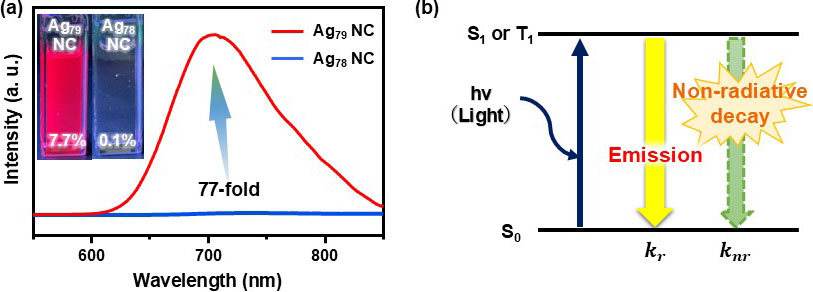
    Room Temperature PL Emission for Both Ag NC in the Solution Medium
    (a) Room-temperature PL emission for both Ag78 and Ag79 NC in the solution medium. Inset showing the excitation of the solutions from both NCs under UV-light irradiation, (b) schematic representation of PL emission enhancement Ag79 NC through the synergistic effect. Credit: Yuichi Negishi et al.

    Designing and Comparing Silver Nanoclusters

    To probe the structure-property relationship in greater detail, the team synthesized and compared two closely related anion-templated Ag NCs: [SO4@Ag78S15(CpS)27(CF3COO)18]+: Ag78 NC (CpS: cyclopentatethiolate), [SO4@Ag79S15(iPrS)28(iPrSO3)15(CF3COO)4]: Ag79 NC (iPrS: iso-propyl thiolate). Both NCs share a common structural framework, with the key distinction being a single additional Ag atom in the outermost shell of Ag79 NC.

    This addition was achieved through subtle modifications of the surface-protecting ligands, particularly the in-situ generated iPrSO3– group, which created a void within the NC framework that enabled the extra atom’s incorporation. While the core structures remained largely unchanged, the shell modification had profound effects.
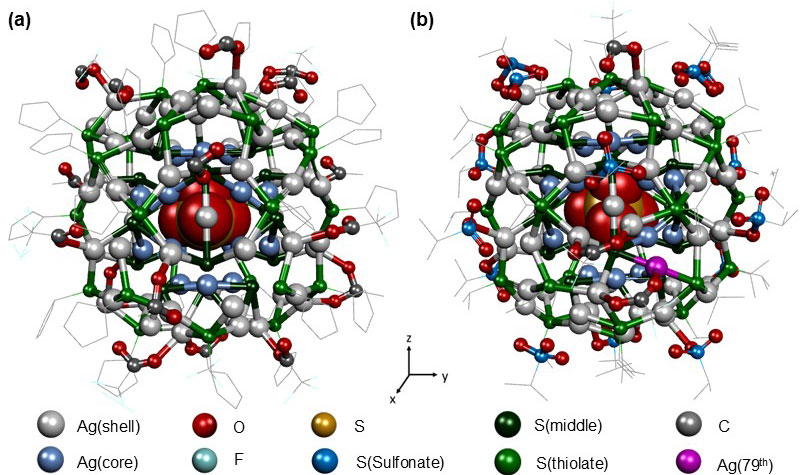
    Structural Architectures of Anion Templated Ag NCs
    Structural architectures of anion-templated (a) Ag78 and (b) Ag79 NCs. Hydrogen atoms are omitted for clarity. Credit: Yuichi Negishi et al.

    In Ag79 NC, the added silver atom enhanced radiative decay rates and a more rigid cluster. The rigidity effectively suppressed non-radiative decay pathways that typically diminish luminescence efficiency. The combination of these factors – enhanced radiative decay from symmetry reduction and reduced non-radiative losses from structural rigidity – enabled the Ag79 NC to exhibit a remarkable 77-fold improvement in PL quantum yield over Ag78 NC at room temperature.

    Toward a New Generation of Light-Emitting Materials

    “This is the first clear evidence that the incorporation of just one extra silver atom, guided by ligand design, can drastically boost performance,” Professor Negishi explained. “Our findings open a pathway to rationally engineer efficient light-emitting nanoclusters through atomic-level structural modifications.”

    With this new advancement, researchers anticipate new opportunities for deploying silver nanoclusters in high-performance light-emitting devices, bioimaging, and catalytic systems, where efficient luminescence at room temperature is critical.

    Reference: “Triggering Photoluminescence in High-Nuclear Silver Nanoclusters via Extra Silver Atom Incorporation” by Aoi Akiyama, Sakiat Hossain, Sourav Biswas, Takafumi Shiraogawa, Pei Zhao, Mana Nakamoto, Daiji Ogata, Tokuhisa Kawawaki, Yoshiki Niihori, Junpei Yuasa, Masahiro Ehara and Yuichi Negishi, 30 September 2025, Journal of the American Chemical Society.
    DOI: 10.1021/jacs.5c10289

    Never miss a breakthrough: Join the SciTechDaily newsletter.
    Follow us on Google and Google News.

    Materials Science Optoelectronics Quantum Materials Tohoku University
    Share. Facebook Twitter Pinterest LinkedIn Email Reddit

    Related Articles

    MRI Technology Cracks the Code on Lithium-Ion Battery Decay

    Superelastic Alloy Stays Strong from Liquid Helium to Boiling Water, Transforming Space and Medicine

    No More Cracked Phone Screens: Scientists Crack the Code to Stronger, More Durable Glass

    New Luminescent Material Could Be the Answer to Crumbling Infrastructure

    21 New Laser Materials Uncovered in Groundbreaking Global Study

    Unmasking the Mystery of Glass: Scientists Uncover Hidden Atomic Structure Secrets

    Changing the Silkworm’s Diet to Spin Silk 2x Stronger

    Researchers Strengthen Machines That Produce “Super Engineering Plastics”

    Research for High Pressure Materials for DoD Underway

    2 Comments

    1. Engineer. Md. Borkotullah Bondhon on October 16, 2025 9:23 am

      I suggest,
      GVNS(Gamma Volcanic Neutrino Spectroscopy).

      Reply
    2. Butbutwhat on October 18, 2025 5:22 pm

      Ok soooo what does that mean for mirrors??? I don’t understand what it even means by 77 times!?! More efficient at looking at your inner self???

      Reply
    Leave A Reply Cancel Reply

    • Facebook
    • Twitter
    • Pinterest
    • YouTube

    Don't Miss a Discovery

    Subscribe for the Latest in Science & Tech!

    Trending News

    Your Blood Pressure Reading Could Be Wrong Because of One Simple Mistake

    Astronomers Stunned by Ancient Galaxy With No Spin

    Physicists May Be on the Verge of Discovering “New Physics” at CERN

    Scientists Solve 320-Million-Year Mystery of Reptile Skin Armor

    Scientists Say This Daily Walking Habit May Be the Secret to Keeping Weight Off After Dieting

    New Therapy Rewires the Brain To Restore Joy in Depression Patients

    Giant Squid Detected off Western Australia in Stunning Deep-Sea Discovery

    Popular Sugar-Free Sweetener Linked to Liver Disease, Study Warns

    Follow SciTechDaily
    • Facebook
    • Twitter
    • YouTube
    • Pinterest
    • Newsletter
    • RSS
    SciTech News
    • Biology News
    • Chemistry News
    • Earth News
    • Health News
    • Physics News
    • Science News
    • Space News
    • Technology News
    Recent Posts
    • Hidden Warm Water Beneath Antarctica Could Rapidly Raise Global Sea Levels
    • Scientists Revive Ancient Chemistry Trick To Engineer Next-Generation Glass
    • Scientists Use AI To Supercharge Ultrafast Laser Simulations by More Than 250x
    • Scientists Just Found a Surprising Way To Destroy “Forever Chemicals”
    • Popular Supplement Ingredient Linked to Shorter Lifespan in Men
    Copyright © 1998 - 2026 SciTechDaily. All Rights Reserved.
    • Science News
    • About
    • Contact
    • Editorial Board
    • Privacy Policy
    • Terms of Use

    Type above and press Enter to search. Press Esc to cancel.