
Close Menu
    Facebook X (Twitter) Instagram
    SciTechDaily
    • Biology
    • Chemistry
    • Earth
    • Health
    • Physics
    • Science
    • Space
    • Technology
    Facebook X (Twitter) Pinterest YouTube RSS
    SciTechDaily
    Home»Science»MRI Technology Cracks the Code on Lithium-Ion Battery Decay
    Science

    MRI Technology Cracks the Code on Lithium-Ion Battery Decay

    By Tohoku UniversityMarch 8, 2025No Comments5 Mins Read
    Facebook Twitter Pinterest Telegram LinkedIn WhatsApp Email Reddit
    Share
    Facebook Twitter LinkedIn Pinterest Telegram Email Reddit
    How MRI Was Used To Observe Metal Ion Dissolution in Lithium Battery Cathodes
    Illustration of how MRI was used to observe metal-ion dissolution. Credit: ©Hellar et al.

    Tohoku University researchers used MRI to observe metal ion dissolution in lithium-ion batteries, providing real-time insights into battery degradation.

    Many modern devices depend on rechargeable batteries for convenience and efficiency. Among them, lithium-ion batteries are widely used due to their affordability and high operating voltage, making them well-suited for electronic devices and electric vehicles.

    However, these batteries experience performance degradation over time, and safety concerns increase as they age.

    One key factor contributing to this decline is the dissolution of metal ions from the cathode into the electrolyte. Studying this process has been challenging because the dissolved amounts are extremely small. To effectively address the issue, researchers must first determine where, when, and how much dissolution occurs within the battery.
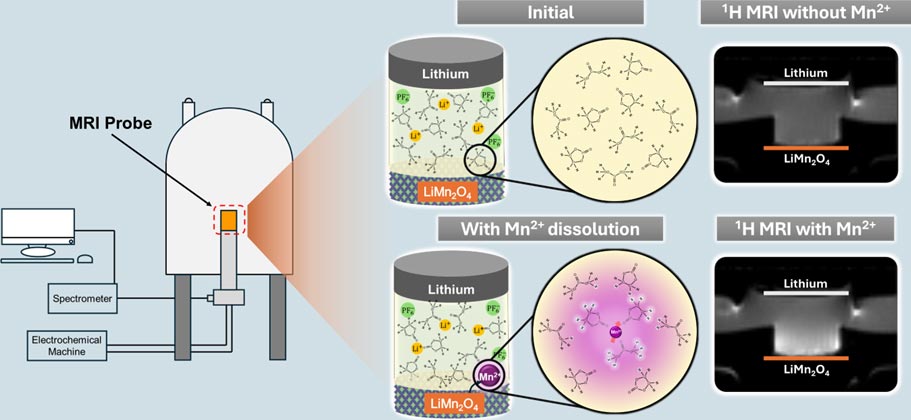
    Schematic Representation of LiMn2O4 Cathode
    Schematic representation of the present work showing the increase in the MRI intensity confirming manganese dissolution from LiMn2O4 cathode. Credit: ©Hellar et al.

    Researchers at Tohoku University have been working on a method to detect and investigate the dissolution of the metal ion in the cathode. Using nuclear magnetic resonance imaging (MRI), they were able to directly observe the dissolution in real time.

    The results of their research were published in Communications Materials on February 13, 2025.

    MRI Technology Sheds Light on Metal Ion Dissolution

    According to Nithya Hellar, a researcher at the Institute of Multidisciplinary Research for Advanced Materials (IMRAM) at Tohoku University, “the results of the present study show that the dissolution of a very small amount of manganese (Mn) can be detected with high sensitivity by MRI and visualized in real-time, which can greatly accelerate the speed of research.”
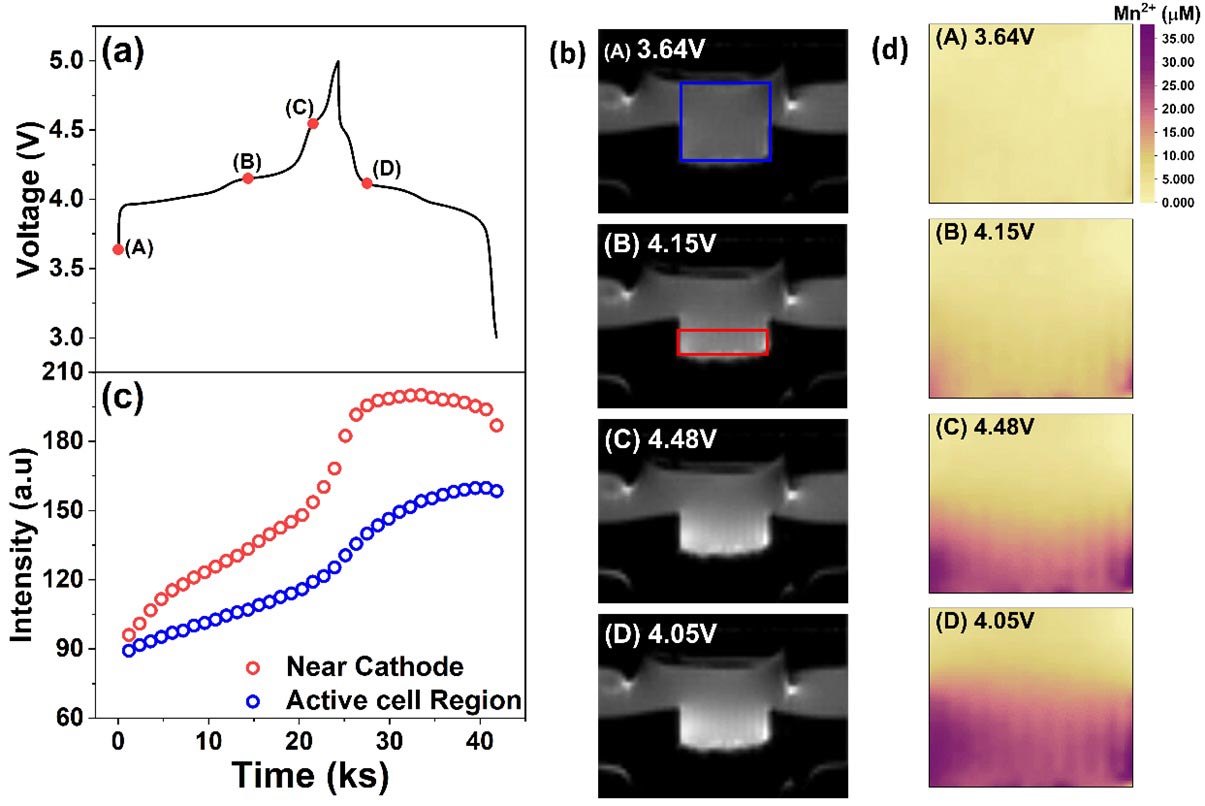
    MRI Imaging and Mn²⁺ Mapping in a Lithium Battery During Charge Discharge
    (a) Charge-discharge profile for LMO cell with gel electrolyte. (b) MR images acquired at potential marked in red in Fig. 2a. (c) Time dependence of MRI signal intensity extracted from the active cell region (region enclosed in the blue frame in Fig. 2b (A)) and near the LMO cathode (region enclosed in red frame in Fig. 2b (B)). (d) Mn2+ concentration mapped images acquired at potentials indicated. Credit: ©Hellar et al.

    An MRI is a medical imaging technology that uses magnetic fields and radio waves to produce imaging scans. To enhance the visibility of areas of interest in an MRI image, contrast agents such as gadolinium are used. Gadolinium is paramagnetic, and it can alter the magnetic properties of targeted areas, thereby increasing their visibility to the MRI.

    The Tohoku University group was able to use this principle of MRI as the Mn dissoluted from the cathode is paramagnetic. Specifically, they looked at the dissolution of Mn2+ from spinel-type LiMn2O4 cathode, in a commercial battery electrolyte LiPF6 EC:DMC. So, if dissolution is occurring it would show up as an increase in signal intensity in the MRI images, and that is exactly what they saw. Using the MRI gave them the ability to directly observe the dissolution as it occurred in real time.

    Implications for Battery Design and Future Research

    The researchers used this technique to investigate whether an alternative electrolyte system could suppress the dissolution. Using the MRI, they could observe the dissolution of the metal ion. It also follows that if there was no increase in signal, that dissolution was not occurring.
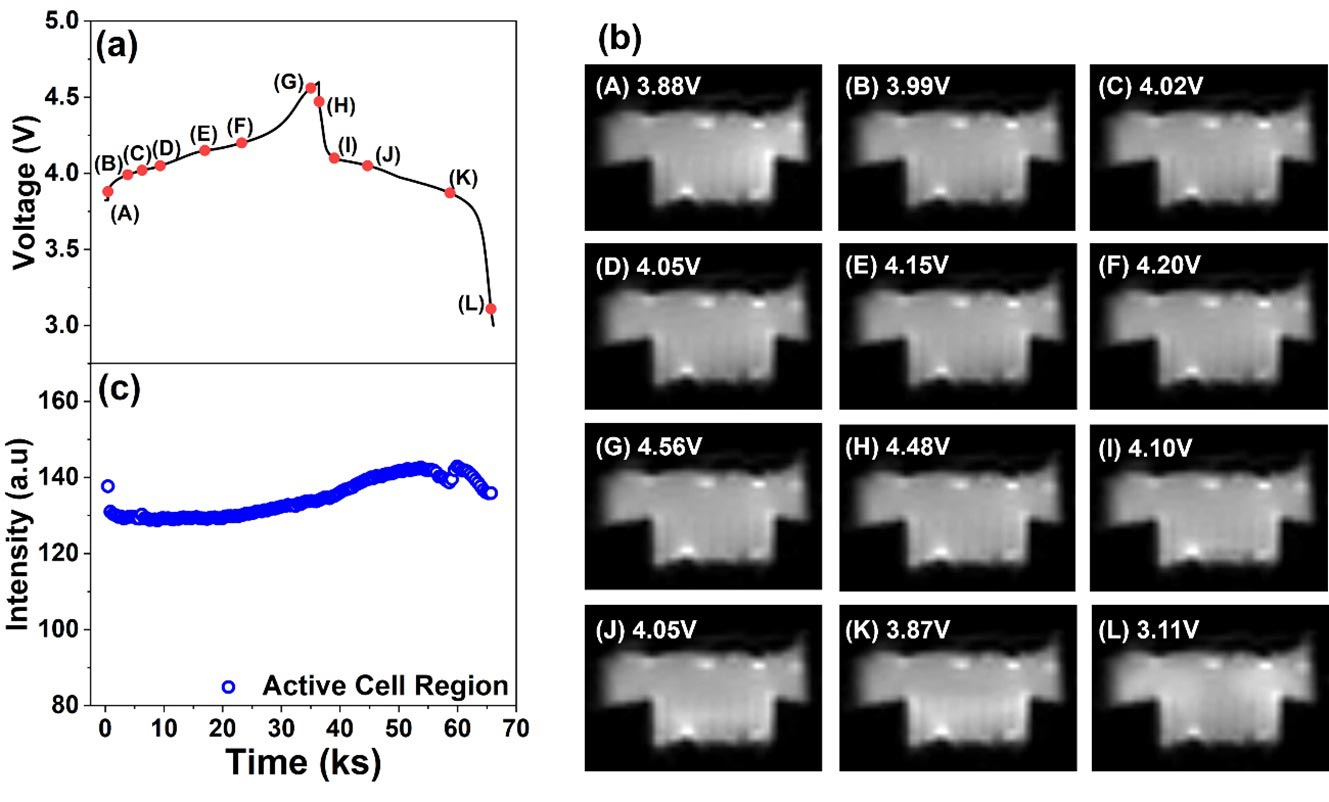
    MRI Imaging of a LiMn₂O₄ Battery During Charge and Discharge
    (a) Charge-discharge profile for LiMn2O4/1M LiTFSI MCP/Li cell. (b) 1H MR images acquired at potentials mentioned in Fig. 3a. (c) 1H MRI signal intensity change during charging and discharging. Credit: ©Hellar et al.

    They tested the electrolyte system LiTFSI MCP developed by researchers from MEET (Munster Electrochemical Energy Technology) Battery Research Center, University of Munster, Germany, which they believed would suppress the dissolution of the metal ion. There was no significant increase in signal intensity on the MRI. From this, they concluded that there was no dissolution occurring.

    Using this testing method gives researchers invaluable help in “exploring the metal ion dissolution in any electrochemical systems under different electrochemical conditions, such as changing the electrolyte solution, salt, electrodes, and additives. This identification method may help design lithium battery materials and improve their performance,” said Junichi Kawamura, Emeritus Professor at Tohoku University.

    Looking to the future, there is enormous promise in how this technique can increase the ability of researchers to understand how reactions within these batteries work and how to test alternate battery technology. “We believe the method developed here can answer the long-time unanswered question of when, where, and how the metal ion dissolution occurs in the lithium-ion battery electrode and can be extended to other electrochemical systems,” said Hellar.

    Reference: “Direct observation of Mn-ion dissolution from LiMn2O4 lithium battery cathode to electrolyte” by Nithya Hellar, Yoshiki Iwai, Masato Ohzu, Sebastian Brox, Arunkumar Dorai, Reiji Takekawa, Naoaki Kuwata, Junichi Kawamura and Martin Winter, 13 February 2025, Communications Materials.
    DOI: 10.1038/s43246-025-00733-2

    Never miss a breakthrough: Join the SciTechDaily newsletter.
    Follow us on Google and Google News.

    Electrolyte Lithium-Ion Materials Science MRI Tohoku University
    Share. Facebook Twitter Pinterest LinkedIn Email Reddit

    Related Articles

    Just Hype? New Study Challenges Core Assumptions About Solid-State Lithium Metal Batteries

    Superelastic Alloy Stays Strong from Liquid Helium to Boiling Water, Transforming Space and Medicine

    No More Cracked Phone Screens: Scientists Crack the Code to Stronger, More Durable Glass

    New Luminescent Material Could Be the Answer to Crumbling Infrastructure

    Neutron Scattering: Unlocking the Secrets of Safer, More Powerful Lithium Batteries

    Unmasking the Mystery of Glass: Scientists Uncover Hidden Atomic Structure Secrets

    Changing the Silkworm’s Diet to Spin Silk 2x Stronger

    Researchers Strengthen Machines That Produce “Super Engineering Plastics”

    New Observations Reveal the Inner Workings of Lithium-Ion Batteries

    Leave A Reply Cancel Reply

    • Facebook
    • Twitter
    • Pinterest
    • YouTube

    Don't Miss a Discovery

    Subscribe for the Latest in Science & Tech!

    Trending News

    Scientists Uncover Potential Brain Risks of Popular Fish Oil Supplements

    Scientists Discover a Surprising Way To Make Bread Healthier and More Nutritious

    After 60 Years, Scientists Uncover Unexpected Brain Effects of Popular Diabetes Drug Metformin

    New Research Uncovers Hidden Side Effects of Popular Weight-Loss Drugs

    Scientists Rethink Extreme Warming After Surprising Ocean Discovery

    Landmark Study Links Never Marrying to Significantly Higher Cancer Risk

    Researchers Discover Unknown Beetle Species Just Steps From Their Lab

    Largest-Ever Study Finds Medicinal Cannabis Ineffective for Anxiety, Depression, PTSD

    Follow SciTechDaily
    • Facebook
    • Twitter
    • YouTube
    • Pinterest
    • Newsletter
    • RSS
    SciTech News
    • Biology News
    • Chemistry News
    • Earth News
    • Health News
    • Physics News
    • Science News
    • Space News
    • Technology News
    Recent Posts
    • Scientists Discover Hidden Pathway Inside Catalysts That Defies Decades of Assumptions
    • Scientists Finally Crack Decades-Old Mystery of “Breathing” Lasers
    • “Like Liquid Metal”: Scientists Create Strange Shape-Shifting Material
    • Early Warning Signals of Esophageal Cancer May Be Hiding in Plain Sight
    • Researchers Have Discovered a THC-Free Cannabis Compound That May Replace Opioids
    Copyright © 1998 - 2026 SciTechDaily. All Rights Reserved.
    • Science News
    • About
    • Contact
    • Editorial Board
    • Privacy Policy
    • Terms of Use

    Type above and press Enter to search. Press Esc to cancel.