
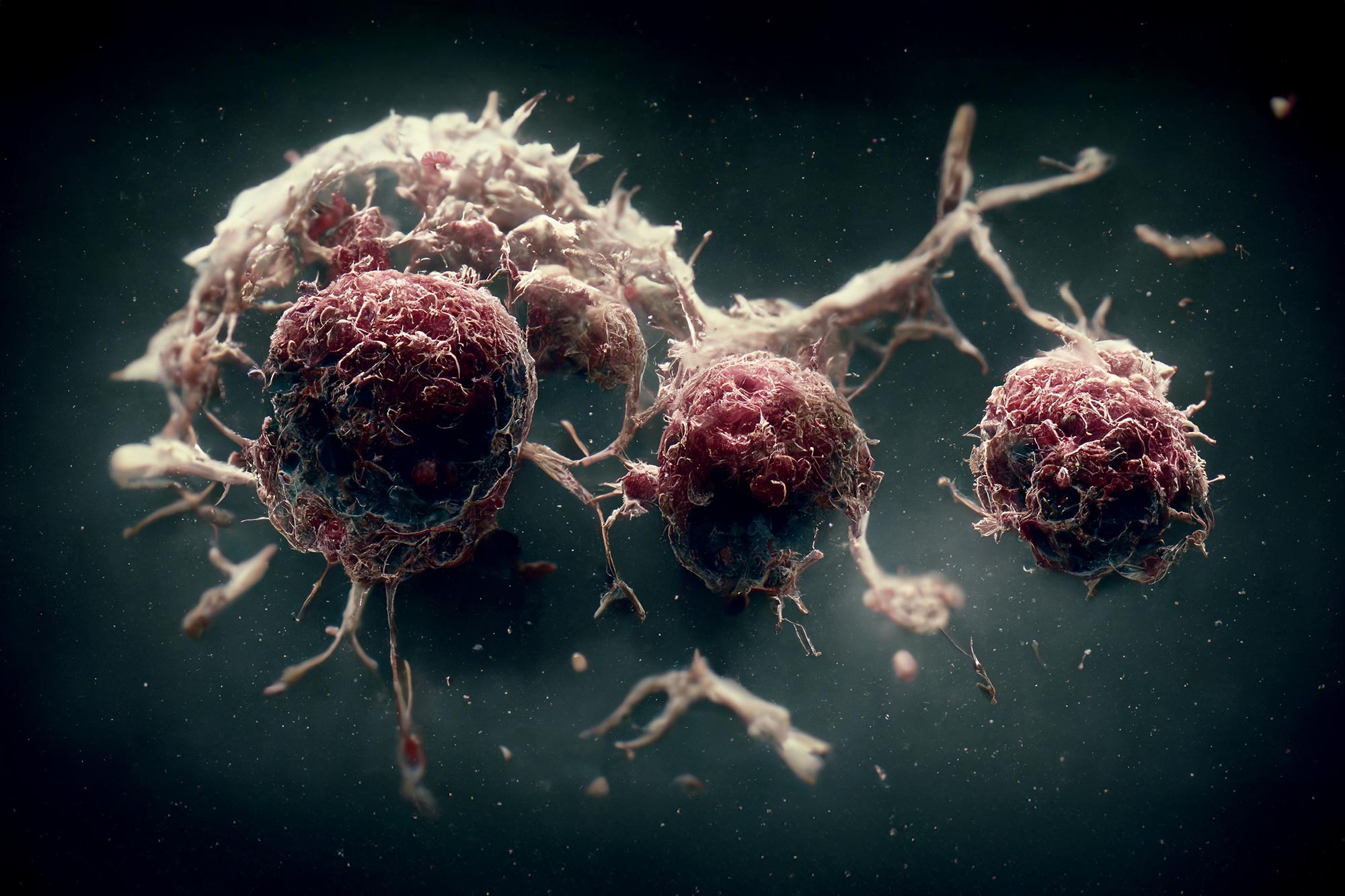
Researchers discovered that in a rare kidney cancer, RNA builds droplet-like hubs that act as growth control centers inside tumor cells. By engineering a molecular switch to dissolve these hubs, they were able to halt cancer growth completely.
In a city, coworking hubs bring people and ideas together. Inside cancer cells, something surprisingly similar takes shape, but instead of sparking creativity, these structures strengthen the disease. Researchers at the Texas A&M University Health Science Center (Texas A&M Health) have uncovered this behavior inside a rare and aggressive form of kidney cancer.
RNA Builds Liquid Hubs That Drive Tumor Growth
A new study published in Nature Communications reveals that RNA, which normally passes along genetic messages, can be repurposed inside cancer cells to create liquid-like “droplet hubs” in the nucleus. These hubs operate as control points that activate genes linked to unchecked growth. The team went beyond observing the process and created a molecular switch capable of breaking these hubs apart on command, which effectively shuts down the cancer’s ability to expand.
RNA as a Construction Worker in Cancer
The cancer at the center of this work is translocation renal cell carcinoma (tRCC), a disease that affects children and young adults and currently has very few treatment options. It develops from TFE3 oncofusions, which form when chromosomes exchange and fuse in incorrect locations.
Before this study, researchers did not fully understand how these fusion proteins caused such aggressive tumor behavior. The Texas A&M group discovered that the proteins recruit RNA to act as a structural framework. Instead of serving only as carriers of information, the RNAs assemble condensates that gather important molecules into dense pockets. These pockets become transcriptional hubs that activate cancer-promoting genes.
“RNA itself is not just a passive messenger, but an active player that helps build these condensates,” said Yun Huang, PhD, professor at the Texas A&M Health Institute of Biosciences and Technology and senior author.
The team also identified that an RNA-binding protein known as PSPC1 helps reinforce these droplets, making them even more effective drivers of tumor growth.
Mapping Cancer’s Hidden Machinery
To uncover how this system operates, the researchers used several advanced molecular tools:
- CRISPR gene editing to “tag” fusion proteins in patient-derived cancer cells, allowing them to track where the proteins travel.
- SLAM-seq, a next-generation sequencing method that measures newly produced RNA to reveal which genes are turned on or off as droplets appear.
- CUT&Tag and RIP-seq to determine where the fusion proteins attach to DNA and RNA.
- Proteomics to identify the proteins that enter the droplets, which highlighted PSPC1 as a key contributor.
Combining these techniques provided the most complete picture so far of how TFE3 oncofusions hijack RNA to build growth hubs inside cancer cells.
Breaking Apart Cancer’s Growth Hubs
Once the mechanism became clear, the researchers asked whether disrupting these droplets could stop the cancer. To test this, they engineered a nanobody-based chemogenetic tool that acts as a precision molecular switch.
- A nanobody (a miniature antibody fragment) is fused with a dissolver protein.
- The nanobody attaches to the cancer-driving fusion proteins.
- A chemical trigger activates the dissolver, which melts the droplets and breaks apart the hubs.
This approach stopped tumor growth entirely in both cultured cancer cells and mouse models.
“This is exciting because tRCC has very few effective treatment options today,” said Yubin Zhou, MD, PhD, professor and director of the Center for Translational Cancer Research. “Targeting condensate formation gives us a brand-new angle to attack the cancer, one that traditional drugs have not addressed. It opens the door to therapies that are much more precise and potentially less toxic.”
Beyond tRCC: A New Approach to Pediatric Cancers
For the researchers, the ability to take these hubs apart was just as important as discovering how they form.
“By mapping how these fusion proteins interact with RNA and other cellular partners, we are not only explaining why this cancer is so aggressive but also revealing weak spots that can be therapeutically exploited,” said Lei Guo, PhD, research assistant professor at the Institute of Biosciences and Technology.
Many pediatric cancers are driven by similar fusion proteins. A tool capable of dissolving condensates could therefore provide a generalized strategy for shutting down growth at its source.
Why It Matters
tRCC accounts for nearly 30% of renal cancers in children and adolescents, yet treatment choices remain limited and outcomes are often challenging. This study not only clarifies how the cancer builds its growth machinery but also demonstrates a practical way to disrupt that machinery.
“This research highlights the power of fundamental science to generate new hope for young patients facing devastating diseases,” Huang added.
Just as cutting the power to a coworking hub would stop all activity, dismantling cancer’s “droplet hubs” could eliminate its ability to expand. By revealing how RNA constructs these hubs and by designing a method to take them apart, Texas A&M Health researchers have identified both a critical weakness and a promising path toward treating one of the most difficult childhood cancers.
Reference: “RNA-mediated condensation of TFE3 oncofusions facilitates transcriptional hub formation to promote translocation renal cell carcinoma” by Lei Guo, Rongjie Zhao, Yi-Tsang Lee, Junhua Huang, James Wengler, Logan Rivera, Tingting Hong, Tianlu Wang, Kunjal Rathod, Ashley Suris, Yitian Wu, Xiaoli Cai, Rui Wang, Yubin Zhou and Yun Huang, 30 September 2025, Nature Communications.
DOI: 10.1038/s41467-025-63761-z
Never miss a breakthrough: Join the SciTechDaily newsletter.
Follow us on Google and Google News.