
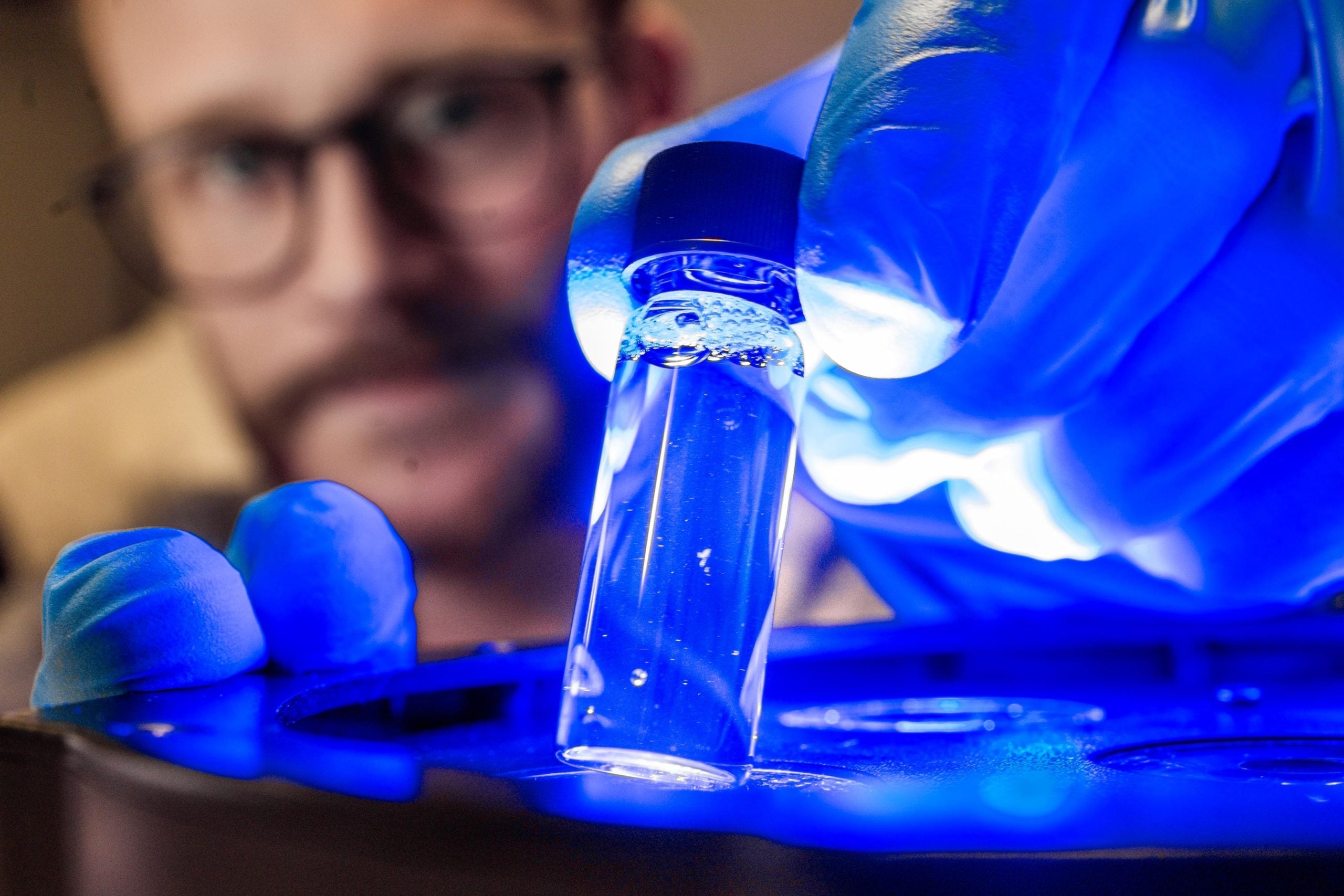
A simple burst of visible light can now create skin-safe electrodes that could transform medical and wearable electronics.
A new study from researchers at Linköping University and Lund University in Sweden shows that visible light can be used to form electrodes made from conductive plastics without relying on hazardous chemicals. The method allows electrodes to be produced on many different surfaces, opening the door to new types of electronics and medical sensors.
“I think this is something of a breakthrough. It’s another way of creating electronics that is simpler and doesn’t require any expensive equipment,” says Xenofon Strakosas, assistant professor at the Laboratory of Organic Electronics, LOE, at Linköping University.
Conductive plastics with unique properties
Scientists at LOE study conductive plastics, also called conjugated polymers, to develop technologies for areas such as healthcare and renewable energy. These materials combine the electrical behavior of metals and semiconductors with the flexibility and softness of plastics, making them especially useful for applications that require both conductivity and adaptability.
Polymers are built from long chains of hydrocarbons, with each repeating unit known as a monomer. When monomers link together, they form polymers through a process called polymerization. Traditionally, polymerization depends on strong and sometimes toxic chemicals. This limits how easily the process can be scaled up and restricts its use in sensitive fields such as medicine.
Polymerization powered by visible light
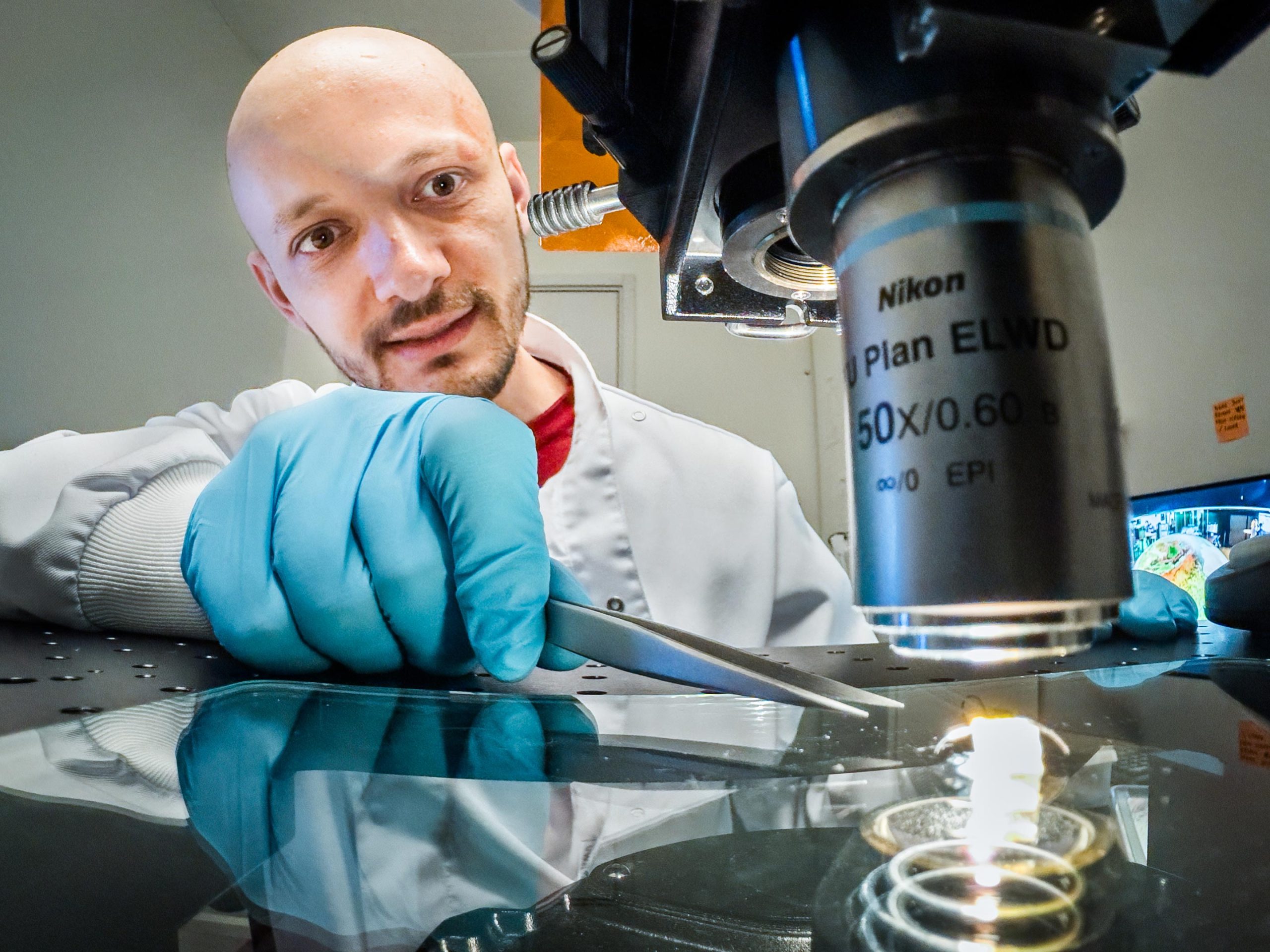
Researchers at Campus Norrköping, working with collaborators in Lund and New Jersey, have now developed a way for polymerization to occur using only visible light. The key lies in specially designed water-soluble monomers created by the research team. Because of this design, the process does not require toxic chemicals, harmful UV light, or additional treatment steps to produce functional electrodes.
“It’s possible to create electrodes on different surfaces such as glass, textiles, and even skin. This opens up a much wider range of applications,” says Xenofon Strakosas.
In practice, a liquid solution containing the monomers can be applied to a surface. A laser or another light source is then used to draw detailed electrode patterns directly onto that surface. Any solution that does not polymerize can be washed away, leaving only the finished electrodes behind.

Medical applications and improved brain signal recording
“The electrical properties of the material are at the very forefront. As the material can transport both electrons and ions, it can communicate with the body in a natural way, and its gentle chemistry ensures that tissue tolerates it – a combination that is crucial for medical applications,” says Tobias Abrahamsson, researcher at LOE and lead author of the study published in the scientific journal Angewandte Chemie.
To test the approach, the researchers used light to pattern electrodes directly onto the skin of anaesthetized mice. Compared with conventional metal EEG electrodes, the new electrodes showed clearer recordings of low-frequency brain activity.
Future uses from wearable sensors to mass production
“As the method works on many different surfaces, you can also imagine sensors built into garments. In addition, the method could be used for large-scale manufacture of organic electronics circuits, without dangerous solvents,” says Tobias Abrahamsson.
The researchers believe this light-based technique could pave the way for safer, more flexible electronics that are easier to manufacture and better suited for close contact with the human body.
Reference: “Visible-Light-Driven Aqueous Polymerization Enables in Situ Formation of Biocompatible, High-Performance Organic Mixed Conductors for Bioelectronics” by Tobias Abrahamsson, Fredrik Ek, Rémy Cornuéjols, Donghak Byun, Marios Savvakis, Cecilia Bruschi, Ihor Sahalianov, Eva Miglbauer, Chiara Musumeci, Mary J. Donahue, Ioannis Petsagkourakis, Maciej Gryszel, Martin Hjort, Jennifer Y. Gerasimov, Glib Baryshnikov, Renee Kroon, Daniel T. Simon, Magnus Berggren, Ilke Uguz, Roger Olsson and Xenofon Strakosas, 10 November 2025, Angewandte Chemie.
DOI: 10.1002/ange.202517897
Never miss a breakthrough: Join the SciTechDaily newsletter.
Follow us on Google and Google News.
2 Comments
Excellent! Perhaps we can finally reduce the weight of now TOO HEAVY cellphones by printing circuits directly on a thin plastic substrate. No metal frames, glass backs and so forth that add weight that breaks the phone when it is dropped or wears a hole in your pocket.
Do we need this?