
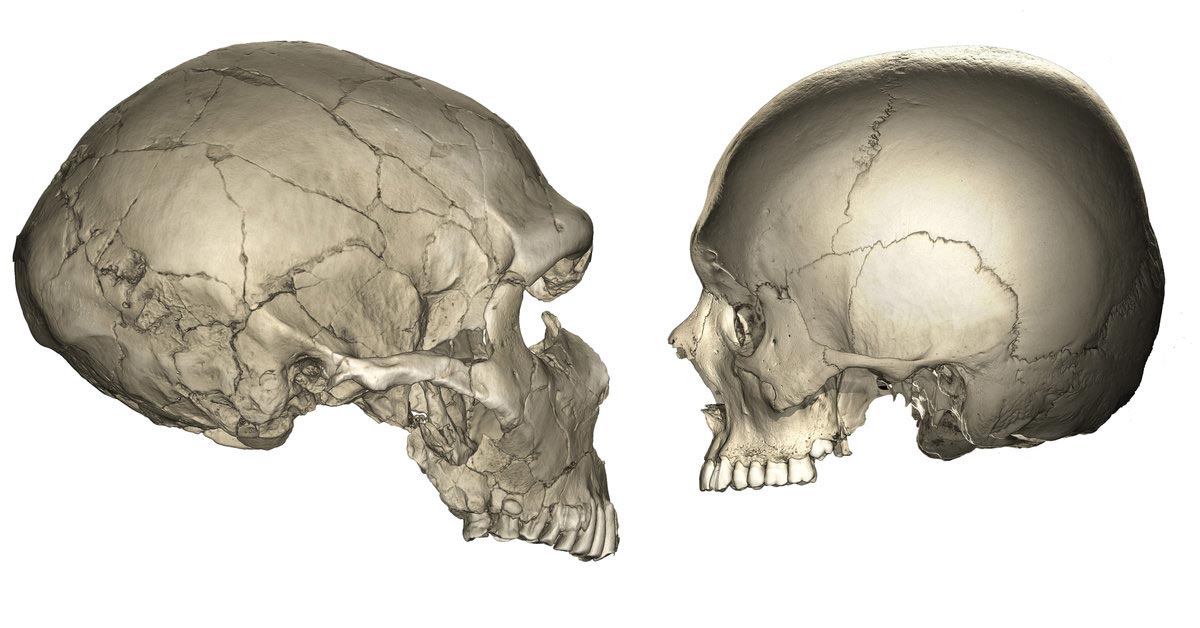
Facial growth stops at puberty in Homo sapiens.
Humans differ from chimpanzees and Neanderthals in how their faces grow. In humans, facial growth slows down during childhood and stops after adolescence. This is mainly due to a decrease in skull bone cell activity during puberty, which limits facial growth and results in a smaller adult face.
The human face is markedly different from that of our fossil relatives and ancestors, most notably, it is smaller and more gracile. However, the reasons for this evolutionary shift are still not fully understood. To explore this mystery, a research team led by the Max Planck Institute for Evolutionary Anthropology has been investigating how and why our species developed such a distinctive facial structure.
“Our findings reveal that a change in development – particularly during late growth stages – led to smaller faces,” says first author Alexandra Schuh from the Max Planck Institute for Evolutionary Anthropology. “Compared to Neanderthals and chimpanzees who continue growing longer, human facial growth stops earlier, around adolescence, resulting in a smaller adult face.”
Tracking changes in facial size in different species
To reach this conclusion, the researchers tracked changes in facial size across ontogeny, from birth to adulthood, in different species. This allowed them to pinpoint key developmental differences between species. Additionally, by analyzing bone cellular activity, the team observed a decline that mirrors the cessation of growth observed around adolescence in humans.
“Identifying key developmental changes allows us to understand how species-specific traits emerged throughout human evolution,” says Schuh. These results highlight parts of the mechanisms behind cranial gracilization, a process that has shaped the morphology of our species.
Reference: “Human midfacial growth pattern differs from that of Neanderthals and chimpanzees” by Alexandra Schuh, Philipp Gunz, Chiara Villa, Bruno Maureille, Michel Toussaint, Grégory Abrams, Jean-Jacques Hublin and Sarah E. Freidline, 24 March 2025, Journal of Human Evolution.
DOI: 10.1016/j.jhevol.2025.103667
Never miss a breakthrough: Join the SciTechDaily newsletter.
Follow us on Google and Google News.
9 Comments
thank you for this
Oh, oh. I know why. God
Yes it is our one God. We will continue to hear one missing loop in all those apes and monkeys till the end. The funny thing after millions of years and evolution still this monkey speechless. Monkey is monkey and is an animal. Human is human .
Yes of course it was ” God ” ha ha ha !!!
I don’t see a “why.” I see the mechanism, “…a change in development – particularly during late growth stages – led to smaller faces,” But what is the cause behind the change in development? Change in diet?
If you look at the trend in facial features between wild and domesticated animals the answer with high probability becomes obvious. Humans are experts at domesticating species; and, we domesticated ourselves.
{^_^}
That makes a lot of sense. In order to domesticate an animal, we too needed to first be domesticated.
I think it’s an evolution process hiding from predators. Smaller head and face makes it easier to hide in small holes or cracks in rocks or caves and can’t be eaten.
Humans evolved as distinct and different from Neanderthals and so is the apes from man. If it’s not so, the more adaptable humans would have ended like the Neanderthals… extinct. Environmental and climatic conditions made man came out of different breeds to adapt itself where he chose to live.