
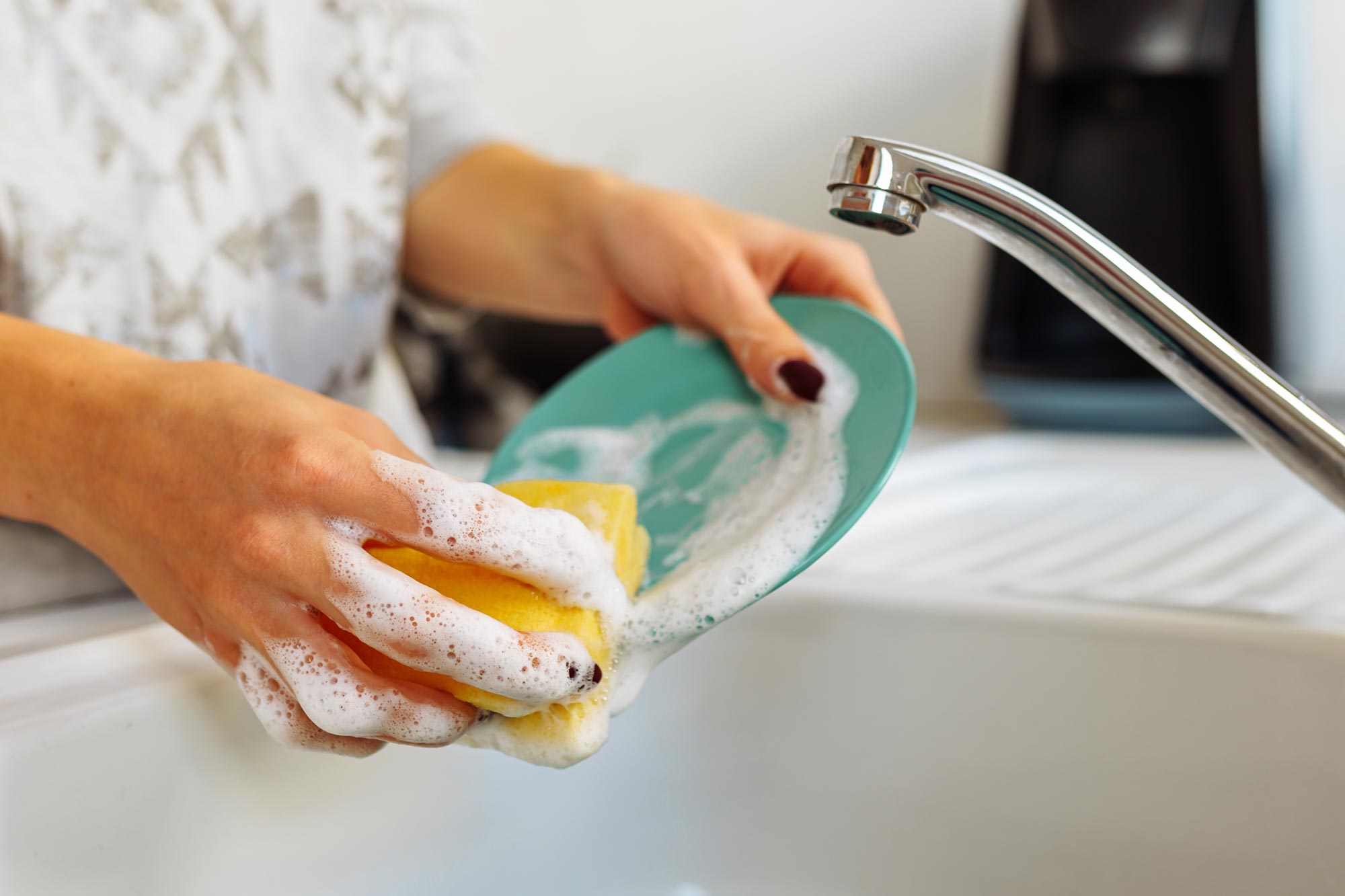
Kitchen sponges shed microplastics, but water use drives most environmental harm. Real-world and lab data show reducing water consumption has the greatest impact.
Kitchen sponges may look harmless, but each scrub can release tiny plastic fragments that slip unnoticed down the drain. These microplastics, now found everywhere from oceans to drinking water, have many sources, and researchers are beginning to realize that everyday household items play a role.
A team led by the University of Bonn set out to measure just how much microplastic comes from sponges and whether it poses a meaningful environmental threat. Their findings reveal a nuanced picture. Sponges do shed plastic, but another factor dominates the overall impact of dishwashing.
Microplastics are now widespread in the environment, showing up in oceans, soil, air, and even food and drinking water. Studies suggest they can be ingested by wildlife and humans, where they may carry harmful chemicals or trigger inflammation in living tissues. Despite growing concern about these potential health and ecological effects, many everyday sources of microplastics remain poorly understood.
How Researchers Measured Microplastic Release
The researchers asked households in Germany and North America to use one of three sponge types during their normal dishwashing routines. By weighing each sponge before and after use, the team estimated how much material was lost and how much microplastic was released.
Alongside this, laboratory experiments used a custom device called the “SpongeBot,” which simulates the physical stress of scrubbing. This combination of real-world data and controlled testing helped produce more reliable results.
All the tested sponges lost material over time, releasing microplastics as they wore down. Annual emissions ranged from about 0.68 to 4.21 grams (0.02 to 0.15 ounces) per person, depending on the sponge type. Sponges made with less plastic produced fewer particles. Still, the analysis found that microplastic release was not the main environmental concern. Instead, water use during dishwashing had a far greater impact.
Citizen participation was essential to the study because it captured real household behavior. By observing how people actually wash dishes, researchers obtained more accurate data than lab-only studies typically provide. This approach improved estimates of microplastic release under everyday conditions.
Environmental Impact: Water vs. Microplastics
While the amount of microplastics released per person is relatively small, scaling the data to an entire country reveals a larger effect. In Germany, for example, emissions could reach up to 355 tonnes (about 391 U.S. tons) per year if one sponge type were used nationwide. Although wastewater treatment plants capture much of this material, several tons still make their way into water systems or soil each year.
Even so, the broader environmental assessment shows that water use dominates the impact of dishwashing. About 85 to 97 percent of the total environmental burden comes from water consumption, while microplastics contribute only a minor share to ecosystem damage.
The study highlights several practical ways to reduce environmental impact:
- Use less water when washing dishes, since this has the greatest effect.
- Choose sponges with lower plastic content to limit microplastic release.
- Keep using sponges longer, as extending their lifespan reduces overall resource use
Reference: “From sink to Sea: Microplastic release from kitchen sponges and potential environmental effects” by Leandra Hamann, Christina Galafton, Peter T. Rühr, Alexander Blanke and Nils Thonemann, 24 February 2026, Environmental Advances.
DOI: 10.1016/j.envadv.2026.100693
Never miss a breakthrough: Join the SciTechDaily newsletter.
Follow us on Google and Google News.
19 Comments
use Dishwasher
The statements about water use being the “greatest impact” are ridiculous. We don’t yet know all the horrors that the microplastics are causing or will eventually cause, so you can’t just use some silly formula to say that wasting a little water is worse than swallowing plastics! Whi came up with those formula, as it’s clearly extremely subjective and unreliable.
So, I wonder how much residual plastic went down a drain or into the environment during manufacture of said sponges.
So, I wonder how much residual plastic went down a drain or into the environment during manufacture of said sponges.
“About 85 to 97 percent of the total environmental burden comes from water consumption, while microplastics contribute only a minor share to ecosystem damage.”
I doubt that such a broad-brush claim about water can be justified. The “total environmental burden” is determined by the local climate, particularly the annual precipitation. It is also impacted by the source — surface waters versus fossil aquifers — and how the waste water is handled locally. That is, whether the treated water stays locally or is released into rivers to find its way to the ocean quickly.
The claims aren’t science. They are more like propaganda supporting the memes of self-styled environmentalists who are subjectively favoring their preferred ‘hot button.’
What about cloths? I’m surprised this article didn’t address cloths. Do they shed anything or should that have been one of the recommendations?
Cloths?
Wash cloths and rags that are used to clean things including dishes. They are made of fabric and might be cotton and plastic-free, or could contain polyester or other plastics.
Oh, just realized you weren’t asking what “cloths” were, you were just emphasizing or maybe had a duplicate comment. I wish we could delete or edit our comments…hint hint SciTechDaily….?
I second that ‘hint.’
Quite
Also cellolose sponges.
Their recommendations are bonkers. Using sponges longer, will lead to greater shedding as they deteriorate, and increased risk of bacterial/fungal growth. Just use a dish towel, and launder them.
How much microplastics were contained in the natural sponges that used to be so widely available? Why are they so hard to find now?
0, they were overfished. Limited natural supply, overwhelming demand.
The article fails to mention that there are already plenty of sponges that are plastic-free. The basic standard cellulose sponge is plastic-free. Scrubby sponges and the synthetic foam sponges are the ones that have all the plastics, but even those scrubby sponges can be made without plastic and you just have to search for plastic free versions.
I fail to see how using less water will help at all since it’s the sponges that are the source of the plastics. Using sponges for longer times won’t do a thing to help reduce microplastic shedding. If you’re not using an old sponge, you’re using a new sponge and both will shed plastics. And the older sponge probably sheds more. SMH
Yes, I use a cellulose-based one and it’s actually better than those awful green ones. However, I can’t find any in our major supermarkets in the UK, I have to buy them online. The supermarkets need to start taking responsibility instead of just selling whatever makes them the most profit!
thanks
Thank you for this article, have just been online to buy some cellulose based sponges.
The owl house luz noceda