
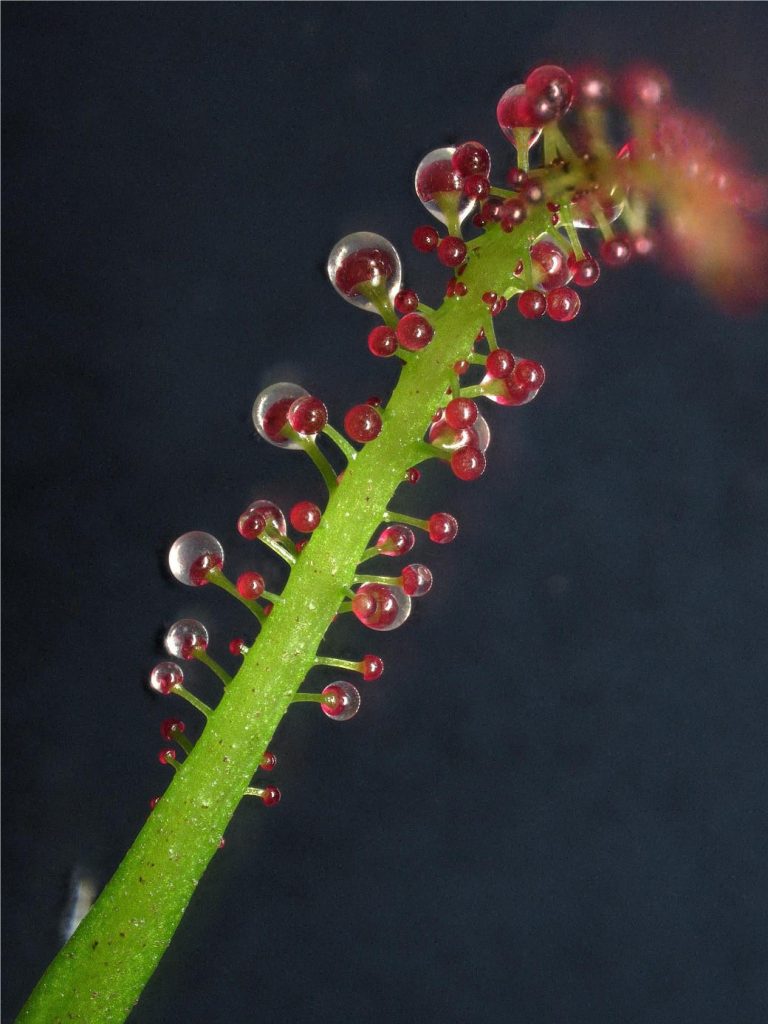
Triphyophyllum peltatum, a West African plant with medicinal potential, becomes carnivorous under phosphorus deficiency. Scientists have successfully cultivated it, revealing insights into its adaptability and the evolution of carnivory.
Triphyophyllum peltatum is a unique plant native to the tropical regions of West Africa. This particular liana species garners significant attention from the medical and pharmaceutical sectors owing to its special constituents. Laboratory tests have revealed that its constituents exhibit promising medically useful activities against pancreatic cancer and leukemia cells, among others, as well as against the pathogens that cause malaria and other diseases.
However, the plant species is also interesting from a botanical perspective: Triphyophyllum peltatum is the only known plant in the world that can become a carnivore under certain circumstances. Its menu then includes small insects, which it captures with the help of adhesive traps in the form of secretion drops and digests with lytic enzymes synthesized.
High Flexibility in the Developmental Phases
High flexibility can be observed in the leaves of the plant, which develop three different types depending on the stage of development. While in the juvenile phase, simple leaves are initially formed, later so-called “trap leaves” can be formed, which carry a large number of adhesive traps. When these trap leaves have served their purpose, the plant either forms normal leaves again or – if the plant has entered the liana stage – leaves with two hooks at the tip as climbing support.
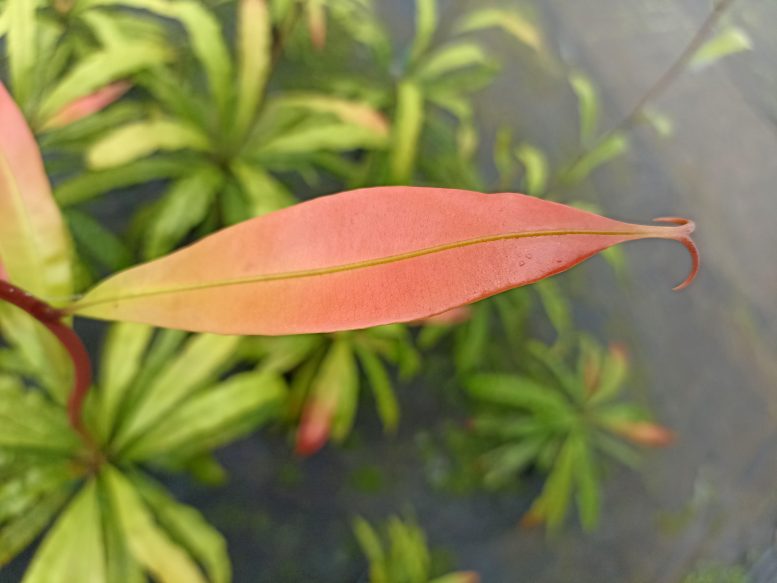
As far as the expression of leaf identity is concerned, Triphyophyllum peltatum shows a high degree of flexibility: the developmental stages can vary in length, and the carnivorous stage can be omitted completely or made up for at a later stage. Thus, the plant seems to adapt to the prevailing conditions of its habitat.
Success in Propagation and Cultivation
The trigger that turns the plant into a carnivore was previously unknown. One reason for this was the fact that Triphyophyllum peltatum was considered very difficult to cultivate and therefore the formation of trap leaves was difficult to study experimentally. This problem has now been solved by scientists at Leibniz Universität Hannover (LUH) and Julius-Maximilians-Universität Würzburg (JMU).
They first succeeded in cultivating the Triphyophyllum peltatum in the greenhouse of the Würzburg Botanical Garden. In Hannover, conditions were developed to propagate the plants in large numbers under in vitro conditions, i.e. in culture vessels on well-defined nutrient media.
Professor Traud Winkelmann from the Institute of Horticultural Production Systems at Leibniz University Hannover and her colleague Anne Herwig from the Institute of Soil Science at LUH were involved, as well as Würzburg professors Gerhard Bringmann (Institute of Organic Chemistry) and Rainer Hedrich (Julius-von-Sachs-Institute of Biosciences).
Phosphorus Deficiency Triggers the Transformation
But what is even more significant is that with the help of these plants, the research team was able to identify the factor that triggers the transformation to the carnivore lifestyle. The team has now published the results of this research in the current issue of the journal New Phytologist.
“We exposed the plant to different stress factors, including deficiencies of various nutrients, and studied how it responded to each. Only in one case were we able to observe the formation of traps: in the case of a lack of phosphorus,” says Traud Winkelmann, summarizing the central result of the study. In fact, a greatly reduced supply of phosphorus is already sufficient to trigger the development into a carnivorous plant, according to the scientist.
In its original habitat in African tropical forests on nutrient-poor soils, Triphyophyllum peltatum can thus avoid the threat of malnutrition by forming traps and accessing the important nutritional element through the digestion of its insect prey. “These new findings are a breakthrough because they allow future molecular analyses that will help understand the origins of carnivory,” the scientists are convinced.
Reference: “Carnivory on demand: phosphorus deficiency induces glandular leaves in the African liana Triphyophyllum peltatum” by Traud Winkelmann, Gerhard Bringmann, Anne Herwig and Rainer Hedrich, 16 May 2023, New Phytologist.
DOI: 10.1111/nph.18960
The study was funded by the German Research Foundation.
Never miss a breakthrough: Join the SciTechDaily newsletter.
Follow us on Google and Google News.
2 Comments
So look for the new bridezilla squashing phosphate and nitrophosphate drinks over taurine ones at your next maidens night out. Also a new isoquinaline steak sauce for the guys!
I checked; there are other carnivorous plants.