
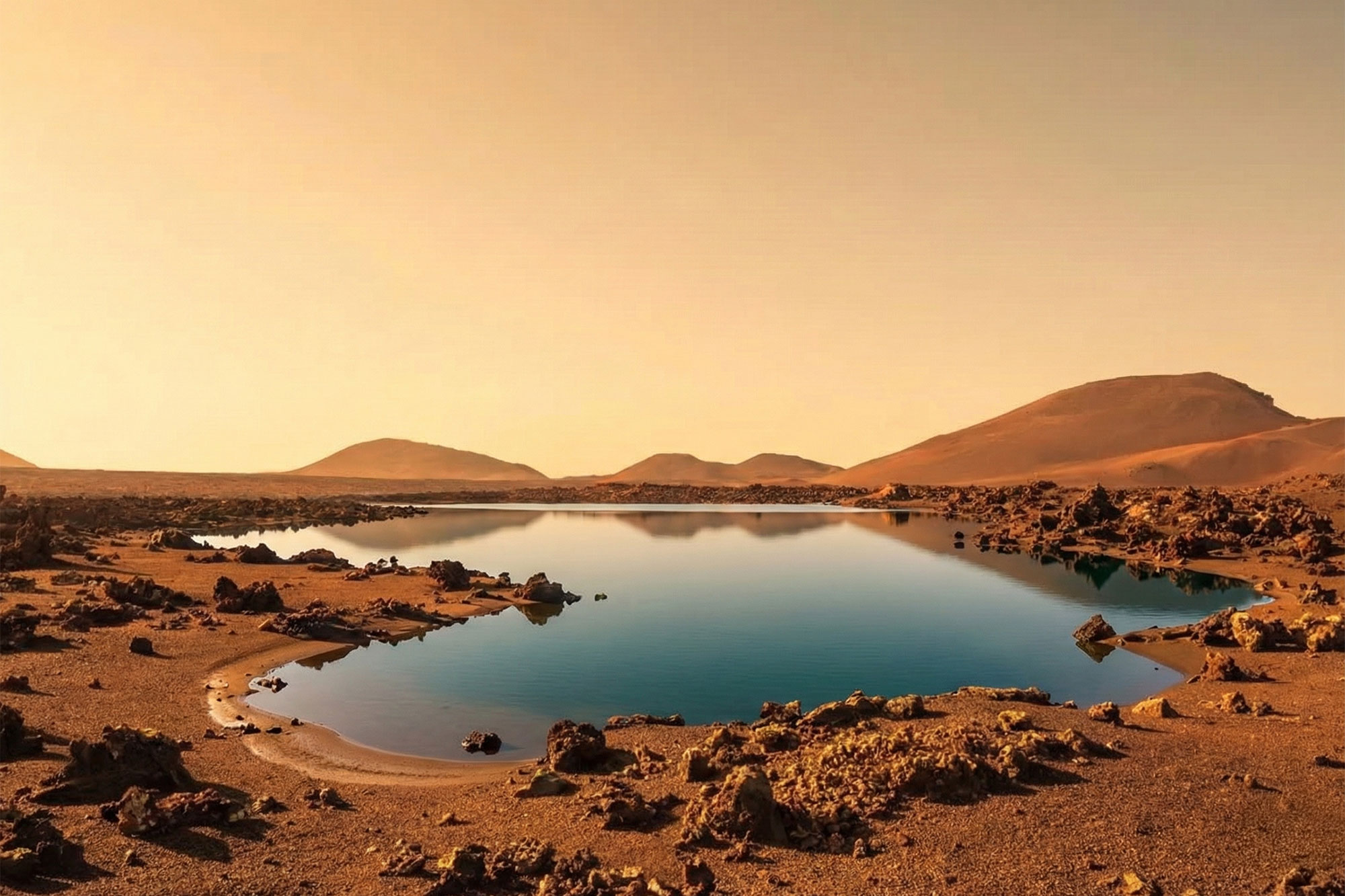
New climate modeling suggests that small lakes on ancient Mars could have stayed liquid for decades, even in a generally cold environment.
Small lakes on early Mars may have stayed in liquid form for many years, despite average temperatures that were far below freezing.
Researchers at Rice University used a climate model redesigned for Mars to explore whether lakes could survive under such cold conditions. Their results indicate that lakes in places like Gale Crater near the planet’s equator could have endured beneath a thin layer of seasonal ice for decades, and possibly longer if the surrounding climate remained steady. This work helps address a long-standing question in Mars research, since the planet’s surface shows clear signs of long-lasting liquid water even though many climate models suggest early Mars was too cold to allow it.
The study, published in AGU Advances, proposes a new way to understand how these lakes could have existed without a persistently warm climate and why ancient Martian lake beds remain remarkably well preserved today.
“Seeing ancient lake basins on Mars without clear evidence of thick, long-lasting ice made me question whether those lakes could have held water for more than a single season in a cold climate,” said Eleanor Moreland, a Rice graduate student and lead author of the study. “When our new model began showing lakes that could last for decades with only a thin, seasonally disappearing ice layer, it was exciting that we might finally have a physical mechanism that fits what we see on Mars today.”

Adapting Earth’s climate tool kit
The team modified a climate modeling framework known as Proxy System Modeling, originally created by Earth climate researcher Sylvia Dee, which is typically used to rebuild ancient environments from indirect evidence like tree rings or ice cores.
Because Mars does not have trees or similar natural markers, the researchers turned to data gathered by Mars rovers. They relied on the planet’s rocks and minerals, treating these geological records as stand-ins for a traditional climate archive.
Over the course of several years, the model was redesigned to simulate lakes on Mars as it existed roughly 3.6 billion years ago. The updated version accounted for key differences from Earth, including weaker sunlight, a carbon dioxide-rich atmosphere, and seasonal cycles unlike those on our planet.
Using this approach, the researchers ran 64 separate scenarios with a new model called Lake Modeling on Mars with Atmospheric Reconstructions and Simulations (LakeM2ARS). These simulations were grounded in observations from NASA’s Curiosity rover in Gale Crater and established Mars climate models.
Each scenario followed the evolution of a hypothetical lake within the crater for 30 Martian years, or about 56 Earth years, to test whether liquid water could realistically persist under those ancient conditions.

“It was fun to work through the thought experiment of how a lake model designed for Earth could be adapted for another planet, though this process came with a hefty amount of debugging when we had to change, say, gravity,” said Dee, an associate professor of Earth, environmental and planetary sciences and co-author of the study.
“We were surprised and encouraged by how sensitively the model responded to parameters like atmospheric pressure and temperature seasonality. It shows that with some creativity and experimentation, Earth-origin models can yield realistic climate scenarios for Mars.”
A hidden protector
In some simulations, the lakes completely froze during colder seasons, whereas in others, the lakes remained liquid and were covered by a thin layer of ice instead of freezing solid. This thin ice acted as an insulating lid, significantly reducing water loss while still allowing sunlight to warm the lake ice during warmer months.
As a result of this seasonal cycling, some simulated lakes barely changed in depth over decades, suggesting that they could be stable for longer durations even with average air temperatures below freezing for much of the time.
“This seasonal ice cover behaves like a natural blanket for the lake,” said Kirsten Siebach, an associate professor of Earth, environmental and planetary sciences and co-author of the study.

It insulates the water in winter while allowing it to melt in summer, Siebach said. “Because the ice is thin and temporary, it would leave little evidence behind, which could explain why rovers have not found clear signs of perennial ice or glaciers on Mars,” she said.
The findings suggest that early Mars may have supported long-lasting lakes without requiring consistently warm conditions, challenging earlier beliefs that surface water on Mars would require persistent warmth.
Future exploration
If ancient Martian lakes persisted under seasonal ice rather than thick permanent ice, features on Mars that have been difficult to reconcile with past climate models, including preserved shorelines, sediment layers, and mineral deposits, may now have clearer interpretations.
The researchers said they look forward to applying LakeM2ARS to other Martian basins to investigate whether similar lakes could have existed elsewhere. They also aim to examine how factors such as changes in atmospheric composition or groundwater circulation might have affected the stability of lake ice over time.
“If similar patterns emerge across the planet, the results would support the idea that even a quite cold early Mars could sustain year-round liquid water, a key ingredient for environments to be suitable for life,” Moreland said.
Reference: “Seasonal Ice Cover Could Allow Liquid Lakes to Persist in a Cold Mars Paleoclimate” by Eleanor L. Moreland, Sylvia G. Dee, Yueyang Jiang, Grace Bischof, Michael A. Mischna, Nyla Hartigan, James M. Russell, John E. Moores and Kirsten L. Siebach, 29 December 2025, AGU Advances.
DOI: 10.1029/2025AV001891
The additional co-authors of this study include Rice undergraduate student Nyla Hartigan, Michael Mischna from the Jet Propulsion Laboratory at the California Institute of Technology, James Russell from Brown University and Grace Bischof and John Moores from York University. The Rice Faculty Initiative Fund and the Canadian Space Agency supported this research.
Never miss a breakthrough: Join the SciTechDaily newsletter.
Follow us on Google and Google News.