

The key may lie in Arctic clouds during winter, as climate models tend to underestimate how much liquid they contain and how much heat they retain. This leads to inaccurate predictions of future warming.
The Arctic is one of the coldest regions on Earth, but in recent decades it has been warming rapidly, three to four times faster than the global average. Yet current climate models have struggled to explain this accelerated warming.
Now, researchers from Kyushu University—graduate student Momoka Nakanishi of the Interdisciplinary Graduate School of Engineering Sciences and her adviser, Associate Professor Takuro Michibata of the Research Institute for Applied Mechanics—have suggested that clouds may be the key factor. Their findings were published in the journal Ocean-Land-Atmosphere Research.
Heat-trapping properties of mixed-phase clouds
The most common clouds in the Arctic are mixed-phase clouds, which contain both ice crystals and supercooled liquid water droplets. During the Arctic summer, when sunlight is constant, these clouds reflect sunlight back into space like a parasol, helping to cool the region. In contrast, during the long, dark Arctic winter, when there is no sunlight to reflect, the same clouds behave like a blanket, trapping heat radiated from the Earth’s surface and sending it back down to the ground.
“However, how well these mixed-phase clouds trap heat depends on their ratio of ice to liquid,” explains Nakanishi. “The more liquid water the clouds contain, the better they are at trapping heat. But many climate models have a large bias in representing this ratio, causing incorrect predictions.”
Satellite comparison reveals model bias
In this study, Nakanishi and Michibata analyzed 30 climate models and compared them to satellite observations of clouds in the Arctic during winter over the last decade. They found that 21 of the 30 models significantly overestimated the fraction of ice to liquid in wintertime Arctic clouds.
“These ice-dominant models are not properly accounting for the present-day warming potential of the clouds during the winter,” says Nakanishi. “That’s why they cannot account for the rapid warming we are currently seeing.”
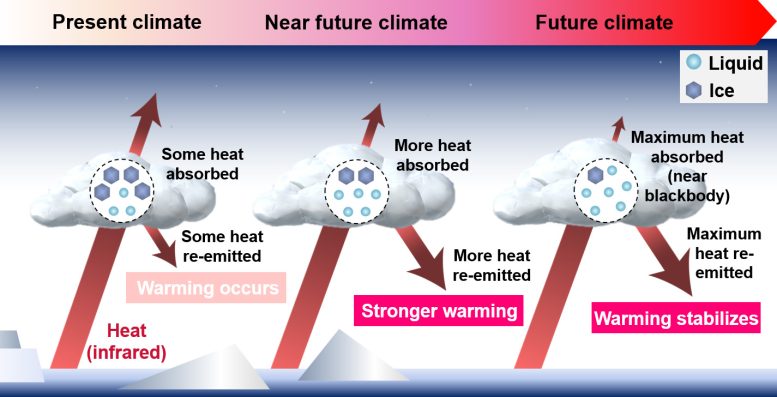
However, every cloud has a silver lining. While climate models are underestimating the rate of global warming in the present day, they are overestimating the rate of global warming in the future.
The errors in future projections are due to a process called “cloud emissivity feedback”. In a nutshell, as the Arctic warms, clouds shift from containing mostly ice to more liquid, which increases their ability to trap heat, further warming the Arctic and creating a positive feedback loop.
Liquid-rich clouds and heat feedback saturation
But importantly, this feedback loop has a time limit. Once clouds become so rich in liquid that they behave like blackbodies—fully absorbing and re-emitting heat—further warming has less effect.
However, because many climate models underestimate how much liquid is already present in today’s clouds, they assume a larger shift still lies ahead. As a result, they overestimate how much extra heat-trapping will occur in the future, and predict the feedback effect will last longer than reality suggests.
Moving forward, the study’s findings could be used to refine climate models so that they provide a more accurate representation of the ice-to-liquid ratio within clouds and better predictions of current and future rates of Arctic warming.
Since the Arctic’s climate also plays a key role in shaping weather patterns further south, these findings could also lead to more accurate forecasts of extreme weather in mid-latitude regions.
“The biggest uncertainty in our forecasts is due to clouds,” concludes Michibata. “Fixing these models is essential not just for the Arctic, but for understanding its impact on weather and climate change across the globe.”
Reference: “How Does Cloud Emissivity Feedback Affect Present and Future Arctic Warming?” by Momoka Nakanishi and Takuro Michibata, 29 April 2025, Ocean-Land-Atmosphere Research.
DOI: 10.34133/olar.0089
Funding: Japan Science and Technology Agency, Japan Society for the Promotion of Science, Environmental Restoration and Conservation Agency, Japan Ministry of Education, Culture, Sports, Science, and Technology
Never miss a breakthrough: Join the SciTechDaily newsletter.
Follow us on Google and Google News.
2 Comments
“The biggest uncertainty in our forecasts is due to clouds,”
This has been known for some time. To make things worse, it isn’t just the composition of clouds that is a problem. The partial-differential equations that have to be solved for heat exchange in clouds is so challenging that even the present-day supercomputers aren’t up to that task. It takes too much time to do the calculations at the same spatial scales used for the other meteorological measurements. To speed up the calculations, modelers have turned to what is called “parameterization.” What that means is that experts on clouds have agreed upon ways to simplify the cloud/energy behavior and made estimates of what happens using their best guesses, and have forsaken trying to exactly solve the cloud/energy equations. They do this for a coarser spatial resolution as well.
The problem is, the reason climatologists and atmospheric physicists use computer models is that humans are not good at subjectively analyzing complex systems with several inter-dependent feedback loops. Therefore, we have a conflict. We are depending on humans with limited understanding to second-guess how the systems work in a simplified manner, and then codify those assumptions for calculations, “based on physics.” However, knowing the limitations of human’s abilities to understand how the systems work, what is the probability that they have guessed right?
It is a Catch 22 situation because the best use of computer models is to gain insight into how complex systems work, but we can’t do that in a reasonable amount of time, let alone real-time, for the scale used for most of the other meteorological measurements. Therefore, we end up using the outputs of models with questionable accuracy to forecast the future, and hopefully advance our understanding of the complex systems using models that are almost certainly wrong in different aspects.
“All models are wrong, but some are useful.” — George Box
The challenge is to determine which climate models are actually useful. It appears that only the Russian models are close to historical reality. Yet, the climate modeling community insists on using what is called an ensemble — essentially the models from everyone who has skin in the game. The assumption is that taking the average of the best model and all the inferior ones will lead to better results. I would submit that all that the inferior models do is to corrupt the results of the singular best model. How are we to learn anything important from using demonstrably inferior models that are averaged together?
The question that wasn’t asked, let alone answered, is “What role, if any, does CO2 play in cloud formation and composition?”