

Close Menu
    Facebook X (Twitter) Instagram
    SciTechDaily
    • Biology
    • Chemistry
    • Earth
    • Health
    • Physics
    • Science
    • Space
    • Technology
    Facebook X (Twitter) Pinterest YouTube RSS
    SciTechDaily
    Home»Health»Scientists Uncover Immune Cells That Could Hold the Secret to Slowing Aging
    Health

    Scientists Uncover Immune Cells That Could Hold the Secret to Slowing Aging

    By Ben-Gurion University of the NegevNovember 5, 2025No Comments4 Mins Read
    Facebook Twitter Pinterest Telegram LinkedIn WhatsApp Email Reddit
    Share
    Facebook Twitter LinkedIn Pinterest Telegram Email Reddit
    Cells Aging Time Clock
    Researchers have identified a special type of T helper cell that grows with age and helps clear aging cells from the body, possibly unlocking new ways to slow aging and extend healthspan. Credit: SciTechDaily.com

    Once thought to be a flaw in the system, new research suggests that CD4 T cells may actually hold the key to maintaining a properly functioning, age-appropriate immune system.

    Prof. Alon Monsonego of Ben-Gurion University of the Negev has found that T helper lymphocytes, a type of immune cell responsible for coordinating immune responses, change in how they function as people grow older. These age-related changes can reveal a person’s biological age, which may not always match the number of years they have lived.

    In collaboration with Prof. Esti Yeger-Lotem, Prof. Monsonego’s research group identified a previously unknown subset of T helper cells that builds up over time. The significance of these cells became clearer after a Japanese study of supercentenarians (people living well beyond 100 years) showed that this same type of T helper cell was abundant in their immune systems. Prof. Monsonego now suggests that these cells could be essential to keeping the immune system properly balanced throughout life.

    The research, led by Dr. Yehezqel Elyahu from Prof. Monsonego’s lab in partnership with Prof. Valery Krizhanovsky of the Weizmann Institute of Science, was recently published in Nature Aging.
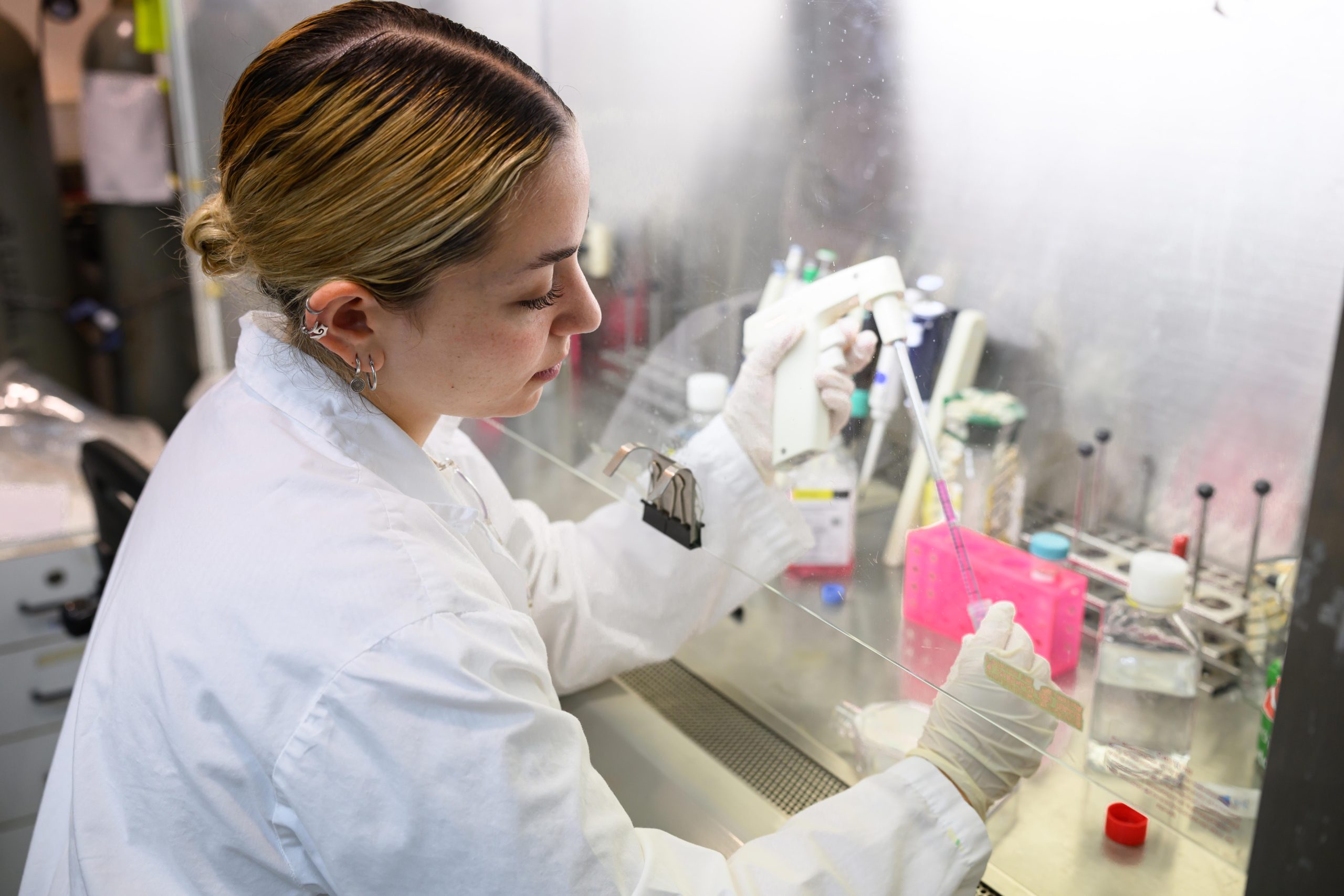
    Alon Monsonego's Lab
    A student working in Prof. Alon Monsonego’s lab at Ben-Gurion University of the Negev on the Marcus Family Campus in Beer-Sheva. Credit: Dani Machlis/BGU

    Cellular Senescence and Immune Defense
    Alon Monsonego
    Prof. Alon Monsonego. Credit: Dani Machlis/BGU

    In the scientific world, aging is a process wherein cells fail to repair the normal wear and tear on them. As a result, people age. Specifically, senescence cells serve a physiological function when kept under proper regulation.

    However, when they accumulate such as occurs with aging, they can cause inflammation and damage. A certain fraction of T helper cells that accumulate with aging, surprisingly, were found to have killing properties. So, these T helper cells act to clean out the system of senescent cells. In fact, Prof. Monsonego discovered that if they lowered the concentrations of these T helper cells in mice, the mice aged faster and lived for less time.

    Interestingly, these unique and unexpected subset of T helper cells increase with age and play a prominent role in reducing aging.

    If T helper cells change with age and are critical for the aging process, then, according to Prof. Monosonego and his team, we need to start tracking people in their 30s to assess the pace of aging as early as possible and follow the biological age of individuals so that early interventions help maintain their normal aging. A gap of decades can grow between biological and chronological ages.

    “People say that to reverse aging and “rejuvenate”, we need to reset their immune system like the immune systems of people in their 20s. However, our research shows that this might not be the case. People don’t need a super-charged immune system; they need one that is working properly and appropriate for their stage in life. So, one of the “axioms” of how to reduce aging may be incorrect,” says Prof. Monsonego.
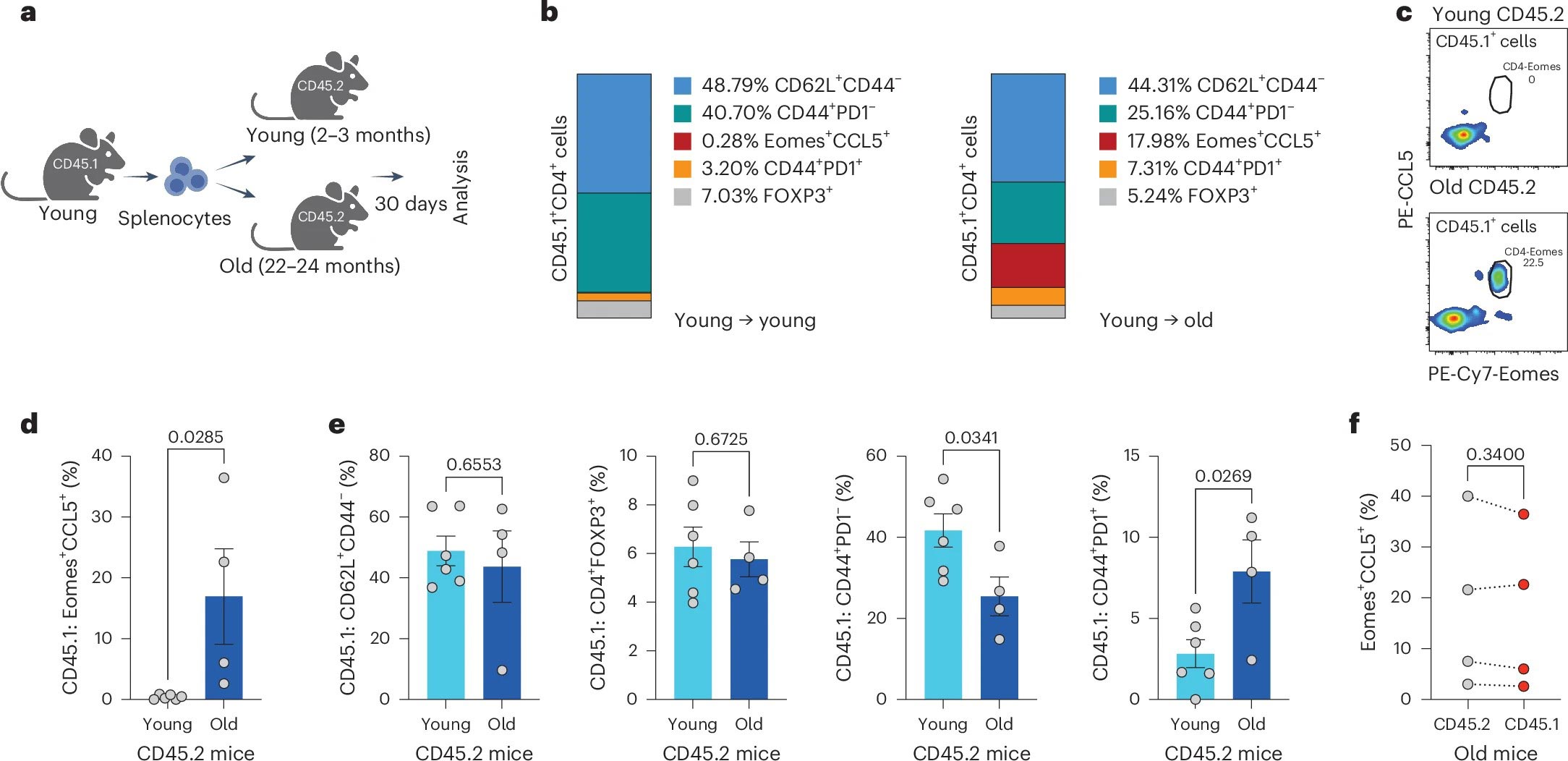
    CD4 T Cells Infographic Aging
    a. Young mouse spleen cells (CD45.1) were injected into young or old recipient mice (CD45.2); spleens were analyzed 30 days later. b. Flow cytometry showed proportions of naïve, memory, regulatory, and CD4-Eomes T cells in young vs. old mice. c. Representative plots illustrated higher or lower CD4-Eomes (Eomes⁺CCL5⁺) T cell levels among transferred cells in young and old mice. d. Quantitative comparison showed the frequency of CD4-Eomes cells differed between young and old recipients. e. Other T cell subsets (naïve, Treg, memory, PD1⁺) were also compared, showing age-dependent variation. f. In old mice, transferred young cells (CD45.1) were compared to the mice’s own cells (CD45.2), showing distinct CD4-Eomes proportions. Credit: Created with BioRender.com

    Furthermore, the cells that they discovered can be used for the diagnostic and therapeutic strategies associated with dysregulated aging, longevity, and age-related diseases.

    Reference: “CD4 T cells acquire Eomesodermin to modulate cellular senescence and aging” by Yehezqel Elyahu, Ilana Feygin, Ekaterina Eremenko, Noa Pinkas, Alon Zemer, Amit Shicht, Omer Berner, Roni Avigdory-Meiri, Anna Nemirovsky, Keren Reshef, Lior Roitman, Valery Krizhanovsky and Alon Monsonego, 7 October 2025, Nature Aging.
    DOI: 10.1038/s43587-025-00953-8

    The research was supported by the Israel Ministry of Science and Technology (Grant no. 3-16148) and the Litwin and Gural Foundations.

    Never miss a breakthrough: Join the SciTechDaily newsletter.
    Follow us on Google and Google News.

    Aging Ben-Gurion University of The Negev Cell Biology Gerontology Immunology Popular
    Share. Facebook Twitter Pinterest LinkedIn Email Reddit

    Related Articles

    “Zombie” Skin Cells Exposed: Three Secret Shapes That Decide If You Age or Heal

    Can We Slow Down Aging? New Biomarker Shows Promise

    Unlocking the Secrets of Aging: Could Protein Clumps Predict Age-Related Diseases?

    Stress Accelerates Aging of the Immune System

    New Research Reveals Immune Cell’s Response to Pathogens Differs Greatly by Sex and Age

    Research Shows Exposure to Common Cold Coronaviruses Can Teach the Immune System to Recognize SARS-CoV-2

    Common Molecular Feature of Antibodies That Neutralize SARS-CoV-2 Discovered, Boosting COVID-19 Vaccine Prospects

    Tiny RNA That Should Attack COVID-19 Coronavirus Diminish With Age, Disease

    Revitalizing the Aging Brain by Activating Immune Cells

    Leave A Reply Cancel Reply

    • Facebook
    • Twitter
    • Pinterest
    • YouTube

    Don't Miss a Discovery

    Subscribe for the Latest in Science & Tech!

    Trending News

    Mezcal “Worm” in a Bottle Mystery: DNA Testing Reveals a Surprise

    New Research Reveals That Your Morning Coffee Activates an Ancient Longevity Switch

    This Is What Makes You Irresistible to Mosquitoes

    Shockingly Powerful Giant Octopuses Ruled the Seas 100 Million Years Ago

    Scientists Stunned by New Organic Molecules Found on Mars

    Rewriting Dinosaur Evolution: Scientists Unearth Remarkable 150-Million-Year-Old Stegosaur Skull

    Omega-3 Supplements Linked to Cognitive Decline in Surprising New Study

    First-of-Its-Kind Discovery: Homer’s Iliad Found Embedded in a 1,600-Year-Old Egyptian Mummy

    Follow SciTechDaily
    • Facebook
    • Twitter
    • YouTube
    • Pinterest
    • Newsletter
    • RSS
    SciTech News
    • Biology News
    • Chemistry News
    • Earth News
    • Health News
    • Physics News
    • Science News
    • Space News
    • Technology News
    Recent Posts
    • This New Chip Could Make GPUs Far More Efficient
    • This Tiny World in the Outer Solar System Should Be Airless, but It Has an Atmosphere
    • NASA’s Webb Space Telescope Reveals a Dark Airless Super-Earth That Looks Like Mercury
    • These Simple Daily Habits Can Quickly Improve Blood Pressure and Heart Risk Factors
    • A Common Nutrient May Play a Surprising Role in Anxiety
    Copyright © 1998 - 2026 SciTechDaily. All Rights Reserved.
    • Science News
    • About
    • Contact
    • Editorial Board
    • Privacy Policy
    • Terms of Use

    Type above and press Enter to search. Press Esc to cancel.