

Dorothee Dormann and Edward Lemke introduce a new approach to assess personal risk for age-related diseases.
Could measuring protein clumps in our cells become a novel method to assess our risk of age-related diseases? Professors Dorothee Dormann and Edward Lemke from Johannes Gutenberg University Mainz (JGU), who also serve as adjunct directors at the Institute of Molecular Biology (IMB) in Mainz, suggest the idea of a “protein aggregation clock” for gauging aging and health. This innovative concept is discussed in their new perspective article published in the scientific journal Nature Cell Biology.
As we age, the DNA and proteins that make up our bodies gradually undergo changes that cause our bodies to no longer work as well as before. This in turn makes us more prone to getting age-related diseases, such as cardiovascular disease, cancer, and Alzheimer’s disease. One important change is that the proteins in our cells can sometimes become misfolded and clump together to form aggregates, so-called amyloids.
Misfolding and aggregation can happen to any protein, but a specific group of proteins known as intrinsically disordered proteins (IDPs) are especially prone to forming amyloids. IDPs make up around 30 percent of the proteins in our cells and they are characterized by having no fixed structure. Instead, they are flexible and dynamic, flopping around like strands of cooked spaghetti.
The Role of Protein Aggregates in Disease
While the molecular mechanisms are widely debated and an important aspect of basic research, scientists know that aggregates formed from IDPs tend to accumulate in many long-lived cells – such as neurons or muscle cells – as we age. Moreover, they can cause many age-related diseases, particularly neurodegenerative diseases such as Alzheimer’s and Parkinson’s disease.
Therefore, having many aggregates in a cell could be an indicator of how unhealthy the cell is or if a person is likely to develop an age-related disease soon. In their recently published article, Dormann and Lemke propose that IDP aggregation could be used as a biological “clock” to measure a person’s health and age.
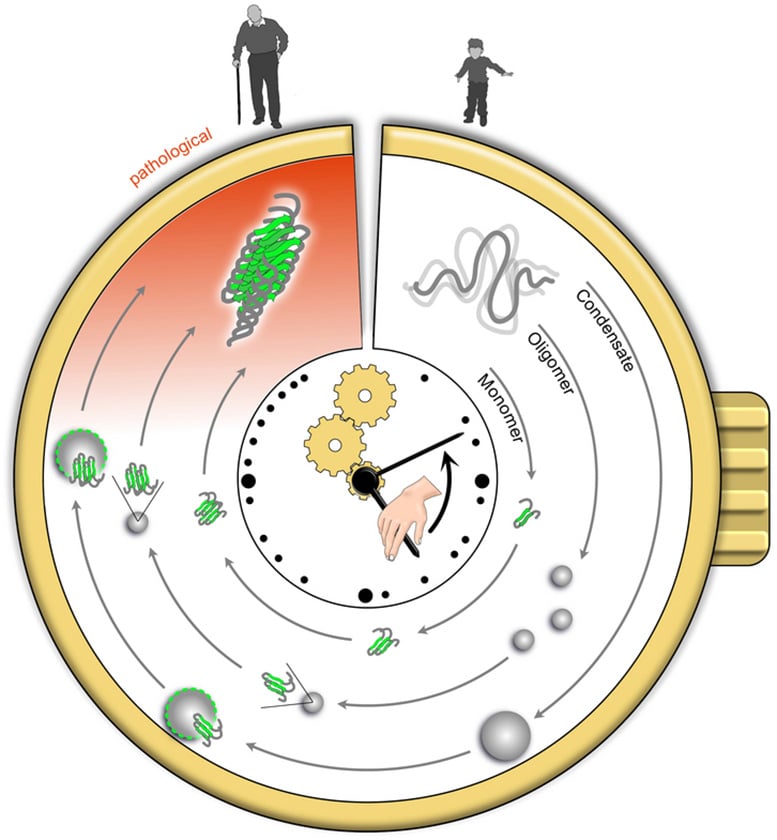
If developed further into a sensitive diagnostic test, a protein aggregation clock could be extremely useful. Firstly, doctors could use it to help diagnose age-related diseases at very early stages or identify people who are not yet sick but have a higher risk of developing disease as they age. This would allow them to be given preventative treatments before they develop severe disease. Secondly, scientists could use it to assess the effects of new experimental treatments to reduce protein aggregation in order to prevent or delay age-related diseases.
“In practice, we are still far away from a routine diagnostic test, and it is important that we improve our understanding of the fundamental mechanisms leading to IDP aggregation,” said Dormann. “However, we want to stimulate thinking and research in the direction of studying protein aggregates to measure biological aging processes,” Lemke added. “We are optimistic that in the future we will be able to overcome the current challenges of reading a protein aggregation clock through more research on IDP dynamics and making further technological developments.”
Comparison With Other Biological Clocks
Although there are other “clocks” to measure aging and health, most of them are based on nucleic acids like DNA. Dormann and Lemke think that a biological clock based on proteins would be a useful complement to these existing clocks, as proteins are among the most abundant molecules in cells and are crucial for all cellular functions. With the help of such a protein aggregation clock, they hope that scientists and doctors will be able to move one step closer to helping people age healthily and preventing age-related diseases.
With their research, Dorothee Dormann and Edward Lemke contribute to the Center for Healthy Ageing (CHA), a virtual research center launched in 2021. The CHA brings together scientists in basic and clinical research from across Mainz who focus on aging and age-related diseases. Their findings are to be used to promote healthy aging and to find treatments that help prevent or cure age-related diseases.
Reference: “Adding intrinsically disordered proteins to biological ageing clocks” by Dorothee Dormann, and Edward Anton Lemke, 23 May 2024, Nature Cell Biology.
DOI: 10.1038/s41556-024-01423-w
Never miss a breakthrough: Join the SciTechDaily newsletter.
Follow us on Google and Google News.