
Scientists at UC Berkeley have developed a new platform called “Oz” that can simultaneously control up to 1,000 photoreceptors in the eye, offering new insights into the mechanisms of human vision and the causes of vision loss.
In Frank Baum’s original novel The Wonderful Wizard of Oz, the Emerald City is described as such a brilliant shade of green that visitors must wear green-tinted glasses to protect their eyes from “the brightness and glory” of the city.
The glasses are one of the wizard’s many deceits; viewed through green-tinted lenses, the city would, of course, appear even greener.
Now, using a new technique called “Oz,” scientists at the University of California, Berkeley, have found a way to manipulate the human eye into perceiving a brand-new color — a blue-green hue of unparalleled saturation that the research team has named “olo.”
“It was like a profoundly saturated teal … the most saturated natural color was just pale by comparison,” said Austin Roorda, a professor of optometry and vision science at UC Berkeley’s Herbert Wertheim School of Optometry & Vision Science, and one of the creators of Oz.
Oz works by using tiny doses of laser light to individually control up to 1,000 photoreceptors in the eye at one time. Using Oz, the team is able to show people not only a green more stunning than anything in nature, but also other colors, lines, moving dots, and images of babies and fish.
The platform could also be used to answer basic questions about human sight and vision loss.
“We chose Oz to be the name because it was like we were going on a journey to the land of Oz to see this brilliant color that we’d never seen before,” said James Carl Fong, a doctoral student in electrical engineering and computer sciences (EECS) at UC Berkeley.
“We’ve created a system that can track, target, and stimulate photoreceptor cells with such high precision that we can now answer very basic, but also very thought-provoking, questions about the nature of human color vision,” Fong said. “It gives us a way to study the human retina at a new scale that has never been possible in practice.”
The Oz technique is described in a new study recently published in the journal Science Advances. The work was funded in part by federal grants from the National Institutes of Health and the Air Force Office of Scientific Research.

Humans are able to see in color thanks to three different types of photoreceptor “cone” cells embedded in the retina. Each type of cone is sensitive to different wavelengths of light: S cones detect shorter, bluer wavelengths;, M cones detect medium, greenish wavelengths; and L cones detect longer, reddish wavelengths.
However, due to an evolutionary quirk, the light wavelengths that activate the M and L cones are almost entirely overlapping. This means that 85% of the light that activates M cones also activates L cones.
“There’s no wavelength in the world that can stimulate only the M cone,” said study senior author Ren Ng, a professor of EECS at UC Berkeley, “I began wondering what it would look like if you could just stimulate all the M cone cells. Would it be like the greenest green you’ve ever seen?”
To find out, Ng teamed up with Roorda, who had created a technology that used tiny microdoses of laser light to target and activate individual photoreceptors. Roorda calls the technology “a microscope for looking at the retina,” and it is already being used by ophthalmologists to study eye disease.
But for a human to actually perceive a whole new color, Ng and Roorda would need to find a way to activate not just one cone cell, but thousands of them.
A movie screen the size of a fingernail
Fong first started working on the Oz project in 2018 as an undergraduate engineering student, and has created much of the complex software needed to translate images and colors into thousands of tiny laser pulses directed at the human retina.
“I joined after meeting this other student who was working with Ren, who told me that they were shooting lasers into people’s eyes to make them see impossible colors,’” Fong said.
For Oz to work, first you need a map of the unique arrangement of the S, M and L cone cells on an individual’s retina. To get these maps, the researchers collaborated with Ramkumar Sabesan and Vimal Prahbhu Pandiyan at the University of Washington, who have developed an optical system that can image the human retina and identify each cone cell.
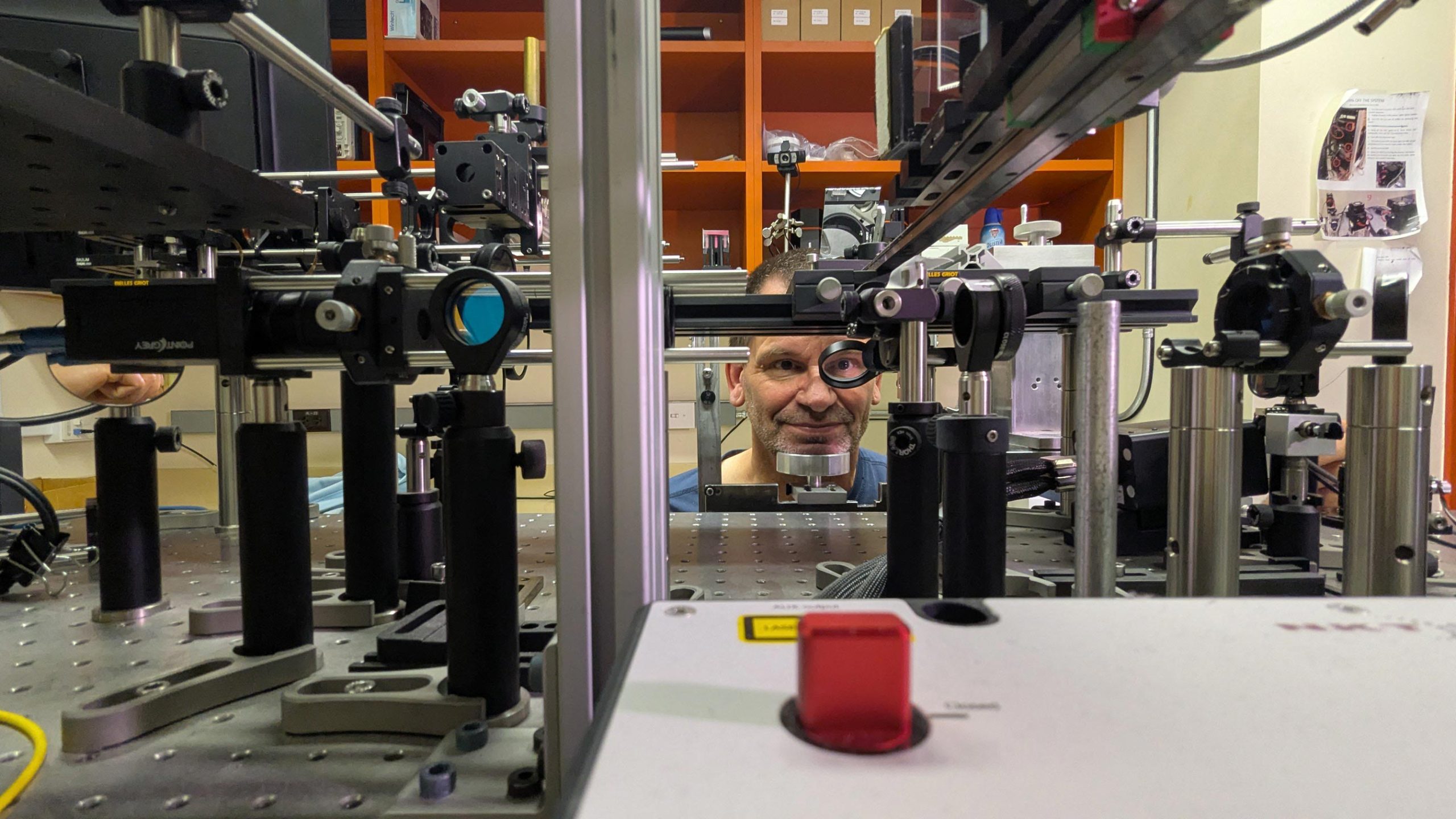
With an individual’s cone map in hand, the Oz system can be programmed to rapidly scan a laser beam over a small patch of the retina, delivering tiny pulses of energy when the beam reaches a cone that it wants to activate, and otherwise staying off.
The laser beam is just one color — the same hue as a green laser pointer — but by activating a combination of S, M and L cone cells, it can trick the eye into seeing images in full technicolor. Or, by primarily activating the M cone cells, Oz can show people the color olo.
“If you look at your index fingernail at arm’s length, that’s about the size of the display,” said Roorda. “But if we could, we would have filled the entire visual space like an IMAX.”
The ‘wow’ experience
Hannah Doyle, a doctoral student in EECS and co-lead author of the paper, designed and ran the human experiments with Oz. Five human subjects got the chance to see the color olo, including Roorda and Ng, who were aware of the purpose of the study, but not the specifics of what they would see.
In one experiment, Doyle asked the participants to compare olo to other colors. They described it as blue-green or peacock green, and reported that it was much more saturated than the nearest monochromatic color.
“The most saturated colors you can experience in nature are the monochromatic ones. Light from a green laser pointer is one example,” Roorda said. “When I pinned olo up against other monochromatic light, I really had that ‘wow’ experience.”
Doyle also tried “jittering” the Oz laser, directing it ever-so-slightly off target so the light pulses hit random cones rather than only M cones. The participants immediately stopped seeing olo and started seeing the regular green of the laser.
“I wasn’t a subject for this paper, but I’ve seen olo since, and it’s very striking. You know you’re looking at something very blue-green,” Doyle said. “When the laser gets jittered, the normal color of the laser almost looks like yellow because the difference is so stark.”
Probing the nature of color vision
Oz isn’t just useful for projecting tiny movies into the eye. The research team is already finding ways to use the technique to study eye disease and vision loss.
“Many diseases that cause visual impairment involve lost cone cells,” Doyle said. “One application that I’m exploring now is to use this cone by cone activation to simulate cone loss in healthy subjects.”
They are also exploring whether Oz could help people with color blindness to see all the colors of the rainbow, or if the technique could be used to allow humans to see in tetrachromatic color, as if they had four sets of cone cells.
It may also help answer more fundamental questions about how the brain makes sense of the complex world around us.
“We found that we can recreate a normal visual experience just by manipulating the cells — not by casting an image, but just by stimulating the photoreceptors. And we found that we can also expand that visual experience, which we did with olo,” Roorda said. “It’s still a mystery whether, if you expand the signals or generate new sensory inputs, will the brain be able to make sense of them and appreciate them? And, you know, I like to believe that it can. I think that the human brain is this really remarkable organ that does a great job of making sense of inputs, existing or even new.”
Reference: “Novel color via stimulation of individual photoreceptors at population scale” by James Fong, Hannah K. Doyle, Congli Wang, Alexandra E. Boehm, Sofie R. Herbeck, Vimal Prabhu Pandiyan, Brian P. Schmidt, Pavan Tiruveedhula, John E. Vanston, William S. Tuten, Ramkumar Sabesan, Austin Roorda and Ren Ng, 18 April 2025, Science Advances.
DOI: 10.1126/sciadv.adu1052
Additional authors of the study include Congli Wang, Alexandra E. Boehm, Sophie R. Herbeck, Brian P. Schmidt, Pavan Tiruveedhula, John E. Vanston and William S. Tuten of UC Berkeley. This work was supported by a Hellman Fellowship, FHL Vive Center Seed Grant, Air Force Office of Scientific Research grants (FA9550-20-1-0195, FA9550-21-1-0230), National Institutes of Health grant (R01EY023591, R01EY029710, U01EY032055) and a Burroughs Wellcome Fund Career Award at the Scientific Interface.
Never miss a breakthrough: Join the SciTechDaily newsletter.
Follow us on Google and Google News.
15 Comments
Spoiler alert; you have seen aquablue before
The only thing spoiled is your inability to comprehend the article.
If you “spoil” the “inability”… doesn’t it become “ability”?
I feel like this is another case of the media obfuscating actual science for clickbait. Olo is not a “new” color it’s a previously indistinguishable hue of a colour that literally everyone has seen before.
The same thing happens when tetrachromics see blue.
U write an article about a color nit seen by humans yet..u don’t show it here in the study..???.even w ur tricky dicky lazerr..photos can be tkn….wow I learned Alot today..I can’t see a color I like?? Mmmm
Am I hired for the study??
It’s largely explained in the article – there’s too much crossover in natural light between cone cells to see these colors naturally. It mechanically can’t be replicated on a phone screen, which itself is limited in terms of what colors it can present in the first place.
This is literally something that requires direct stimulation of your cone cells to experience, as is explained in the article.
Actually, I want to confirm what I read here: When I received the spirit of a deceased young Russian woman (I’m an American guy myself), a certain color blue-green, like turquoise or aquamarine, just like what you describe. This is a real thing. My eyes or sensory system would see this most penetrating, amplified color just like your article. I suppose, reading this stimulating piece, that what was happening was my spiritual experience somehow heightened the M cone cells and the receptor system that registers that color. I was quite stunned by the visual sensation’s intensity, purity, and beauty. That experience lasted for several months (in late 1999) following my interesting psychic encounter. People thought I might have taken some drug, but I never did. Anyway, later on the focus shifted to magenta, like the saturating color of azaleas.
Nah bro, you cant just drop that bombshell in the beginning of your comment and not explain. I’ll wait….
nuh uh
Don’t forget, people with Tetrachromacy can just naturally see this due to a quirk in how certain wavelengths of light are interpreted by the brain. As someone with the condition and who experienced this test somewhat recently due to a chart mixup, it’s identical
When you say “does not appear in nature” is that including prisms? If you hold a CD or a crystal up to sunlight, you can see a vivid spectrum which includes extremely saturated cyans and greens. Mathematically this new color should be somewhere in there.
I may be stupid but I really don’t understand this 😭shouldn’t it be visible because it’s wavelength is right for us to see? It’s a greeny-blue, right, so it can’t be past infrared or ultraviolet, so I don’t understand why it isn’t visible to us. And the people who had the Oz lazer thing in their eyes, how were they able to realise that it was a different colour that they hadn’t seen? People see a lot of colours, and since it’s obviously between infrared and ultraviolet, I feel like they should have seen it somehow, or at least whatever the normal colour they can see normally is. I’m not trying to disagree with anyone here, I’m genuinely interested, I know I don’t have the best knowledge of this sort of stuff but I figured I could learn.
Wavelength and ‘qualia’, how you experience the wavelength, are two different things.
They are not talking about blue-green wavelengths, they are talking about blue-green qualia, which is triggered by receptors in your eye. They artificially stimulated the receptors in a way that no natural wavelength would do.
Pointing a laser beam straight into your eye cannot be healthy.
XD- Yeah this is written by the university of course they say its game changing