

Live human brain slices show that only a razor‑thin balance of amyloid beta keeps synapses safe. Any disruption, even slight, can rapidly trigger Alzheimer’s-like damage.
For the first time, researchers have shown using living human brain tissue how a toxic variant of a protein associated with Alzheimer’s disease can attach to and damage the connections between brain cells.
The study used small samples of healthy brain tissue obtained during routine neurosurgical procedures. These samples were exposed to amyloid beta, a protein linked to the development of Alzheimer’s.
Unlike the response to the normal form of amyloid beta, the brain tissue did not attempt to repair the damage caused by the toxic version.
The study also found that even small changes in the natural levels of amyloid beta, either increasing or decreasing, were enough to disrupt brain cells. This suggests the brain requires a finely tuned ‘sweet spot’ of the protein to function properly, experts say.
Researchers at the University of Edinburgh hope the discoveries will allow them to hone in on drugs that have the best chance of preventing the loss of synapses – connections which allow the flow of messages between brain cells and are vital to healthy brain function.
Alzheimer’s disease attacks synapses, and their loss strongly predicts reduced memory and thinking abilities.
Keeping Human Brain Tissue Alive in the Lab
Central to the early success of the Dyson RAD Dementia Research Acceleration Project has been the pioneering method that keeps tiny fragments of human brain alive in laboratory dishes for several weeks after collection, with the patient’s permission.
This innovative approach offers a rare and powerful opportunity to investigate the early stages of Alzheimer’s disease in living human brain cells.
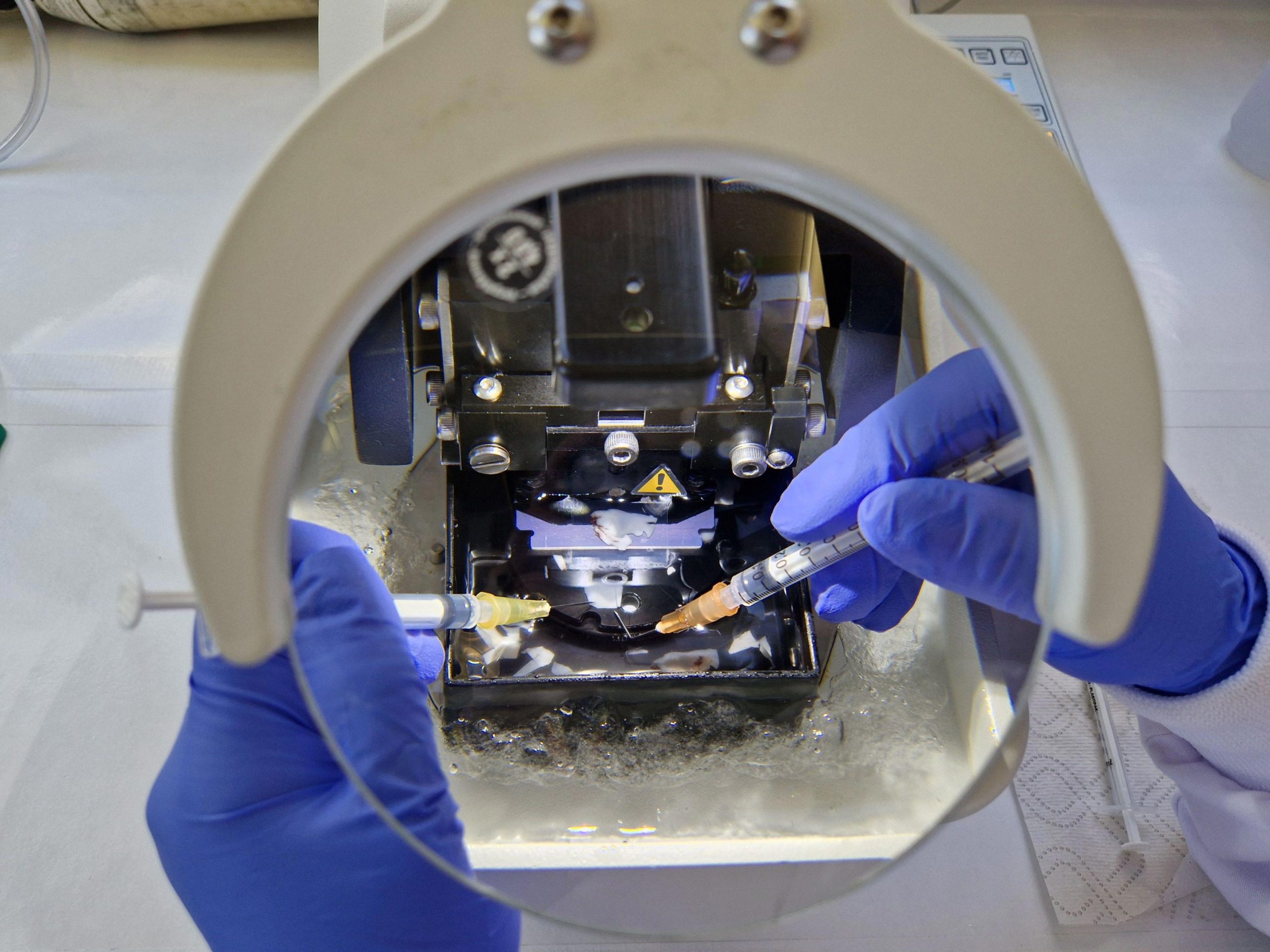
Researchers also discovered that brain slices taken from the temporal lobe, a region known to be affected early in Alzheimer’s, released higher levels of another key disease protein, called tau. This may help explain why this part of the brain is particularly vulnerable in the early stages of the condition, as increased tau release may enable faster spread of toxic forms of this protein between cells.
In addition, a number of the samples were found to contain early indicators of Alzheimer’s, such as amyloid plaques and tau tangles, demonstrating the potential of this model to study the disease before symptoms appear.
Accelerating Drug Discovery
Experts say this innovative approach will make it easier to test experimental drugs before they enter clinical trials, increasing the chance of finding drugs that work in the human brain.
The study is published in Nature Communications and was supported by a fellowship from Race Against Dementia (RAD) – a charity formed by Sir Jackie Stewart following his wife’s dementia diagnosis – and a £1 million donation from the James Dyson Foundation – Sir James Dyson’s charity that supports medical research and engineering education. The donation helped employ two scientists, secure time from research nurses, and obtain the cutting-edge laboratory equipment needed for working with living human brain tissue.
The project links experts from Formula One and Dyson with early-career researchers to accelerate progress towards a cure for dementia. It marries best practice from these fast-paced, innovative industries with novel scientific techniques to investigate the biology of human brain tissue.
Dr Claire Durrant, RAD Dyson Fellow and UK Dementia Research Institute Emerging Leader at the Centre for Discovery Brain Sciences at the University of Edinburgh, said: “Working alongside the neurosurgical team at the University of Edinburgh, we have shown that living human brain slices can be used to explore fundamental questions relating to Alzheimer’s disease. We believe this tool could help accelerate findings from the lab into patients, bringing us one step closer to a world free from the heartbreak of dementia.
“These findings are a testament to the incredible support of my funders and the hard work of my team members Dr Robert McGeachan and Dr Soraya Meftah who led on the experiments.”
Voices from the Frontlines of Dementia Research
Sir Jackie Stewart OBE, founder of Race Against Dementia, which has supported Dr Durrant’s laboratory since 2019, said: “It’s a horrendous reality that as things stand, one in three people born today, will die with dementia. Someone develops dementia every three seconds – and we still don’t have a cure. I created Race Against Dementia to challenge this awful disease in the fullest sense. Our collaboration across industries allows us to think keener and faster and the breakthrough that we have achieved shows what is possible when science moves faster, with new tools and fresh thinking. Our unique program is enabling us to test potential treatments which are bringing us closer to a world without dementia. I am sure that for you, like me, that cannot happen soon enough.”
James Dyson, Founder of Dyson, said: “I’ve been delighted to support Dr Durrant’s novel approach. Working with brain surgeons and their consenting patients nationwide to collect samples of living human brain and keep them alive in the lab is a groundbreaking method. It allows researchers to better examine Alzheimer’s disease on real human brain cells rather than relying on animal substitutes, such as mice. Dr Durrant’s findings show that she is progressing towards solving one of the most devastating problems of our time.”
Professor Tara Spires-Jones, Group Leader at the UK Dementia Research Institute at the University of Edinburgh, said: “This important work by Dr Durrant’s team brings a new tool to scientists’ toolbox to better understand Alzheimer’s disease and how to treat it. The use of living human tissue samples generously donated by people undergoing surgery to remove brain tumours allows scientists to probe how living human brain reacts to toxic proteins produced in Alzheimer’s, and in the future will allow testing of whether new treatments are effective in human brain. This cutting-edge study is an example of how the UK Dementia Research Institute is at the forefront of global efforts to understand and treat Alzheimer’s.”
Reference: “Divergent actions of physiological and pathological amyloid-β on synapses in live human brain slice cultures” by Robert I. McGeachan, Soraya Meftah, Lewis W. Taylor, James H. Catterson, Danilo Negro, Calum Bonthron, Kristján Holt, Jane Tulloch, Jamie L. Rose, Francesco Gobbo, Ya Yin Chang, Jamie Elliott, Lauren McLay, Declan King, Imran Liaquat, Tara L. Spires-Jones, Sam A. Booker, Paul M. Brennan and Claire S. Durrant, 30 April 2025, Nature Communications.
DOI: 10.1038/s41467-025-58879-z
The study was funded by the James Dyson Foundation.
Never miss a breakthrough: Join the SciTechDaily newsletter.
Follow us on Google and Google News.