
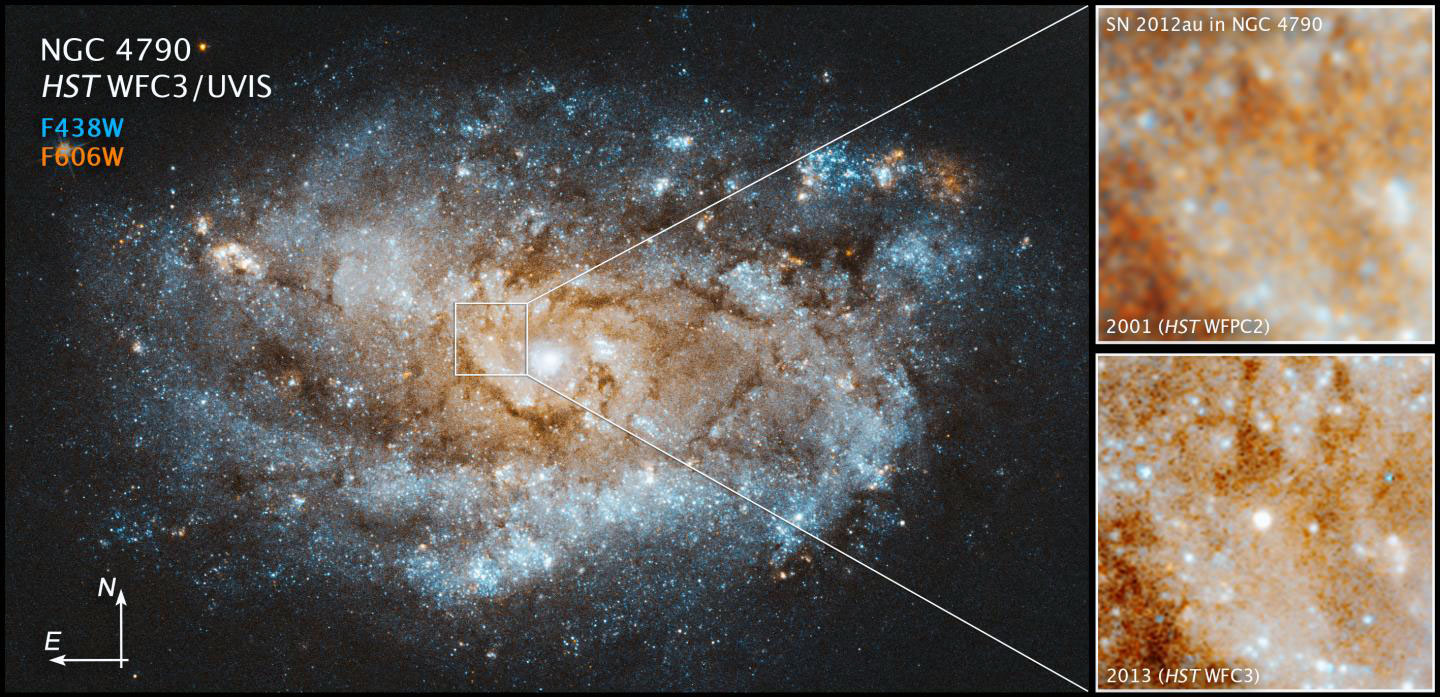
The explosions of stars, known as supernovae, can be so bright they outshine their host galaxies. They take months or years to fade away, and sometimes, the gaseous remains of the explosion slam into hydrogen-rich gas and temporarily get bright again — but could they remain luminous without any outside interference?
That’s what Dan Milisavljevic, an assistant professor of physics and astronomy at Purdue University, believes he saw six years after “SN 2012au” exploded.
“We haven’t seen an explosion of this type, at such a late timescale, remain visible unless it had some kind of interaction with hydrogen gas left behind by the star prior to the explosion,” he said. “But there’s no spectral spike of hydrogen in the data — something else was energizing this thing.”
As large stars explode, their interiors collapse down to a point at which all their particles become neutrons. If the resulting neutron star has a magnetic field and rotates fast enough, it may develop into a pulsar wind nebula.
This is most likely what happened to SN 2012au, according to findings published in the Astrophysical Journal Letters.
“We know that supernova explosions produce these types of rapidly rotating neutron stars, but we never saw direct evidence of it at this unique time frame,” Milisavljevic said. “This a key moment when the pulsar wind nebula is bright enough to act like a lightbulb illuminating the explosion’s outer ejecta.”
SN 2012au was already known to be extraordinary — and weird — in many ways. Although the explosion wasn’t bright enough to be termed a “superluminous” supernova, it was extremely energetic and long-lasting, and dimmed in a similarly slow light curve.
Milisavljevic predicts that if researchers continue to monitor the sites of extremely bright supernovae, they might see similar transformations.
“If there truly is a pulsar or magnetar wind nebula at the center of the exploded star, it could push from the inside out and even accelerate the gas,” he said. “If we return to some of these events a few years later and take careful measurements, we might observe the oxygen-rich gas racing away from the explosion even faster.”
Superluminous supernovae are a hot topic in transient astronomy. They’re potential sources of gravitational waves and black holes, and astronomers think they might be related to other kinds of explosions, like gamma-ray bursts and fast radio bursts. Researchers want to understand the fundamental physics behind them, but they’re difficult to observe because they’re relatively rare and happen so far from Earth.
Only the next generation of telescopes, which astronomers have dubbed “Extremely Large Telescopes,” will have the ability to observe these events in such detail.
“This is a fundamental process in the universe. We wouldn’t be here unless this was happening,” Milisavljevic said. “Many of the elements essential to life come from supernova explosions — calcium in our bones, oxygen we breathe, iron in our blood — I think it’s crucial for us, as citizens of the universe, to understand this process.”
Reference: “Results from a Systematic Survey of X-Ray Emission from Hydrogen-poor Superluminous SNe” by R. Margutti, R. Chornock, B. D. Metzger, D. L. Coppejans, C. Guidorzi, G. Migliori, D. Milisavljevic, E. Berger, M. Nicholl, B. A. Zauderer, R. Lunnan, A. Kamble, M. Drout and M. Modjaz, 29 August 2018, The Astrophysical Journal.
DOI: 10.3847/1538-4357/aad2df
Never miss a breakthrough: Join the SciTechDaily newsletter.
Follow us on Google and Google News.