

In a breakthrough with promising real-world applications, a team of Rutgers biophysicists, bioengineers, and plant biologists has captured the first live images.
In a groundbreaking study, researchers at Rutgers University-New Brunswick have captured continuous, 24-hour images of cellulose synthesis, the process by which plant cell walls are built, using living plant cells. This marks the first time the dynamic process of cell-wall construction has been observed in real time, offering critical insights that could lead to the development of more resilient crops, enhanced food production, and lower-cost biofuels.
Published in the journal Science Advances, the study reveals cellular activity never before documented and opens new possibilities for practical applications in areas such as advanced textiles, biodegradable plastics, improved biofuels, and medical innovations. According to the researchers, the findings also deepen fundamental understanding of how plant cell walls are formed.
The discovery is the result of more than six years of interdisciplinary collaboration among three Rutgers University laboratories, drawing on expertise from the School of Arts and Sciences, the School of Engineering, and the School of Environmental and Biological Sciences.
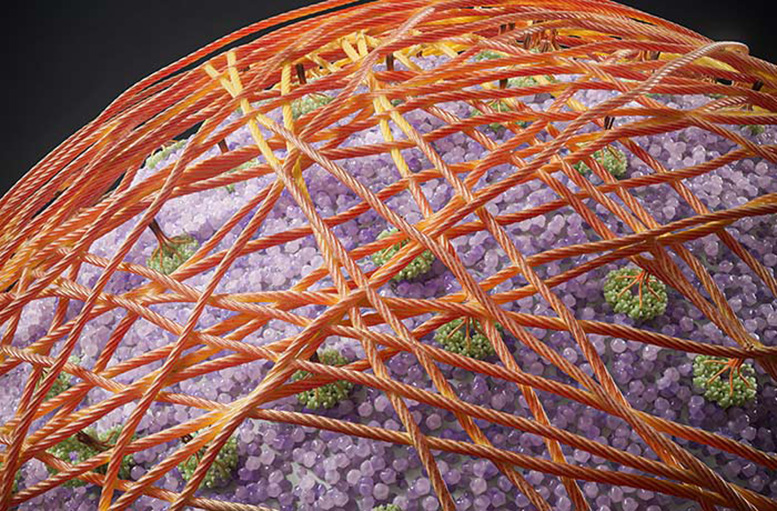
“This work is the first direct visualization of how cellulose synthesizes and self-assembles into a dense fibril network on a plant cell surface, since Robert Hook’s first microscopic observation of cell walls in 1667,” said Sang-Hyuk Lee, an associate professor in the Department of Physics and Astronomy and an author of the study. “This study also provides entirely new insights into how simple, basic physical mechanisms such as diffusion and self-organization may lead to the formation of complex cellulose networks in cells.”
Watching Cellulose Build Itself
The microscope-generated video images show protoplasts – cells with their walls removed – of cabbage’s cousin, the flowering plant Arabidopsis, chaotically sprouting filaments of cellulose fibers that gradually self-assemble into a complex network on the outer cell surface.
“I was very surprised by the emergence of ordered structures out of the chaotic dance of molecules when I first saw these video images,” said Lee, who also is a faculty member at the Institute for Quantitative Biomedicine. “I thought plant cellulose would be made in a lot more of an organized fashion, as depicted in classical biology textbooks.”
A time-lapse video showing Arabidopsis cells generate cellulose fibrils. Credit: Lee Lab/Rutgers University
Cellulose is the most abundant biopolymer – large molecules naturally produced by living organisms – on Earth. A carbohydrate that is the primary structural component of plant cell walls, cellulose is widely used in industry to make a range of products, including paper and clothing. It also is used in filtration, trapping large particles more effectively and enhancing flow, and as a thickening agent in foods such as yogurt and ice cream.
“This discovery opens the door for researchers to begin dissecting the genes that could play various roles for cellulose biosynthesis in the plant,” said Eric Lam, a Distinguished Professor in the Department of Plant Biology in Rutgers School of Environmental and Biological Sciences and an author on the study. “The knowledge gained from these future studies will provide new clues for approaches to design better plants for carbon capture, improve tolerance to all kinds of environmental stresses, from drought to disease, and optimize second-generation cellulosic biofuels production.”
A Personal Dream Realized
The work is the culmination of a childhood dream for Shishir Chundawat, an associate professor in the Department of Chemical and Biochemical Engineering in the Rutgers School of Engineering and an author on the study.
“I have always been fascinated by plants and how they capture sunlight via leaves into reduced carbon forms like cellulose that form cell walls,” Chundawat said, who plans to explore new ways to produce new, sustainable biofuels and biochemicals from diverse feedstocks like terrestrial plants and marine algae. “I remember back in middle school when I had collected many leaves of different shapes, sizes, and colors for a science class report, and being very curious about how plants produce all this myriad complexity and diversity in nature. I was inspired by that experience to delve deeper into the fundamental phenomena of biomass production and its utilization using sustainable engineering to produce valuable bioproducts for societal benefit.”
Animations for young students inspired to learn more about plants are available, however, the Rutgers study shows that the process of cellulose synthesis and cell wall formation is much more complex. Credit: Rutgers University
Scientists from each of the three research teams made unique and critical contributions.
When conventional lab microscopes wouldn’t do, providing at best blurry images of the cell wall-building process, the team turned to an advanced super-resolution and minimally invasive technique called total internal reflection fluorescence microscopy. The approach, which captured images only of the underside surface of cells, was sensitive enough to take videos for 24 hours without bleaching and destroying the cells.
Lee, a biophysicist and an expert on using cutting-edge microscopy techniques to study living systems, developed a custom microscope for the project and oversaw the imaging efforts.
Chundawat led a team that pioneered a technique allowing the scientists to tag the emerging cellulose tendrils with fluorescent protein dye.
Chundawat is a bioengineer and expert on protein engineering and glycosciences, the study of complex carbohydrates such as cellulose. To make the cells fluorescent and detectable by the microscope, he and his team developed a probe derived from an engineered bacterial enzyme that binds specifically to cellulose.
Lam, an expert on plant genetics and biotechnology, and his team found a way to remove the cell wall of individual cells of Arabidopsis to create a “blank slate” for new cell walls to be laid down by protoplast cells.
“This provided little to no background cellulose to confound our visualization and tracking of newly synthesized cellulose under optimized conditions,” Lam said.
Reference: “Time-resolved tracking of cellulose biosynthesis and assembly during cell wall regeneration in live Arabidopsis protoplasts” by Hyun Huh, Dharanidaran Jayachandran, Junhong Sun, Mohammad Irfan, Eric Lam, Shishir P. S. Chundawat and Sang-Hyuk Lee, 21 March 2025, Science Advances.
DOI: 10.1126/sciadv.ads6312
Other Rutgers scientists on the study included: Hyun Huh, a postdoctoral scientist with the Institute for Quantitative Biomedicine; Dharanidaran Jayachandran, a doctoral student, and Mohammad Irfan, a postdoctoral scientist in the Department of Chemical and Biochemical Engineering; and Junhong Sun, a lab technician in the Department of Plant Biology.
Funding: U.S. Department of Energy, U.S. National Science Foundation
Never miss a breakthrough: Join the SciTechDaily newsletter.
Follow us on Google and Google News.
6 Comments
thank you
Thank you 👍
Sigma
Oh, cellulose, where do I begin? The moment I saw you, I knew I would enjoy learning this. Thank you, this video is so inspirational.
thank you
I’m very happy to this website