
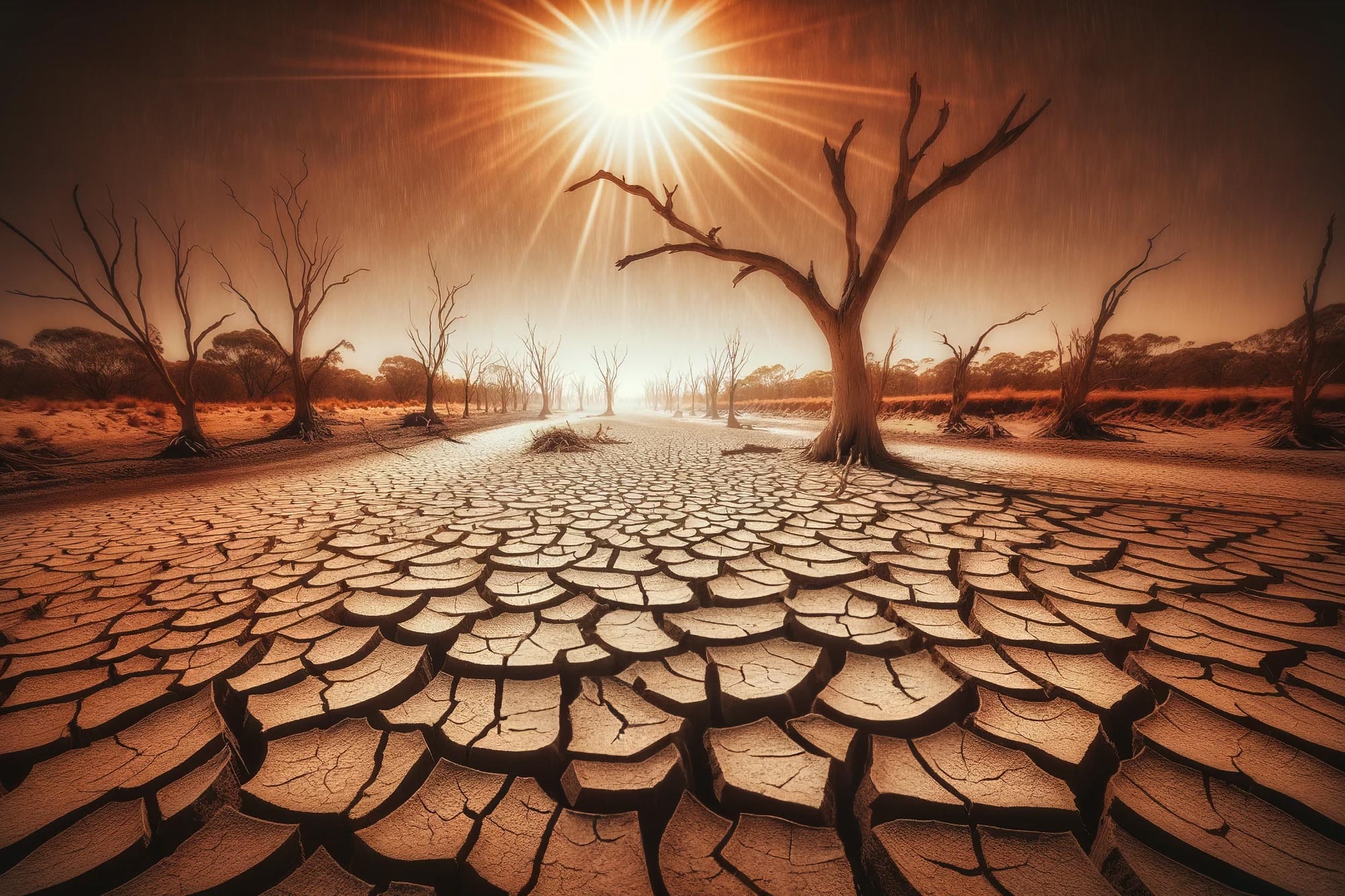
New modeling predicts Australia may experience megadroughts lasting 20 years or more, exacerbated by climate change, posing severe risks to the environment and agriculture.
Australia could soon see megadroughts that last for more than 20 years, according to new modeling from The Australian National University (ANU) and the ARC Centre of Excellence for Climate Extremes.
The researchers’ bleak findings are before factoring in human impact on the climate since the Industrial Revolution. The ANU-led team also found that 20th-century droughts in southwestern and eastern Australia, including the Murray-Darling Basin, were longer on average compared to pre-industrial times.
The Alarming Future of Australian Droughts
According to the scientists, the findings paint a worrying picture of future droughts in Australia that are far worse than anything in recent experience.
Megadroughts are exceptionally severe, long-lasting, and widespread. They can last multiple decades or even centuries. An example of this is the megadrought in the United States’ southwestern region that started in the year 2000 and has continued for more than two decades.
Co-lead author Dr. Georgy Falster, from the ANU Research School of Earth Sciences, said that if a megadrought occurred in Australia today, the consequences would be made even worse because of climate change, as any drought would occur against a backdrop of hotter weather.
Climate Change and Its Role in Drought Severity
“The combination of climate change on top of naturally occurring megadroughts that could last for 20 years means that in the future Australia could see droughts that are worse than anything in recent historical experience,” Dr. Falster said.
“We must consider, and prepare for, the possibility that one of these multi-decade megadroughts could occur in the near future.
“One of the problems with understanding protracted droughts in Australia is that our climate observations since the 1900s give us only a handful of examples to work with. This isn’t representative of the worst-case scenarios that are possible just through natural climate variations.
“Thinking about when we might expect to see a 20-year-long drought in the Murray-Darling Basin in southeastern Australia, this varies a lot. We could see a megadrought occur every 150 years or 1,000 years.
“In this study, we paid particular attention to the Murray-Darling Basin. As the largest agricultural region of Australia, it’s important to know how bad droughts in this region could be.”
The ANU-led team looked at the full spectrum of droughts Australia could experience, including length and intensity, even without the effects of climate change. They also wanted to find out how human-caused climate change is now altering the characteristics of Australian droughts.
Droughts and Climate Change: A Risky Combination
The researchers used multiple climate models to simulate droughts that occurred during the past millennium – from the year 850 to 2000 – to determine how they might change in the future.
This includes predicting how long Australian droughts could last for, and how dry they could be.
“One of the confronting findings of our work is that it is possible for droughts in Australia to be much longer than any of the droughts that we’ve experienced in recent times. Droughts that continue for 20 years or more are something that we should expect to happen,” Dr. Falster said.
“Megadroughts are part of the natural variations in Australia’s climate. But worryingly we are now also adding human-caused climate change into the mix, and that is probably increasing the chances of the next megadrought here.
“We compared simulated droughts in the 20th century, from the year 1900 to 2000, with those from the pre-industrial period, before the year 1850, to see if human-caused climate change has impacted how Australians experience droughts today.”
Co-author Professor Nerilie Abram, also from ANU, said human-caused climate change is contributing to longer droughts in southwestern and eastern Australia, including the Murray-Darling Basin.
She said these are also the regions where we can expect future rainfall declines due to climate change, thereby increasing the risk of droughts.
“It is likely that changes to drought intensity could still arise as climate change continues to worsen,” Professor Abram said.
“One example of this is the 21st century ‘Tinderbox Drought’, which was only three years long but was exceptionally intense and set the conditions for the Black Summer bushfires. The Tinderbox Drought was likely made more severe by climate change.
“The only thing we can do to lessen the potential severity and length of future droughts is to rapidly reduce greenhouse gas emissions. For example, by rapidly transitioning to renewable energy sources.
“We can also reduce the impacts of future droughts by being prepared with water storage and management plans, and community support networks.”
The research is published in a special edition of the journal Hydrology and Earth System Sciences.
Reference: “Potential for historically unprecedented Australian droughts from natural variability and climate change” by Georgina M. Falster, Nicky M. Wright, Nerilie J. Abram, Anna M. Ukkola and Benjamin J. Henley, 27 March 2024, Hydrology and Earth System Sciences.
DOI: 10.5194/hess-28-1383-2024
This work was co-led by ANU and The University of Sydney in collaboration with the University of New South Wales (UNSW), the University of Wollongong and the University of Monash.
Never miss a breakthrough: Join the SciTechDaily newsletter.
Follow us on Google and Google News.
3 Comments
“An example of this is the megadrought in the United States’ southwestern region that started in the year 2000 and has continued for more than two decades.”
Two decades is hardly enough time to judge whether the recent drought is comparable to the drought of 1300 CE that probably disrupted the ancestral Pueblo culture.
All of the General Circulation Models have a history of running warm compared to actual temperature measurements. However, they do an even worse job of predicting precipitation at the regional level, sometimes even being contradictory. Why should we believe this new model?
“… the consequences would be made even worse because of climate change, as any drought would occur against a backdrop of hotter weather.”
Maybe things are different on the bottom of the world — upside down as it were — but there is general agreement that of the approximately 1 deg C increase in global average temperature, most of it has been at night and in the Winter. I hope that their new model isn’t similarly inverted.