
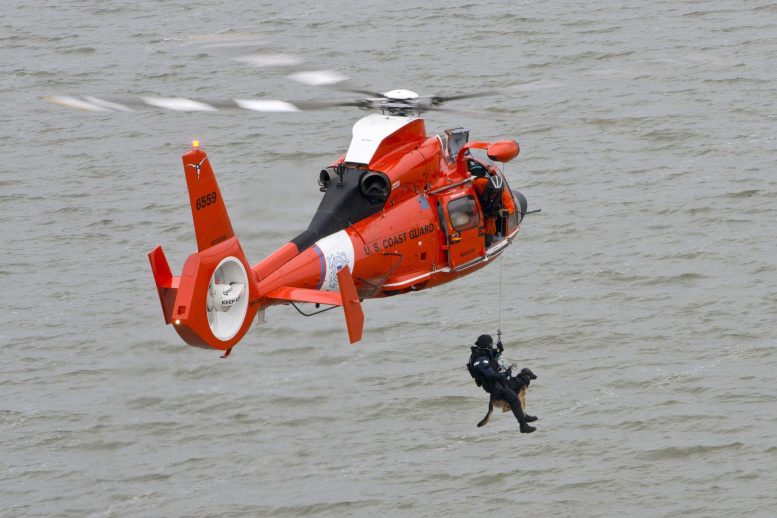
An international research collaboration led by ETH Zurich and MIT has developed a mathematical method that can speed up search and rescue operations at sea. The new algorithm accurately predicts locations to which objects and people floating in water will drift.
Hundreds of people die at sea every year due to vessel and airplane accidents. Emergency teams have little time to rescue those in the water because the probability of finding a person alive plummets after six hours. Beyond tides and challenging weather conditions, unsteady coastal currents often make search and rescue operations exceedingly difficult.
New insight into coastal flows gleaned by an international research team led by George Haller, Professor of Nonlinear Dynamics at ETH Zurich, promises to enhance the search and rescue techniques currently in use. Using tools from dynamical systems theory and ocean data, the team has developed an algorithm to predict where objects and people floating in water will drift. “Our work has a clear potential to save lives,” says Mattia Serra, a former Ph.D. student at ETH and now a postdoctoral fellow at Harvard, who is the first author of a study recently published in Nature Communications.
Hidden traps lead to missing persons
In today’s rescue operations at sea, elaborate models of ocean dynamics and weather forecasting are used to predict the path of drifting objects. For fast-changing coastal waters, however, such predictions are often inaccurate due to uncertain parameters and missing data. As a result, a search may be launched in the wrong location, causing a loss of precious time.
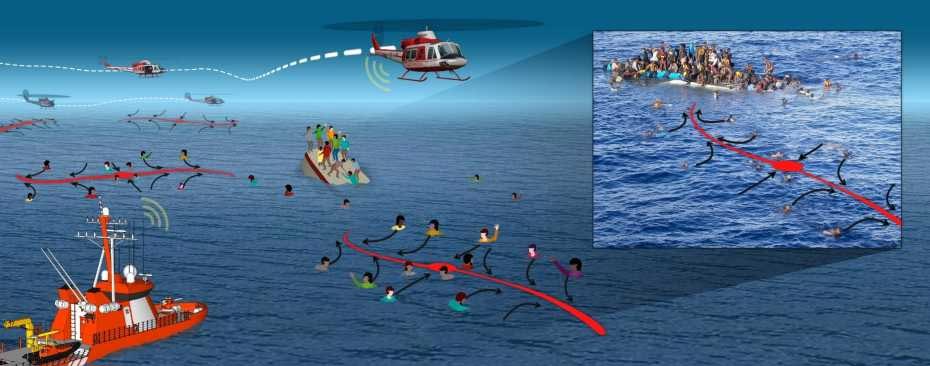
Haller’s research team obtained mathematical results predicting that objects floating on the ocean’s surface should congregate along a few special curves which they call TRansient Attracting Profiles (TRAPs). These curves are invisible to the naked eye but can be extracted and tracked from instantaneous ocean surface current data using recent mathematical methods developed by the ETH team. This enables quick and precise planning of search paths that are less sensitive to uncertainties in the time and place of the accident.
A new tool for rescuers
In collaboration with a team of MIT’s Department of Mechanical Engineering, a group of the Woods Hole Oceanographic Institution and the US Coast Guard, the ETH team tested their new, TRAP-based search algorithm in two separate ocean experiments near Martha’s Vineyard near the northeastern coast of the United States. Working from the same real-time data available to the Coast Guard, the team successfully identified TRAPs in the region in real time. They found that buoys and manikins thrown in the water indeed quickly gathered along these evolving curves. “Of several competing approaches tested in this project, this was the only algorithm that consistently worked in situ,” says Haller.
“Our results are rapidly obtained, easy to interpret, and cheap to implement,” points out Serra. He adds that the method they have developed also has the potential to predict the evolution of oil spills. The next plan of the research group is to test their new prediction tool in other ocean regions as well. As Haller stresses: “Our hope is that this method will become a standard part of the toolkit of coast guards everywhere.”
Read New MIT Search-and-Rescue Algorithm Identifies Hidden “Traps” in Ocean Waters for more on this research.
Reference: “Search and rescue at sea aided by hidden flow structures” by Mattia Serra, Pratik Sathe, Irina Rypina, Anthony Kirincich, Shane D. Ross, Pierre Lermusiaux, Arthur Allen, Thomas Peacock and George Haller, 26 May 2020, Nature Communications.
DOI: 10.1038/s41467-020-16281-x
Never miss a breakthrough: Join the SciTechDaily newsletter.
Follow us on Google and Google News.