
Close Menu
    Facebook X (Twitter) Instagram
    SciTechDaily
    • Biology
    • Chemistry
    • Earth
    • Health
    • Physics
    • Science
    • Space
    • Technology
    Facebook X (Twitter) Pinterest YouTube RSS
    SciTechDaily
    Home»Biology»Sharks Follow This Universal Math Rule, Confirming a Century-Old Law of Biology
    Biology

    Sharks Follow This Universal Math Rule, Confirming a Century-Old Law of Biology

    By Rohan O'Neil, James Cook UniversityJune 27, 2025No Comments3 Mins Read
    Facebook Twitter Pinterest Telegram LinkedIn WhatsApp Email Reddit
    Share
    Facebook Twitter LinkedIn Pinterest Telegram Email Reddit
    Smiling Great White Shark Close
    A new study using 3D scans of sharks has confirmed that their body shape follows a long-theorized biological rule, the ‘two-thirds scaling law,’ with remarkable precision. Credit: Stock

    A new study has confirmed that sharks follow established patterns when it comes to body size, and this finding could change how scientists understand biological trends throughout the animal kingdom.

    For over a hundred years, scientists have used a theory that describes how an animal’s surface area and volume change with size.

    Now, researchers from James Cook University (JCU) and the University of Massachusetts have confirmed this theory in sharks, using advanced 3D modeling to study one of the ocean’s most iconic predators.

    “We found that sharks follow what’s known as the ‘two-thirds scaling law’ almost perfectly,” said Joel Gayford, JCU PhD candidate and lead author on the study.

    “This law helps explain how animals exchange heat, energy, and oxygen with their environment – so confirming it in full-sized animals, not just cells, is a big deal.”

    3D scans reveal precise body measurements

    The team created detailed digital models of 54 shark species using high-resolution 3D scans developed in collaboration with computer graphics artist Johnson Martin.

    These scans gave researchers precise measurements of surface area and volume, providing valuable insights into how body shape affects physiology.

    “This ratio is fundamental,” said JCU Marine Biology Professor, Dr Jodie Rummer, a co-author on the study.

    “It underpins how animals breathe, regulate temperature, and process waste. And now, for the first time, we’ve shown it holds true in animals as complex and diverse as sharks.”

    Surface-to-volume ratios match predictions

    To rigorously test the rule, the team used phylogenetic regression — a statistical method that considers evolutionary relationships — and found that shark surface area is proportional to volume raised to the power of 0.64. That’s just 3% off the theoretical prediction of 0.67.
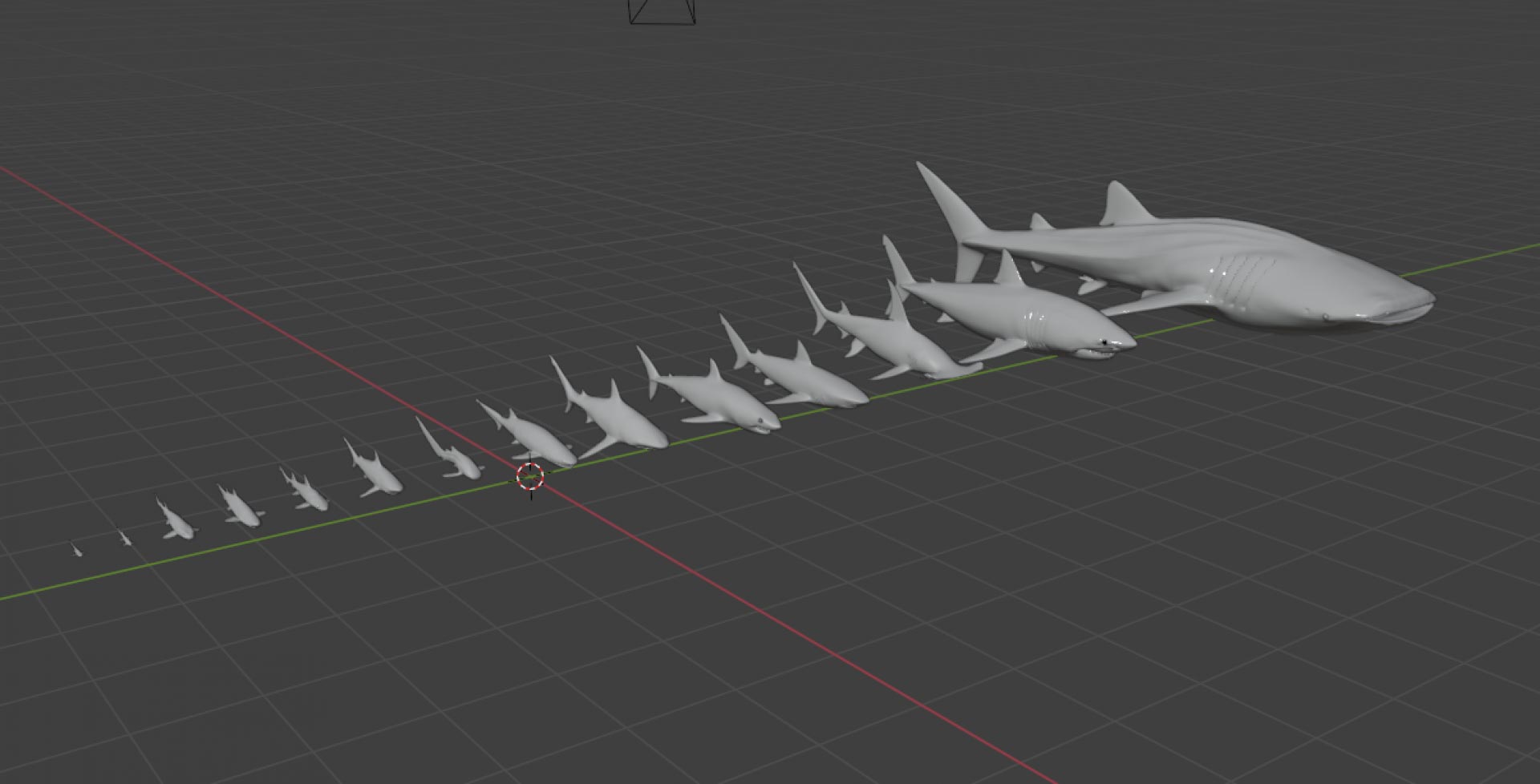
    3D Models of Shark Sizes Used To Test Scaling Law
    Cutting-edge 3D modeling has confirmed sharks follow the ‘two-thirds scaling law’ almost perfectly. Credit: James Cook University

    “It’s remarkable,” said Prof Rummer. “This suggests sharks have evolved to stick to this ratio, possibly because deviating from it is too costly or constrained by early development.”

    Evolutionary constraints on shark anatomy

    Indeed, the team believes evolutionary and developmental constraints could explain why sharks from vastly different habitats and lifestyles still obey the same scaling rule.

    “Changing the way tissue is distributed throughout the body might require major changes during early embryonic development – and that’s expensive, energetically speaking,” said Mr Gayford.

    Importantly, these findings have real-world applications.

    “Surface area-to-volume ratios are key inputs in equations used to model how animals respond to climate change, like how fast they regulate their body temperatures or how efficiently they use oxygen,” Mr Gayford said.

    “Now, we can use those equations with much greater confidence in sharks and other large animals.”

    The research highlights how modern imaging technology — and some very patient digital modeling — can answer age-old biological questions.

    Reference: “The geometry of life: testing the scaling of whole-organism surface area and volume using sharks” by Joel Harrison Gayford, Duncan J. Irschick, Johnson Martin, Andrew Chin and Jodie L. Rummer, 31 May 2025, Royal Society Open Science.
    DOI: 10.1098/rsos.242205

    Never miss a breakthrough: Join the SciTechDaily newsletter.
    Follow us on Google and Google News.

    Biomechanics Evolutionary Biology James Cook University Marine Biology Popular Sharks
    Share. Facebook Twitter Pinterest LinkedIn Email Reddit

    Related Articles

    Great Whites May Have Contributed to Extinction of Megalodon Sharks

    “Suction Thrust” – Many-Limbed Marine Organisms Don’t Actually Push Themselves Forward to Swim

    Prehistoric Shark Hid Its Largest, Sharpest Teeth

    Whale Shark Girls Overtake the Boys to Become World’s Largest Fish

    Unexpected Discovery of a 410-Million-Year-Old Fossil Forces Rethink of Shark Evolution

    Scientists Surprised When They Examine Stomach Contents of Great White Sharks and Find Out What They Really Eat

    Legacy of Cold War Nuclear Bomb Tests Solves Whale Shark Mystery

    Great White Shark Have a More Varied Diet Than Previously Thought

    Relationships of Male Dolphins from Shark Bay Determined by Slow Swimming

    Leave A Reply Cancel Reply

    • Facebook
    • Twitter
    • Pinterest
    • YouTube

    Don't Miss a Discovery

    Subscribe for the Latest in Science & Tech!

    Trending News

    Scientists Discover Cheap, Natural Remedy for High Blood Pressure

    Earth’s Upper Atmosphere Is Cooling Fast and Scientists Finally Know Why

    32,000 Olympic Pools of Magma Nearly Erupted Beneath Atlantic Island

    Exercise Changes the Heart in a Way Researchers Never Expected

    Too Much Sleep May Age Your Body Faster, New Study Warns

    Scientists Uncover Promising New Strategy To Stop Parkinson’s in Its Tracks

    Experts Reveal the Surprising Cancer Link Behind a Common Vitamin

    This Strange “Golden Orb” Found 2 Miles Deep Stumped Scientists for Years

    Follow SciTechDaily
    • Facebook
    • Twitter
    • YouTube
    • Pinterest
    • Newsletter
    • RSS
    SciTech News
    • Biology News
    • Chemistry News
    • Earth News
    • Health News
    • Physics News
    • Science News
    • Space News
    • Technology News
    Recent Posts
    • The Type of Alcohol You Drink Could Affect How Long You Live
    • 19-Year Study Reveals the Surprising Truth About Sitting and Dementia
    • This Common Vitamin May Help Stop Prediabetes From Turning Into Diabetes
    • Canada’s Billion-Year-Old Rocks Could Hold the Future of Clean Energy
    • Climate Change Is Quietly Choking Rivers Across the Planet
    Copyright © 1998 - 2026 SciTechDaily. All Rights Reserved.
    • Science News
    • About
    • Contact
    • Editorial Board
    • Privacy Policy
    • Terms of Use

    Type above and press Enter to search. Press Esc to cancel.