
Groundbreaking Link Between Alcohol and Facial Development
Through the utilization of cutting-edge artificial intelligence (AI) and deep learning technology, researchers have made a striking discovery linking alterations in the shape of children’s faces to the quantity of alcohol their mothers consumed, both prior to and during pregnancy.
Published today (February 16, 2023) in the journal Human Reproduction, one of the world’s leading reproductive medicine journals, the study is the first to detect this association in the children of mothers who drank alcohol up to three months before becoming pregnant but stopped during pregnancy. In addition, it found the association with altered face shape existed even if mothers drank less than 12g of alcohol a week – the equivalent of a small, 6-ounce (175 ml) glass of wine or 12 ounces (330 ml) of beer.
The finding is important because the shape of children’s faces can be an indication of health and developmental problems.
Gennady Roshchupkin, assistant professor and leader of the computational population biology group at Erasmus Medical Centre, Rotterdam, The Netherlands, who led the study, said: “I would call the face a ‘health mirror’ as it reflects the overall health of a child. A child’s exposure to alcohol before birth can have significant adverse effects on its health development and, if a mother regularly drinks a large amount, this can result in fetal alcohol spectrum disorder, FASD, which is reflected in children’s faces.”
FASD in Developmental and Cognitive Challenges
FASD is defined as a combination of growth retardation, neurological impairment, and recognizably abnormal facial development. Symptoms include cognitive impairment, attention deficit hyperactivity disorder (ADHD), learning difficulties, memory problems, behavioral problems, and speech and language delays. FASD is already known to be caused by a mother’s drinking during pregnancy, particularly heavy drinking. However, until now, little was known about the effect of low alcohol consumption on children’s facial development and, therefore, their health. This is also the first study to examine the question in children from multiple ethnic backgrounds.
The researchers used AI and deep learning to analyse three-dimensional images of children taken at the ages of nine (3149 children) and 13 (2477 children). The children were part of the Generation R Study in The Netherlands, an ongoing population-based study of pregnant women and their children from fetal life onwards. The children in this analysis were born between April 2009 and January 2006.
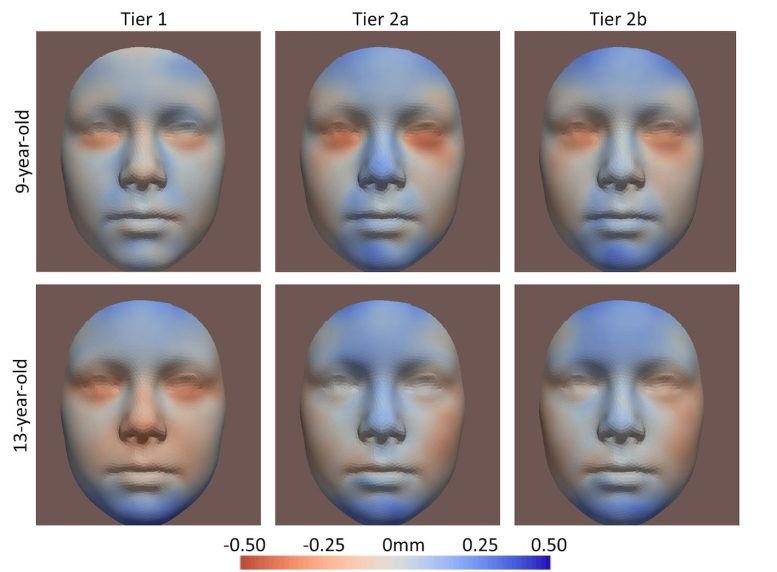
“The face is a complex shape and analyzing it is a challenging task. 3D imaging helps a lot, but requires more advanced algorithms to do this,” said Prof. Roshchupkin. “For this task, we developed an AI-based algorithm, which takes high-resolution 3D images of the face and produce 200 unique measurements or ‘traits’. We analyzed these to search for associations with prenatal alcohol exposure and we developed heat maps to display the particular facial features associated with the mothers’ alcohol consumption.”
Information on the mothers’ alcohol consumption was gained from questionnaires completed by the women in early, mid-, and late pregnancy. The researchers divided them into three groups: mothers who did not drink before or during pregnancy (the control group), mothers who drank during the three months before becoming pregnant but stopped when they became pregnant, and mothers who drank during pregnancy, including those who only drank during the first trimester of pregnancy, and those who continued to drink throughout pregnancy.
Prenatal Alcohol Exposure and Facial Alterations
“We found a statistically significant association between prenatal alcohol exposure and face shape in the nine-year-old children. The more alcohol the mothers drank, the more statistically significant changes there were. The most common traits were turned-up nose tip, shortened nose, turned-out chin and turned-in lower eyelid,” said Mr Xianjing Liu, first author of the study and a PhD student in Prof. Roshchupkin’s group, who developed the AI algorithm.
“Among the group of mothers who drank throughout pregnancy, we found that even if mothers drank very little during pregnancy, less than 12 g a week, the association between alcohol exposure and children’s facial shape could be observed. This is the first time an association has been shown at such low levels of alcohol consumption.”
The link between alcohol consumption and face shape weakened in the older children and no significant association was found when the researchers looked at data for the children at the age of 13 years.
“It is possible that as a child ages and experiences other environmental factors, these changes may diminish or be obscured by normal growth patterns. But that does not mean that alcohol’s effect on the health will also disappear. Therefore, it is crucial to emphasize that there is no established safe level of alcohol consumption during pregnancy and that it is advisable to cease drinking alcohol even before conception to ensure optimal health outcomes for both the mother and the developing fetus,” said Prof. Roshchupkin. “Further investigations on the mechanism of association are needed to fully understand how the association develops and then weakens with age.”
Variations in Exposure and Long-Term Impact
In the nine-year-olds, researchers found statistically significant facial traits were associated with mothers’ alcohol consumption when they compared those who drank before pregnancy but stopped on becoming pregnant with mothers who continued drinking throughout pregnancy.
They also looked at data for women who drank during the first trimester but then stopped, and those who continued to drink. The results were similar, which suggests that the associations were explained mainly by the foetus’s exposure to alcohol in the first three months of pregnancy.
The researchers write that previous studies of childhood development after prenatal exposure to alcohol have suggested that possible mechanisms of action may be metabolic disorders in the mothers, such as problems with blood sugar levels and fatty liver disease, and that this could also explain the link with face shape. However, further investigations are needed.
A strength of the study is the large number of children from multiple ethnic backgrounds. Limitations include that there were no data on alcohol consumption more than three months before pregnancy, and that mothers may not have completed the questionnaire about their drinking habits correctly, possibly underestimating their consumption. As this is an observational study, it cannot show that alcohol consumption causes the changes in face shapes only that it is associated with them.
Reference: “Association between prenatal alcohol exposure and children’s facial shape: a prospective population-based cohort study” by X Liu, M Kayser, S A Kushner, H Tiemeier, F Rivadeneira, V W V Jaddoe, W J Niessen, E B Wolvius and G V Roshchupkin, 16 February 2023, Human Reproduction.
DOI: 10.1093/humrep/dead006
Never miss a breakthrough: Join the SciTechDaily newsletter.
Follow us on Google and Google News.
1 Comment
This is common knowledge. There is nothing new about the underlying premises.