
Close Menu
    Facebook X (Twitter) Instagram
    SciTechDaily
    • Biology
    • Chemistry
    • Earth
    • Health
    • Physics
    • Science
    • Space
    • Technology
    Facebook X (Twitter) Pinterest YouTube RSS
    SciTechDaily
    Home»Space»Simulating NASA’s SLS Rocket Launch for Artemis Missions to the Moon
    Space

    Simulating NASA’s SLS Rocket Launch for Artemis Missions to the Moon

    By NASANovember 30, 2020No Comments2 Mins Read
    Facebook Twitter Pinterest Telegram LinkedIn WhatsApp Email Reddit
    Share
    Facebook Twitter LinkedIn Pinterest Telegram Email Reddit
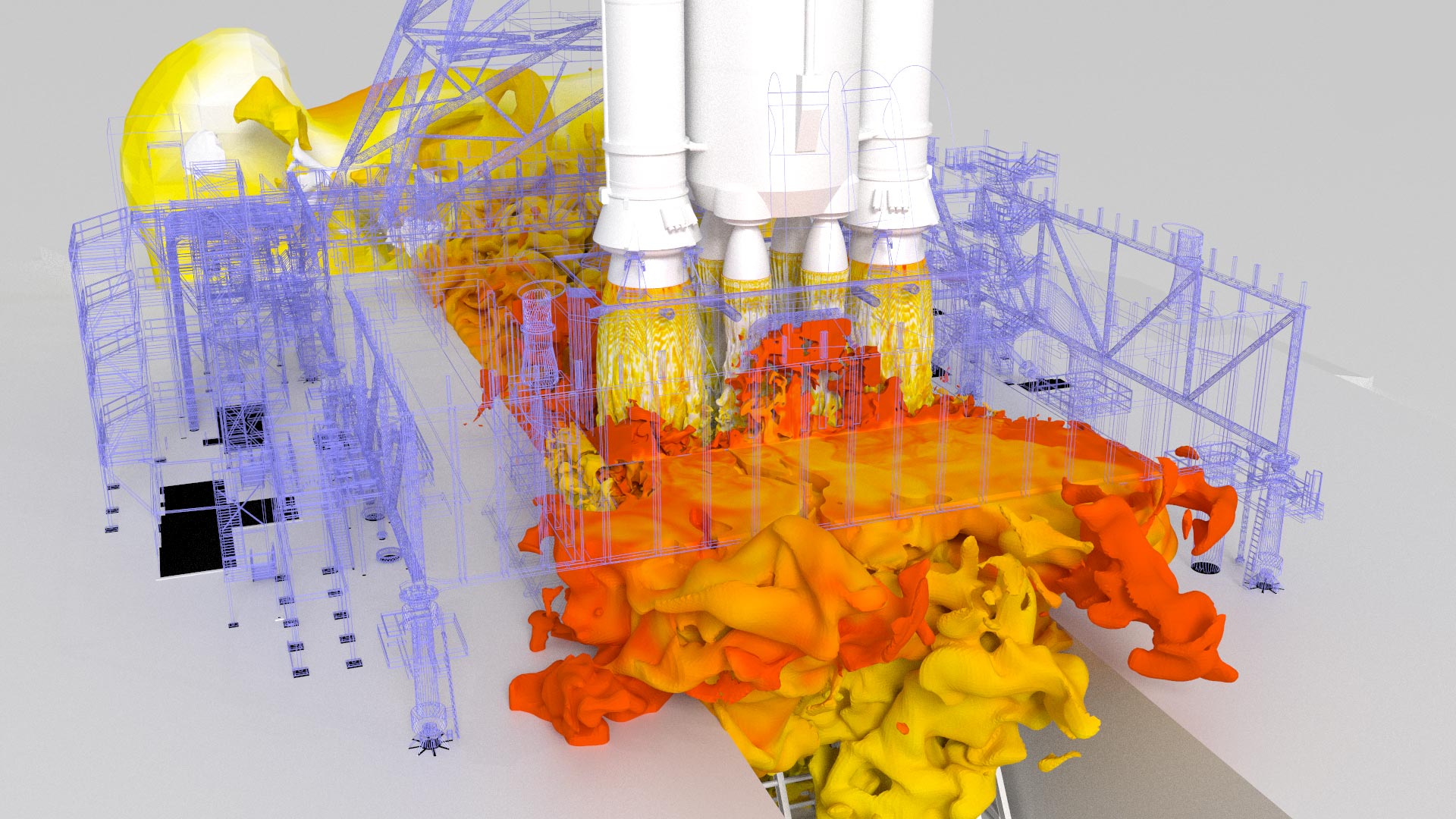
    Artemis Rocket Launch Simulation
    Artemis rocket launch simulation. Credit: NASA/Michael Barad/Timothy Sandstrom

    As part of the Artemis program, NASA is preparing to test the integrated systems that will take crew on missions to the Moon, including a powerful new rocket that will launch crew and cargo to lunar orbit. There are many critical moments in a rocket’s journey from the ground to orbit, but perhaps none more so than the moment of ignition from the launch pad. When the Space Launch System, or SLS, rocket engines begin to roar – emitting fire, smoke, and shockwaves – it is critical the entire launch complex is designed to withstand the pressure.

    The image above shows a visualization of the exhaust gas flow of SLS taking off from Launch Complex 39B at NASA’s Kennedy Space Center in Florida for the Artemis I mission. Plume contours are colored by temperature. White is high temperature, while red is cooler. Purple outlines highlight the geometric complexity included in the launch pad simulation.

    The Launch Ascent and Vehicle Aerodynamics, or LAVA, team at NASA’s Ames Research Center in California’s Silicon Valley, uses these simulations to accurately understand how liquid and gases flowing during launch can cause various kinds of waves.

    The first waves are created when a rocket engine rapidly ignites. This generates a short series of overpressure waves. After that, the turbulent plumes of exhaust generate longer-duration acoustic noise that persists as the spacecraft ascends.

    Both the overpressure and acoustic pressure waves travel directly up through the mobile launcher’s exhaust hole and through the flame trench below the mobile launcher. Once the pressure waves have cleared the mobile launcher, they continue moving up and alongside the rocket towards its payload – putting both at risk.

    To counter these overpressure and acoustic pressure waves, a water-based suppression system dumps more than 400,000 gallons of water per minute onto key locations at the launch site. This is needed to protect the Orion spacecraft and its crew and payloads from the powerful pressure waves created during launch atop SLS. It also creates an extremely complex and dynamic environment.

    To replicate a launch environment digitally, the rocket as well as the gas, liquid, and shockwaves it creates and the water dumped through suppression systems must also be simulated. LAVA can accurately test out all these systems virtually to help ensure when launch day arrives, everything goes smoothly.

    Never miss a breakthrough: Join the SciTechDaily newsletter.
    Follow us on Google and Google News.

    ARTEMIS Mission NASA
    Share. Facebook Twitter Pinterest LinkedIn Email Reddit

    Related Articles

    NASA’s Artemis II Is on the Launch Pad and the Moon Is Next

    NASA Powers Up a Massive Solar Engine for the Moon

    A Massive Rocket Is Rolling and NASA’s Return to the Moon Is Getting Real

    NASA’s Moon Rover Will Hunt for Ice, Map Minerals, and Reveal What Lies Beneath

    4K From the Moon: Artemis II to Trial High-Speed Laser Communications

    NASA Fires Up RS-25 at 111% Power for Artemis Moon Launches

    The International Space Station Is Helping Us Get Back to the Moon – Here’s How

    All Four Rocket Engines Attached to the SLS Core Stage for Artemis I Mission

    Exploration Extravehicular Mobility Unit – Next Generation Spacesuit for Artemis Astronauts

    Leave A Reply Cancel Reply

    • Facebook
    • Twitter
    • Pinterest
    • YouTube

    Don't Miss a Discovery

    Subscribe for the Latest in Science & Tech!

    Trending News

    Monster Storms on Jupiter Unleash Lightning Beyond Anything on Earth

    Scientists Create “Liquid Gears” That Spin Without Touching

    The Simple Habit That Could Help Prevent Cancer

    Millions Take These IBS Drugs, But a New Study Finds Serious Risks

    Scientists Unlock Hidden Secrets of 2,300-Year-Old Mummies Using Cutting-Edge CT Scanner

    Bread Might Be Making You Gain Weight Even Without Eating More Calories

    Scientists Discover Massive Magma Reservoir Beneath Tuscany

    Europe’s Most Active Volcano Just Got Stranger – Here’s Why Scientists Are Rethinking It

    Follow SciTechDaily
    • Facebook
    • Twitter
    • YouTube
    • Pinterest
    • Newsletter
    • RSS
    SciTech News
    • Biology News
    • Chemistry News
    • Earth News
    • Health News
    • Physics News
    • Science News
    • Space News
    • Technology News
    Recent Posts
    • Scientists Were Wrong About This Strange “Rule-Breaking” Particle
    • Webb Space Telescope Uncovers Unexpected Ice Clouds on a Jupiter-Like World
    • 289-Million-Year-Old Reptile Mummy Reveals Origin of Human Breathing System
    • New Brain Discovery Challenges Long-Held Theory of Teenage Brain Development
    • Sharks Are Overheating as Warming Oceans Push Them to the Edge
    Copyright © 1998 - 2026 SciTechDaily. All Rights Reserved.
    • Science News
    • About
    • Contact
    • Editorial Board
    • Privacy Policy
    • Terms of Use

    Type above and press Enter to search. Press Esc to cancel.