

Scientists carefully positioned lasers to compress billions of electrons together, creating a beam five times more powerful than ever before.
Researchers at SLAC have achieved a major milestone in accelerator physics by creating an ultrashort electron beam with record-breaking peak current: five times greater than anything produced before. By mastering a laser-based technique, they compressed electrons into an incredibly tiny space while preserving beam quality, overcoming a long-standing challenge in the field. This breakthrough enables unprecedented precision for exploring phenomena in quantum physics, materials science, and astrophysics, including recreating star-like filaments in the lab. The beam’s power and versatility are already sparking new research and pushing the limits of what’s possible in experimental physics.
A Giant Leap in Electron Beam Power
Scientists at SLAC National Accelerator Laboratory have created an ultrashort electron beam with five times the peak current of any previous beam of its kind on Earth.
This breakthrough, detailed in a paper published in Physical Review Letters, tackles one of the major challenges in particle accelerator and beam physics: producing high-power electron beams without sacrificing quality. It also opens new possibilities for research across a range of fields, including quantum chemistry, astrophysics, and materials science.
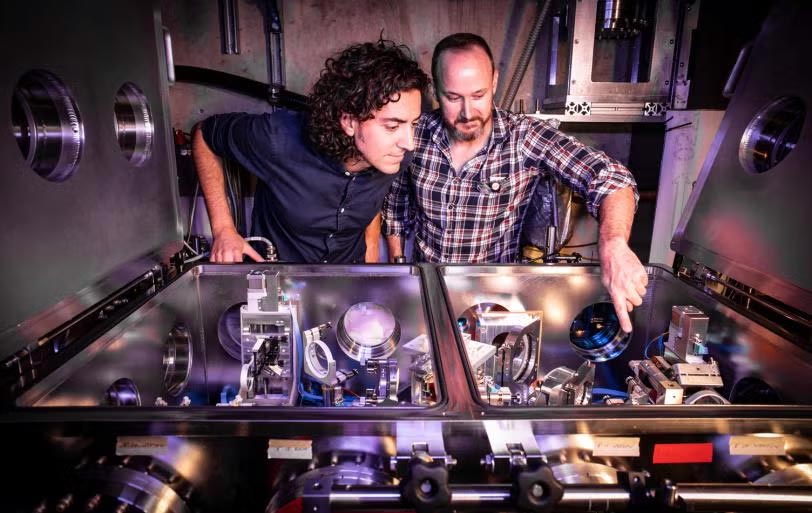
“Not only can we create such a powerful electron beam, but we’re also able to control the beam in ways that are customizable and on demand, which means we can probe a much wider range of physical and chemical phenomena than ever before,” said Claudio Emma, a staff scientist at the Department of Energy’s SLAC National Accelerator Laboratory, who is a researcher at SLAC’s Facility for Advanced Accelerator Experimental Tests (FACET-II) and a lead author on the new study.
The Power Balance
As highlighted in the Accelerator and Beam Physics Roadmap (2022), one of the field’s longstanding goals has been to develop electron beams that are both extremely powerful and precisely controlled. Until now, increasing a beam’s power often meant degrading its quality, a tradeoff that has limited progress in many advanced experiments.
Traditionally, a microwave field is used to compress and focus the electron beam. The electrons within the field are staggered, so that those further back have more energy than those in the front. It’s sort of like runners staggered at the start of a track race, Emma explained. “We then send them around a bend, so the electrons in back catch up with electrons in front, and then at the end, you have a bunch of electrons together in a focused beam.”
The problem with this approach is that as they accelerate, electrons emit radiation and lose energy, so the quality of the beam deteriorates. That creates a tradeoff between beam energy and quality. “We can’t apply traditional methods to compress bunches of electrons at the submicron scale, while also preserving beam quality,” Emma said.
Lasers for the Win
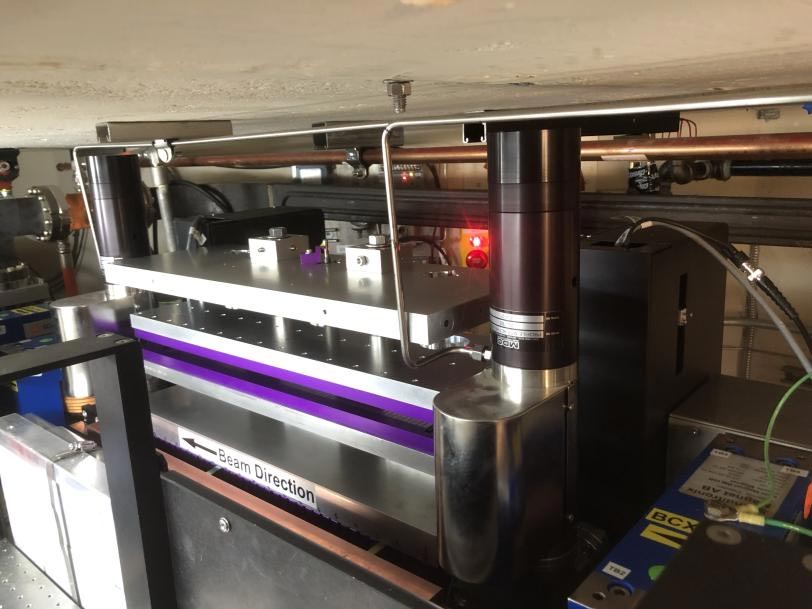
To solve this issue, SLAC researchers compressed billions of electrons into a length less than one micrometer using a laser-based shaping technique originally developed for X-ray free-electron lasers, such as SLAC’s Linac Coherent Light Source (LCLS). “The big advantage of using a laser is that we can apply an energy modulation that’s much more precise than what we can do with microwave fields,” Emma said.
But it’s not as simple as just shooting a few lasers down a tunnel. “We have a one-kilometer-long machine, and the laser interacts with the beam in the first 10 meters, so you have to get the shaping exactly right, then you have to transport the beam for another kilometer without losing this modulation, and you have to compress it,” Emma said. “So it wasn’t easy.”
After several months of testing and finessing their laser shaping technique, Emma and his team can now repeatedly produce high energy, femtosecond-duration, petawatt peak power electron beams that are about five times higher in current than what could previously be achieved.
A Game-Changing Scientific Tool
This new beam will allow scientists to probe a whole series of natural phenomena, including testing hypotheses in quantum physics, materials science, and astrophysics.
In astrophysics, for example, this beam can be directed to a solid or gas target to create a filament similar to those seen in stars. “Scientists know that these filaments occur, but now we can test how they occur and evolve in the lab with a level of power we haven’t had before,” Emma said.
Real-World Applications Already Underway
Fellow FACET-II researchers pounced on the more powerful beam and have already applied it to advancing plasma wakefield technology. Emma is particularly excited about the prospect of further compressing these beams to make attosecond light pulses, further enhancing LCLS’s current attosecond capabilities and driving even more pioneering science. “If you have the beam as a fast camera, then you also have a light pulse that’s very short, and now suddenly you have two complementary probes,” Emma explained. “That’s a unique capability and we can do a lot of things with that.”
Emma and his colleagues are excited about the prospects this new electron beam will bring. “We have a really exciting and interesting facility at FACET-II where people can come and do their experiments,” he said. “If you need an extreme beam, we have the tool for you, and let’s work together.”
Reference: “Experimental Generation of Extreme Electron Beams for Advanced Accelerator Applications” by C. Emma, N. Majernik, K. K. Swanson, R. Ariniello, S. Gessner, R. Hessami, M. J. Hogan, A. Knetsch, K. A. Larsen, A. Marinelli, B. O’Shea, S. Perez, I. Rajkovic, R. Robles, D. Storey and G. Yocky, 27 February 2025, Physical Review Letters.
DOI: 10.1103/PhysRevLett.134.085001
The research was supported by the DOE Office of Science. FACET-II and LCLS are DOE Office of Science user facilities.
Never miss a breakthrough: Join the SciTechDaily newsletter.
Follow us on Google and Google News.
10 Comments
The ongoing story of lasers: “The solution in search of a problem.”
The solution in search of a military organisation……….?
Can you elaborate on how PRL promotes CP violation. I am curious to understand what you mean. Thanks
Please browse:
1. https://scitechdaily.com/microscope-spacecrafts-most-precise-test-of-key-component-of-the-theory-of-general-relativity/#comment-854286.
2. https://zhuanlan.zhihu.com/p/643404671.
Physical Review Letters insists on and promotes CP violation, ignoring natural laws, which is a public insult to public wisdom. Is Physical Review Letters a publication that is science?
Can you be more specific about your complaint? As it is, about all I got out it is that you are unhappy with PRL for some reason that isn’t common knowledge.
Thank you for your interest in science. Please browse:
1. https://scitechdaily.com/microscope-spacecrafts-most-precise-test-of-key-component-of-the-theory-of-general-relativity/#comment-854286.
2. https://zhuanlan.zhihu.com/p/643404671。
If a natural law can be violated, then it isn’t a natural law…
VERY VERY GOOD!!!
Next step to space travel, use a particle accelerator to blast a group of beams in the back of a spaceship, powered by a fusion reactor, outside Earth’s gravity, to propel away to another planet, have three fueling stations between planets, along the trajectory of the next habitable planet, for entry and exit of said planets.