
Close Menu
    Facebook X (Twitter) Instagram
    SciTechDaily
    • Biology
    • Chemistry
    • Earth
    • Health
    • Physics
    • Science
    • Space
    • Technology
    Facebook X (Twitter) Pinterest YouTube RSS
    SciTechDaily
    Home»Space»Sloan Digital Sky Survey to Chart the Cosmos like Never Before
    Space

    Sloan Digital Sky Survey to Chart the Cosmos like Never Before

    By Jim Shelton, Yale UniversityJuly 16, 2014No Comments3 Mins Read
    Facebook Twitter Pinterest Telegram LinkedIn WhatsApp Email Reddit
    Share
    Facebook Twitter LinkedIn Pinterest Telegram Email Reddit
    Sloan Digital Sky Survey Will Bring the Cosmos Into Greater Focus
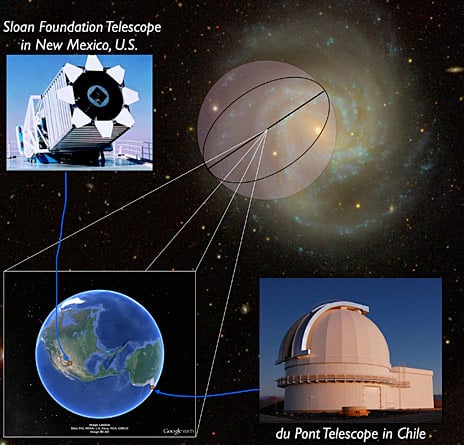
    DSS-IV will extend its reach by using both the Sloan Foundation Telescope at Apache Point Observatory and the du Pont telescope at Las Campanas Observatory in Chile. Because of the orientation of the Earth’s axis, the northern telescope will observe a very different part of the Milky Way than the southern telescope, which will have an excellent view of the galactic center regions. Credit: SDSS collaboration and Dana Berry/SkyWorks Digital Inc.

    Survey officials announced the fourth phase of the Sloan Digital Sky Survey, an initiative that spans four continents and includes 200 astronomers at more than 40 institutions.

    The next phase of a global drive to map the night sky will bring the cosmos into greater focus than at any in human history.

    Yale University scientists are involved in all of the major aspects of the Sloan Digital Sky Survey, an initiative that spans four continents and includes 200 astronomers at more than 40 institutions. They will chart thousands of nearby galaxies, probe the composition of stars throughout the Milky Way with novel clarity, and measure the expansion of the universe during a particularly murky period.

    Survey officials announced the fourth phase of the effort on July 15. It will make use of not only the Sloan Foundation 2.5-meter Telescope in New Mexico, but also the 2.5-meter Irenee du Pont Telescope at Las Campanas Observatory in Chile.

    “The power of a large survey is that there may be surprises we weren’t planning on, and that means learning something really new,” said C. Megan Urry, Yale’s Israel Munson Professor of Astronomy and Astrophysics and director of the Yale Center for Astronomy and Astrophysics.

    “One of the things my group is really excited about is the possibility of getting more information about black holes growing in distant galaxies, including the most luminous ones, known as quasars,” Urry said. “By surveying a very large fraction of the available sky, SDSS IV will greatly increase our knowledge about when and where the most massive black holes grow.”

    Yale joined the project four years ago, in its third phase. More than a dozen Yale professors, postdoctoral researchers, and students are working with the data, and Yale scientists have written more than 25 papers using survey information.

    Already, the survey has registered more than half a million stars in the Milky Way and more than two million galaxies and quasars. The new, fourth phase of the survey broadens the project’s scope and will dramatically expand its database.

    This phase has three new components. One will be to create much more detailed maps of nearby galaxies, thanks to an optical fiber bundle technology that takes spectra of each part of a galaxy simultaneously. Another effort will use the Chilean telescope to monitor the makeup and movement of stars throughout the Milky Way that cannot be observed from New Mexico.

    The third component will focus on mapping the distribution of galaxies and quasars from 3 to 8 billion years ago. During that period, dark energy began to have an impact on the universe.

    “When people ask me what I do I say I’m helping to map the universe,” said John K. Parejko, a postdoctoral research associate at Yale and operations software developer for the sky survey. “It’s not just that we’ll have incredibly more data than ever before, but that the quality and uniformity of the data will be unrivaled for years to come.”

    The survey is funded through the Alfred P. Sloan Foundation and other institutions.


    Never miss a breakthrough: Join the SciTechDaily newsletter.
    Follow us on Google and Google News.

    Astronomy Astrophysics Sloan Digital Sky Survey Yale University
    Share. Facebook Twitter Pinterest LinkedIn Email Reddit

    Related Articles

    Early Quasars Got a “Super Boost” from Star Clusters

    Dragonfly Telephoto Array Reveals Seven Previously Unseen Dwarf Galaxies

    Sloan Digital Sky Survey Reveals Treasure Trove of “Red Nugget” Galaxies

    Study Reveals That Diamond Planets May Be More Common Than Prevoiusly Thought

    Chemical Analysis Reveals that Nearby Galaxy Segue 1 is a “Fossil” from the Early Universe

    Discovery Provides Clues to How Galaxies and Black Holes Develop Together

    Astronomers Discover a New Type of Quasar

    ALMA Gets a Close-Up View of Starbirth

    The Triangulum Stream, Remnant of a Star Cluster Being Ingested by the Milky Way

    Leave A Reply Cancel Reply

    • Facebook
    • Twitter
    • Pinterest
    • YouTube

    Don't Miss a Discovery

    Subscribe for the Latest in Science & Tech!

    Trending News

    Artificial Sweeteners May Harm Future Generations, Study Suggests

    Splashdown! NASA Artemis II Returns From Record-Breaking Moon Mission

    What If Consciousness Exists Beyond Your Brain

    Scientists Finally Crack the 100-Million-Year Evolutionary Mystery of Squid and Cuttlefish

    Beyond “Safe Levels”: Study Challenges What We Know About Pesticides and Cancer

    Researchers Have Found a Dietary Compound That Increases Longevity

    Scientists Baffled by Bizarre “Living Fossil” From 275 Million Years Ago

    Your IQ at 23 Could Predict Your Wealth at 27, Study Finds

    Follow SciTechDaily
    • Facebook
    • Twitter
    • YouTube
    • Pinterest
    • Newsletter
    • RSS
    SciTech News
    • Biology News
    • Chemistry News
    • Earth News
    • Health News
    • Physics News
    • Science News
    • Space News
    • Technology News
    Recent Posts
    • What if Dark Matter Has Two Forms? Bold New Hypothesis Could Explain a Cosmic Mystery
    • Researchers Expose Hidden Chemistry of “Ore-Forming” Elements in Biology
    • Geologists Reveal the Americas Collided Earlier Than We Thought
    • 20x Difference: Study Reveals True Source of Airborne Microplastics
    • Scientists Uncover Hidden Force Powering Yellowstone’s Supervolcano
    Copyright © 1998 - 2026 SciTechDaily. All Rights Reserved.
    • Science News
    • About
    • Contact
    • Editorial Board
    • Privacy Policy
    • Terms of Use

    Type above and press Enter to search. Press Esc to cancel.