
Close Menu
    Facebook X (Twitter) Instagram
    SciTechDaily
    • Biology
    • Chemistry
    • Earth
    • Health
    • Physics
    • Science
    • Space
    • Technology
    Facebook X (Twitter) Pinterest YouTube RSS
    SciTechDaily
    Home»Biology»Snakes Diversified Explosively After the Dinosaurs Were Wiped Out 66 Million Years Ago
    Biology

    Snakes Diversified Explosively After the Dinosaurs Were Wiped Out 66 Million Years Ago

    By PLOSNovember 15, 2021No Comments4 Mins Read
    Facebook Twitter Pinterest Telegram LinkedIn WhatsApp Email Reddit
    Share
    Facebook Twitter LinkedIn Pinterest Telegram Email Reddit
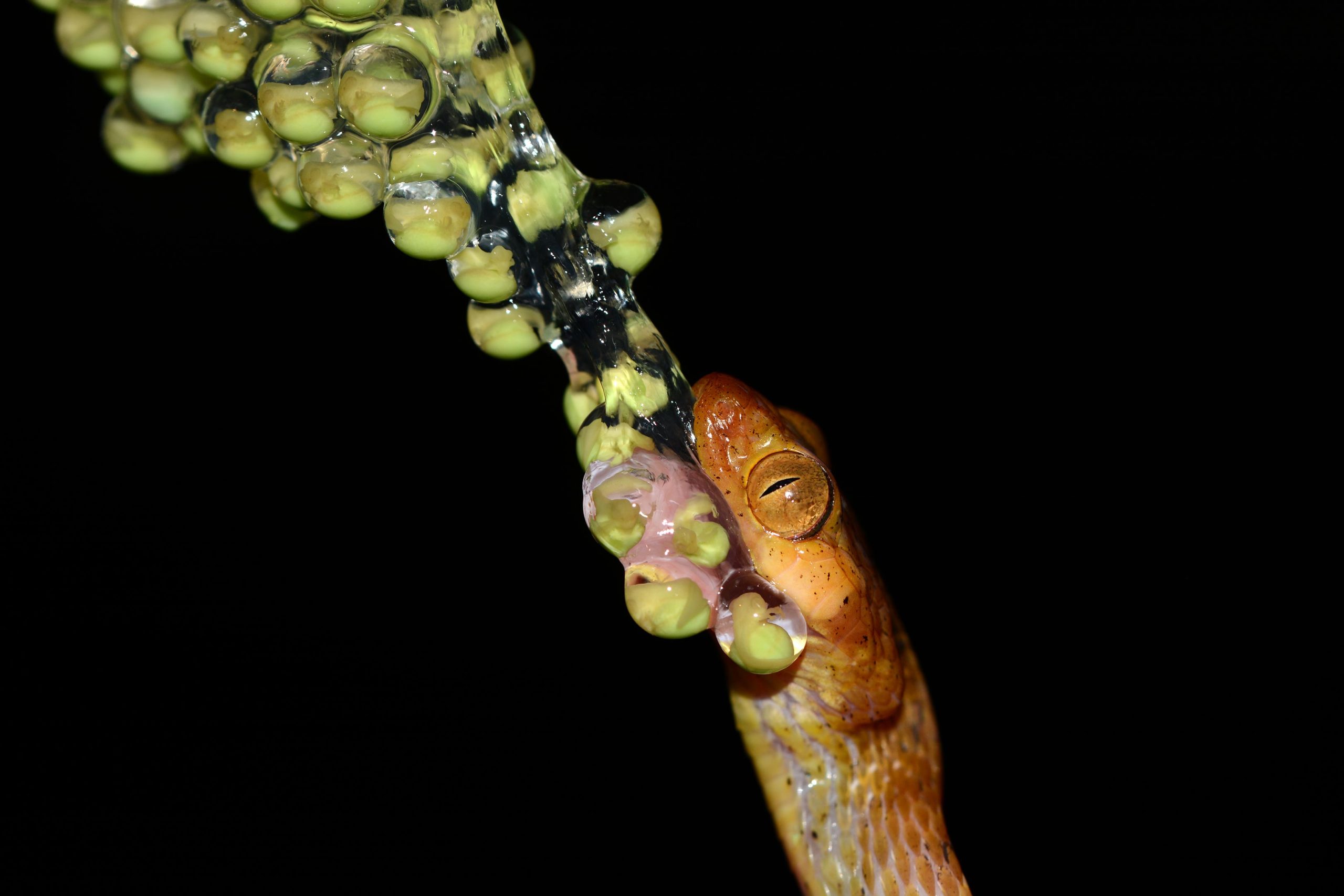
    Imantodes inornatus Yellow Blunt Headed Tree Snake
    A blunt-headed tree snake (Imantodes inornatus) eating its way through a batch of treefrog eggs. Credit: John David Curlis, University of Michigan Museum of Zoology.

    Sudden burst of evolution 66 million years ago expanded snake diets and put vertebrates on the menu.

    The remarkable diversification of mammals and birds after the demise of the dinosaurs 66 million years ago is well known; but what happened to the snakes? According to a study published in the open-access journal PLOS Biology by Michael Grundler at the University of California, Los Angeles and Daniel Rabosky at the University of Michigan, snakes experienced a similarly spectacular burst of evolution from unassuming insectivorous ancestors to diverse lineages that included the newly available birds, fish and small mammals in their diets.

    The K-Pg mass extinction event 66 million years ago – during which 75% of species, including all non-avian dinosaurs, went extinct – marked the beginning of the Cenozoic era and opened a myriad of empty niches for the surviving species to exploit. Like mammals and birds, snakes diversified rapidly during the Cenozoic era, resulting in the nearly 4,000 species that we see today.

    To better understand the pace and sequence of this phenomenon, the researchers collated published data on the diets of 882 living snake species and used sophisticated mathematical models to reconstruct how the diets of their ancestors changed and diversified since the K-Pg boundary. They found that the most recent common ancestor of living snakes was insectivorous, but after the K-Pg boundary, snake diets rapidly expanded to include birds, fish, and small mammals – vertebrate groups that were also flourishing in the wake of the dinosaurs’ extinction.
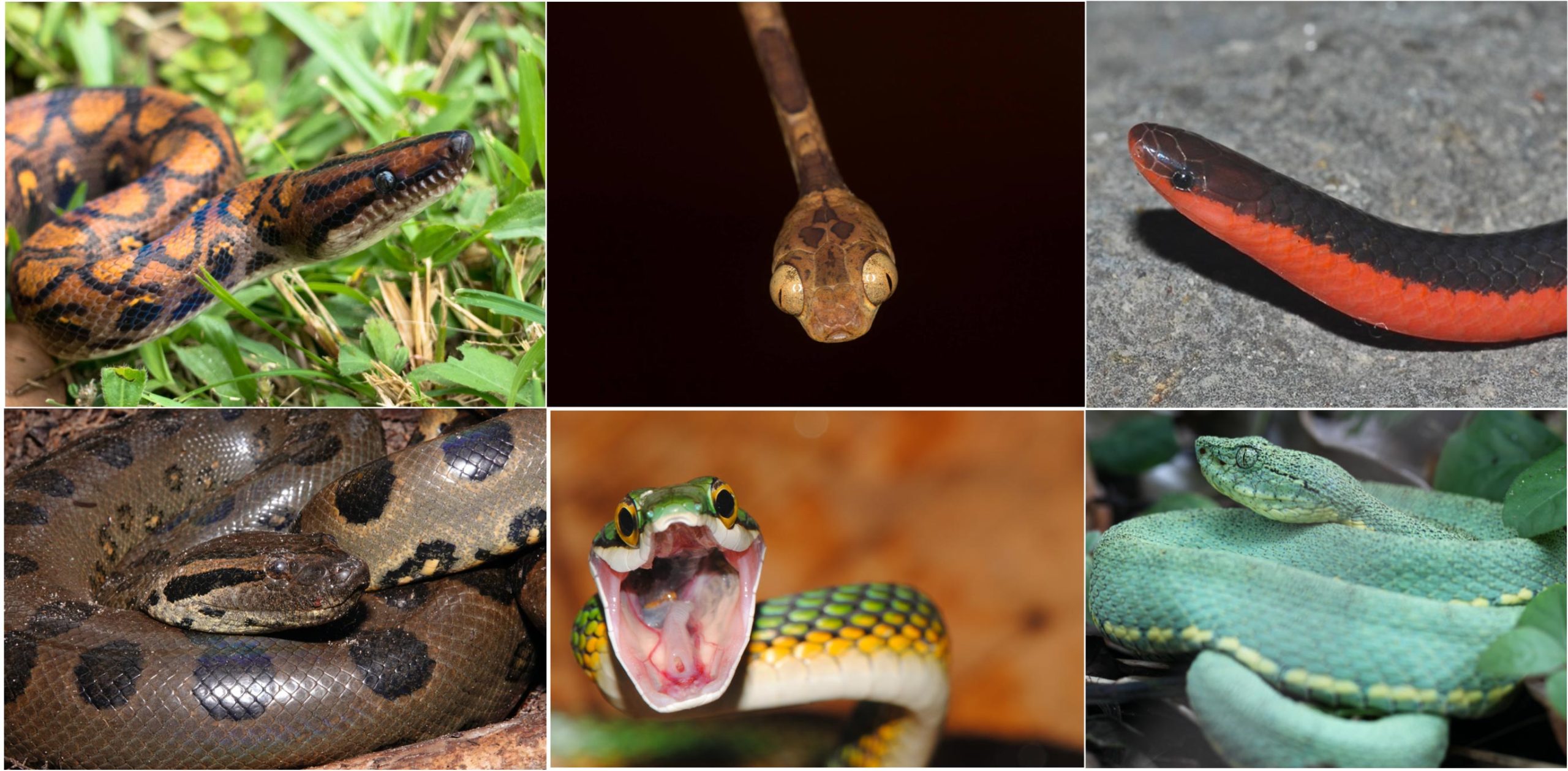
    Snake Panel
    A sampling of snake diversity. Clockwise from upper left: rainbow boa (Epicrates cenchria), image credit Pascal Title, U-M Museum of Zoology; Amazon basin tree snake (Imantodes lentiferus), image credit Pascal Title, U-M Museum of Zoology; western worm snake (Carphophis vermis), image credit Alison Rabosky, U-M Museum of Zoology; two-striped forest pitviper (Bothrops bilineatus), image credit Dan Rabosky, U-M Museum of Zoology; parrot snake (Leptophis ahaetulla), image credit Ivan Prates, U-M Museum of Zoology; and green anaconda (Eunectes murinus), image credit Dan Rabosky, U-M Museum of Zoology. These species show considerable variability in their diets, ranging from generalist predators on vertebrates (rainbow boa, anaconda) to species that specialize on sleeping lizards (tree snake), earthworms (worm snake), and tree frogs (parrot snake).

    Adaptive Radiations and New Opportunities

    The study sheds light on the explosive adaptive radiation that gave rise to modern snake diversity. Diet diversification in snakes slowed after the initial radiation, but some lineages experienced further bursts of adaptive evolution. For example, Colubroid snakes diversified when Old World ancestors colonized North and South America. These findings show that mass extinctions and new biogeographic opportunities can spur evolutionary change, the authors say.

    “Much of the stunning ecological diversity in snakes seems to result from evolutionary explosions triggered by ecological opportunity,” Grundler adds. “We find a major burst of snake diet diversification after the dinosaur extinction, and we also find that, when snakes arrive in new places, they often undergo similar bursts of dietary diversification.”

    For more on this research, read Snakes Diversified Explosively After Mass Extinction Where Dinosaurs Were Wiped Out.

    Reference: “Rapid increase in snake dietary diversity and complexity following the end-Cretaceous mass extinction” by Michael C. Grundler and Daniel L. Rabosky, 14 October 2021, PLOS Biology.
    DOI: 10.1371/journal.pbio.3001414

    Funding: This research was supported by a Graduate Research Fellowship (DGE 1841052) from the National Science Foundation to M.C.G. and by a fellowship from the David and Lucile Packard Foundation to D.L.R. The funders had no role in study design, data collection and analysis, decision to publish, or preparation of the manuscript.

    Never miss a breakthrough: Join the SciTechDaily newsletter.
    Follow us on Google and Google News.

    Evolution Extinction Genetics PLOS Snake
    Share. Facebook Twitter Pinterest LinkedIn Email Reddit

    Related Articles

    First Animals Formed Complex Ecological Communities Before the Cambrian Explosion

    Snakes Diversified Explosively After Mass Extinction Where Dinosaurs Were Wiped Out

    Snake Venom Complexity Is Driven by Prey Diet

    How an Infectious Tumor in Endangered Tasmanian Devils Evolved As It Spread

    Zoonomia Project: Largest Set of Mammalian Genomes Reveals Species at Risk of Extinction

    Evolutionary Origin of Skin Colors Revealed by Genetic Mutation in Snakes

    Shocking Research Finds DNA From an Ancient, Unidentified Ancestor Was Passed Down to Humans Living Today

    Sea Snakes Have Been Modifying Genetically to See Underwater for 15 Million Years

    New Fossils of Ancient Snake With Hind Legs Reveals Tantalizing Details of Evolution

    Leave A Reply Cancel Reply

    • Facebook
    • Twitter
    • Pinterest
    • YouTube

    Don't Miss a Discovery

    Subscribe for the Latest in Science & Tech!

    Trending News

    Your Blood Pressure Reading Could Be Wrong Because of One Simple Mistake

    Astronomers Stunned by Ancient Galaxy With No Spin

    Physicists May Be on the Verge of Discovering “New Physics” at CERN

    Scientists Solve 320-Million-Year Mystery of Reptile Skin Armor

    Scientists Say This Daily Walking Habit May Be the Secret to Keeping Weight Off After Dieting

    New Therapy Rewires the Brain To Restore Joy in Depression Patients

    Giant Squid Detected off Western Australia in Stunning Deep-Sea Discovery

    Popular Sugar-Free Sweetener Linked to Liver Disease, Study Warns

    Follow SciTechDaily
    • Facebook
    • Twitter
    • YouTube
    • Pinterest
    • Newsletter
    • RSS
    SciTech News
    • Biology News
    • Chemistry News
    • Earth News
    • Health News
    • Physics News
    • Science News
    • Space News
    • Technology News
    Recent Posts
    • Fur Seals’ Hearts Suddenly Spike Hours After Returning to Land
    • Scientists Say Cognitive Decline Isn’t Inevitable — Your Brain Can Improve at Any Age
    • This Weird Sea Creature May Have Rewritten Life’s Genetic Rulebook
    • The Hidden Types of Dementia Most People Have Never Heard Of
    • Scientists Discover Why Alcohol Prevents the Liver From Healing, Even After You Quit
    Copyright © 1998 - 2026 SciTechDaily. All Rights Reserved.
    • Science News
    • About
    • Contact
    • Editorial Board
    • Privacy Policy
    • Terms of Use

    Type above and press Enter to search. Press Esc to cancel.