

SOFIA’s observations of Venus required meticulous planning to avoid Sun exposure, involving months of preparation and precise timing. The mission aimed to investigate phosphine on Venus and also studied hydrogen chloride and atomic oxygen, with data analysis now underway.
SOFIA recently completed a new set of observations of Venus to study the chemical composition of the planet’s atmosphere. Observing Venus was particularly challenging. Venus was in a tricky part of the sky to observe, and the Sun was about to set. For safety reasons, SOFIA can only open the door to the telescope while the Sun is above the horizon under very specific circumstances. Great care must be taken to avoid the telescope accidentally observing the Sun and causing damage to the telescope or aircraft. Due to these specific requirements, the flight planning and coordination for these observations took extra care, discussion, and special preparations.
The planning and preparations for observing Venus began more than two months before the flights. The flight crew were specifically trained by the telescope engineers on the exact directions that would be safe to fly with the door open before the Sun went down. They carefully planned contingencies and turns to ensure the telescope’s and aircraft’s safety.
Another challenge for these pre-sunset observations is timing each event in the flight plan. The exact time the Sun sets is different depending on your altitude.
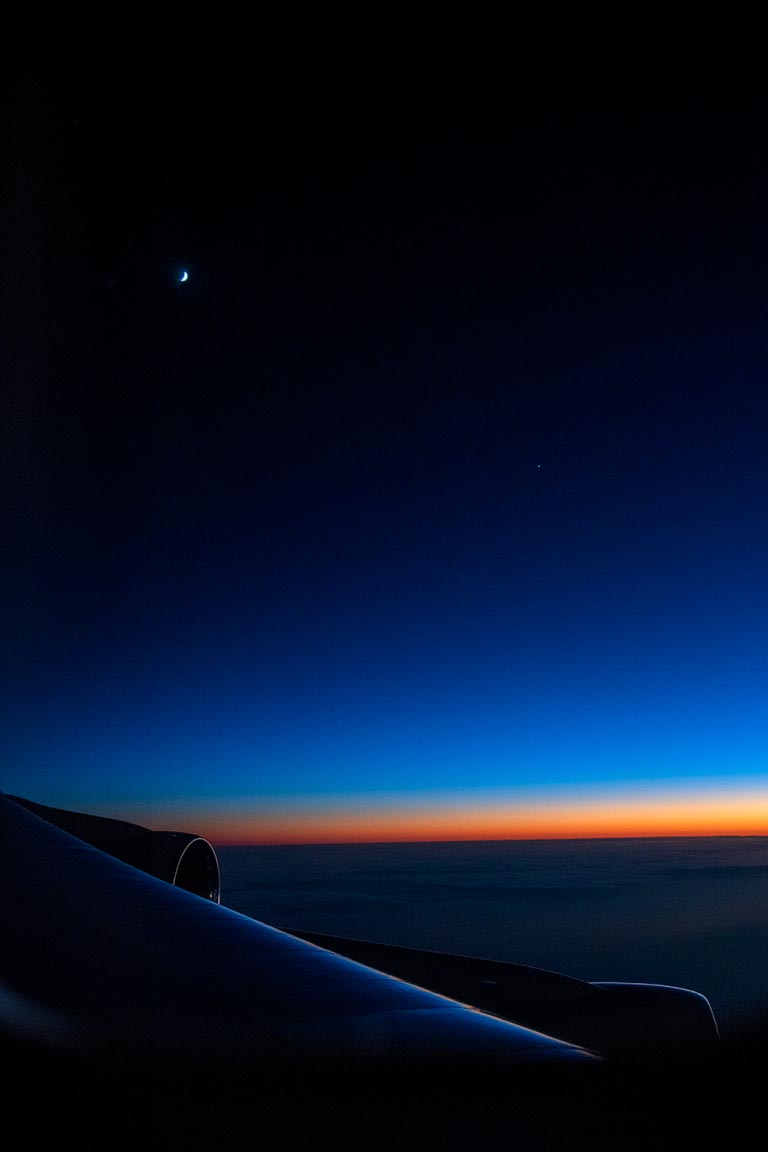
Furthermore, weather and barometric pressure can change the density of the atmosphere, which in turn affects the atmosphere’s refractive properties. Refraction is the bending of light by a medium. A famous example of refraction is a pencil in a glass of water. We know the pencil is straight, but the water refracts the light, making it appear to dramatically bend. The variability of the atmosphere’s pressure and therefore its ability to refract the Sun’s light is a potential safety concern for the observatory. The flight planners for SOFIA designed and timed the delicate dance of the Venus observations to ensure that there was no risk of SOFIA accidentally observing the Sun. Still, everyone on the flight carefully monitored the sky to see the green flash, a phenomenon that indicates the Sun has set over the horizon. Once the Sun was down, the pilots turned the aircraft so SOFIA could observe Venus.
SOFIA started off the night before sunset by opening the upper rigid door – which recently went through a special maintenance period – so SOFIA could observe Jupiter to prepare the instrument and telescope for Venus. Jupiter is 90 degrees away from the setting Sun in the sky, so SOFIA was able to observe it safely while the Sun was above the horizon. During this short look at Jupiter, the telescope operators and instrument scientists got set up and did calibrations as the Sun continued to set. Right on schedule, the aircraft turned and began to collect photos of Venus using the German REceiver for Astronomy at Terahertz Frequencies, or GREAT, instrument.
Studying Phosphine, Hydrogen Chloride, and Oxygen on Venus
One of the goals of the observations was to address recent reports of phosphine on Venus. Due to their higher sensitivities, SOFIA and the GREAT instrument will be able to set a strict upper limit on Venus’ phosphine abundance. Applying GREAT’s ability to make multiple simultaneous observations, the Venus observations also studied hydrogen chloride and conducted the first search for atomic oxygen in Venus’ atmosphere. Now that GREAT has observed Venus, the teams of scientists who proposed these observations will begin the creative process of reducing and analyzing the data. We look forward to learning the results of their work.
Never miss a breakthrough: Join the SciTechDaily newsletter.
Follow us on Google and Google News.