
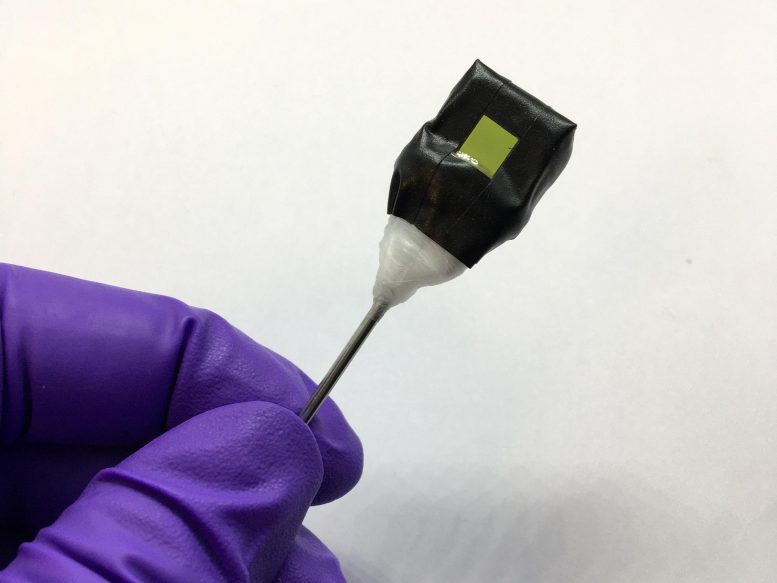
University of Cambridge scientists have developed an ‘artificial leaf’ that, powered by sunlight, converts CO2 and water into ethanol and propanol. This innovation eliminates the intermediary step of producing syngas, making the technology more practical and paving the way for a sustainable, zero-carbon emission future.
Researchers have developed a solar-powered technology that converts carbon dioxide and water into liquid fuels that can be added directly to a car’s engine as drop-in fuel.
The researchers, from the University of Cambridge, harnessed the power of photosynthesis to convert CO2, water, and sunlight into multicarbon fuels – ethanol and propanol – in a single step. These fuels have a high energy density and can be easily stored or transported.
Unlike fossil fuels, these solar fuels produce net zero carbon emissions and completely renewable, and unlike most bioethanol, they do not divert any agricultural land away from food production.
While the technology is still at laboratory scale, the researchers say their ‘artificial leaves’ are an important step in the transition away from a fossil fuel-based economy. The results are reported in the journal Nature Energy.
Bioethanol’s Limitations and a New Alternative
Bioethanol is touted as a cleaner alternative to petrol, since it is made from plants instead of fossil fuels. Most cars and trucks on the road today run on petrol containing up to 10% ethanol (E10 fuel). The United States is the world’s largest bioethanol producer: according to the U.S. Department of Agriculture, almost 45% of all corn grown in the US is used for ethanol production.
“Biofuels like ethanol are a controversial technology, not least because they take up agricultural land that could be used to grow food instead,” said Professor Erwin Reisner, who led the research.
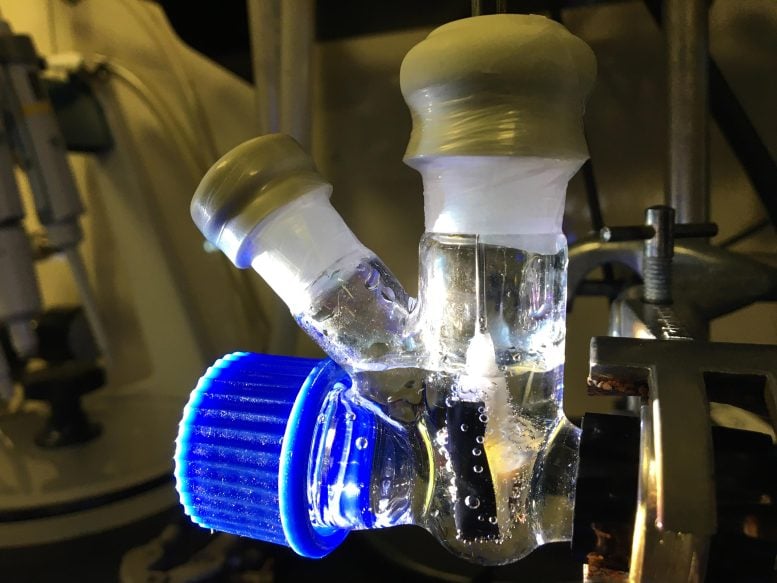
For several years, Reisner’s research group, based in the Yusuf Hamied Department of Chemistry, has been developing sustainable, zero-carbon fuels inspired by photosynthesis – the process by which plants convert sunlight into food – using artificial leaves.
Advancing from Simple to Complex Fuels
To date, these artificial leaves have only been able to make simple chemicals, such as syngas, a mixture of hydrogen and carbon monoxide that is used to produce fuels, pharmaceuticals, plastics, and fertilizers. But to make the technology more practical, it would need to be able to produce more complex chemicals directly in a single solar-powered step.
Now, the artificial leaf can directly produce clean ethanol and propanol without the need for the intermediary step of producing syngas.
The researchers developed a copper and palladium-based catalyst. The catalyst was optimized in a way that allowed the artificial leaf to produce more complex chemicals, specifically the multicarbon alcohols ethanol, and n-propanol. Both alcohols are high energy density fuels that can be easily transported and stored.
Other scientists have been able to produce similar chemicals using electrical power, but this is the first time that such complex chemicals have been produced with an artificial leaf using only the energy from the Sun.
“Shining sunlight on the artificial leaves and getting liquid fuel from carbon dioxide and water is an amazing bit of chemistry,” said Dr. Motiar Rahaman, the paper’s first author. “Normally, when you try to convert CO2 into another chemical product using an artificial leaf device, you almost always get carbon monoxide or syngas, but here, we’ve been able to produce a practical liquid fuel just using the power of the Sun. It’s an exciting advance that opens up whole new avenues in our work.”
At present, the device is a proof of concept and shows only modest efficiency. The researchers are working to optimize the light absorbers so that they can better absorb sunlight and optimizing the catalyst so it can convert more sunlight into fuel. Further work will also be required to make the device scalable so that it can produce large volumes of fuel.
“Even though there’s still work to be done, we’ve shown what these artificial leaves are capable of doing,” said Reisner. “It’s important to show that we can go beyond the simplest molecules and make things that are directly useful as we transition away from fossil fuels.”
Reference: “Solar-driven liquid multi-carbon fuel production using a standalone perovskite-BiVO4 artificial leaf” by Motiar Rahaman, Virgil Andrei, Demelza Wright, Erwin Lam, Chanon Pornrungroj, Subhajit Bhattacharjee, Christian M. Pichler, Heather F. Greer, Jeremy J. Baumberg and Erwin Reisner, 18 May 2023, Nature Energy.
DOI: 10.1038/s41560-023-01262-3
The research was supported in part by the European Commission Marie Skłodowska-Curie Fellowship, the Cambridge Trust, and the Winton Programme for the Physics of Sustainability. Erwin Reisner is a Fellow and Motiar Rahaman is a Research Associate of St John’s College, Cambridge.
Never miss a breakthrough: Join the SciTechDaily newsletter.
Follow us on Google and Google News.
7 Comments
god vey god i lices the conten
Go Get A New Idea Stop Using My Brothers You Stupid Humans
Amazing 🤩
Mark suck my cheese turkey
Day 1 of world war 3 i farted on my turkey sanuuuuuuuuuuuuuuuuuuuuuuuuuuuuuuuuuuuuuuuuuuuuuuuuuuuuuuuuuuuuuuuuuuuuuuuuuuuuuuuuuuuuuuuuuuuuuuuuuuuuu
jordan is stupid mean poo poo head
Hayden Make jordan hard wood