

Close Menu
    Facebook X (Twitter) Instagram
    SciTechDaily
    • Biology
    • Chemistry
    • Earth
    • Health
    • Physics
    • Science
    • Space
    • Technology
    Facebook X (Twitter) Pinterest YouTube RSS
    SciTechDaily
    Home»Physics»Solving Complex Physics Problems at Lightning Speed – 20 Years of Calculations in 1 Hour
    Physics

    Solving Complex Physics Problems at Lightning Speed – 20 Years of Calculations in 1 Hour

    By Chalmers University of TechnologyFebruary 1, 20211 Comment4 Mins Read
    Facebook Twitter Pinterest Telegram LinkedIn WhatsApp Email Reddit
    Share
    Facebook Twitter LinkedIn Pinterest Telegram Email Reddit
    Complex Calculations at Lightning Speed
    Physicists have developed a new method that enables emulation of complex calculations at lightning speed. This could yield new insights about the quantum properties of strongly interacting matter such as atomic nuclei and neutron stars. Illustration: Andreas Ekström and Yen Strandqvist/Chalmers University of Technology. Credit: Andreas Ekström and Yen Strandqvist/Chalmers University of Technology

    A calculation so complex that it takes twenty years to complete on a powerful desktop computer can now be done in one hour on a regular laptop. Physicist Andreas Ekström at Chalmers University of Technology, together with international research colleagues, has designed a new method to calculate the properties of atomic nuclei incredibly quickly.

    The new approach is based on a concept called emulation, where an approximate calculation replaces a complete and more complex calculation. Although the researchers are taking a shortcut, the solution ends up almost exactly the same. It is reminiscent of algorithms from machine learning, but ultimately the researchers have designed a completely new method. It opens up even more possibilities in fundamental research in areas such as nuclear physics.

    “Now that we can emulate atomic nuclei using this method, we have a completely new tool to construct and analyze theoretical descriptions of the forces between protons and neutrons inside the atomic nucleus,” says research leader Andreas Ekström, Associate Professor at the Department of Physics at Chalmers.

    ​Fundamental to Understanding Our Existence

    The subject may sound niche, but it is in fact fundamental to understanding our existence and the stability and origin of visible matter. Most of the atomic mass resides in the center of the atom, in a dense region called the atomic nucleus. The constituent particles of the nucleus, the protons and neutrons, are held together by something called the strong force. Although this force is so central to our existence, no one knows exactly how it works. To increase our knowledge and unravel the fundamental properties of visible matter, researchers need to be able to model the properties of atomic nuclei with great accuracy.

    Andreas Ekstrom
    Andreas Ekström, Associate Professor, Department of Physics, Chalmers University of Technology Photo: Anna-Lena Lundqvist/Chalmers University of Technology. Credit: Anna-Lena Lundqvist/Chalmers University of Technology

    The basic research that Andreas Ekström and his colleagues are working on sheds new light on topics ranging from neutron stars and their properties to the innermost structure and decay of nuclei. Basic research in nuclear physics also provides essential input to astrophysics, atomic physics, and particle physics.

    Opening Doors to Completely New Possibilities

    “I am incredibly excited to be able to make calculations with such accuracy and efficiency. Compared with our previous methods, it feels like we are now computing at lightning speed. In our ongoing work here at Chalmers, we hope to improve the emulation method further, and perform advanced statistical analyses of our quantum mechanical models. With this emulation method, it appears that we can achieve results that were previously considered impossible. This certainly opens doors to completely new possibilities,” says Andreas Ekström.

    More on the Mathematical Shortcut  

    The new emulation method is based on something called eigenvector continuation (EVC). It allows for emulation of many quantum mechanical properties of atomic nuclei with incredible speed and accuracy. Instead of directly solving the time-consuming and complex many-body problem over and over again, researchers have created a mathematical shortcut, using a transformation into a special subspace. This makes it possible to utilize a few exact solutions in order to obtain approximate solutions much faster.
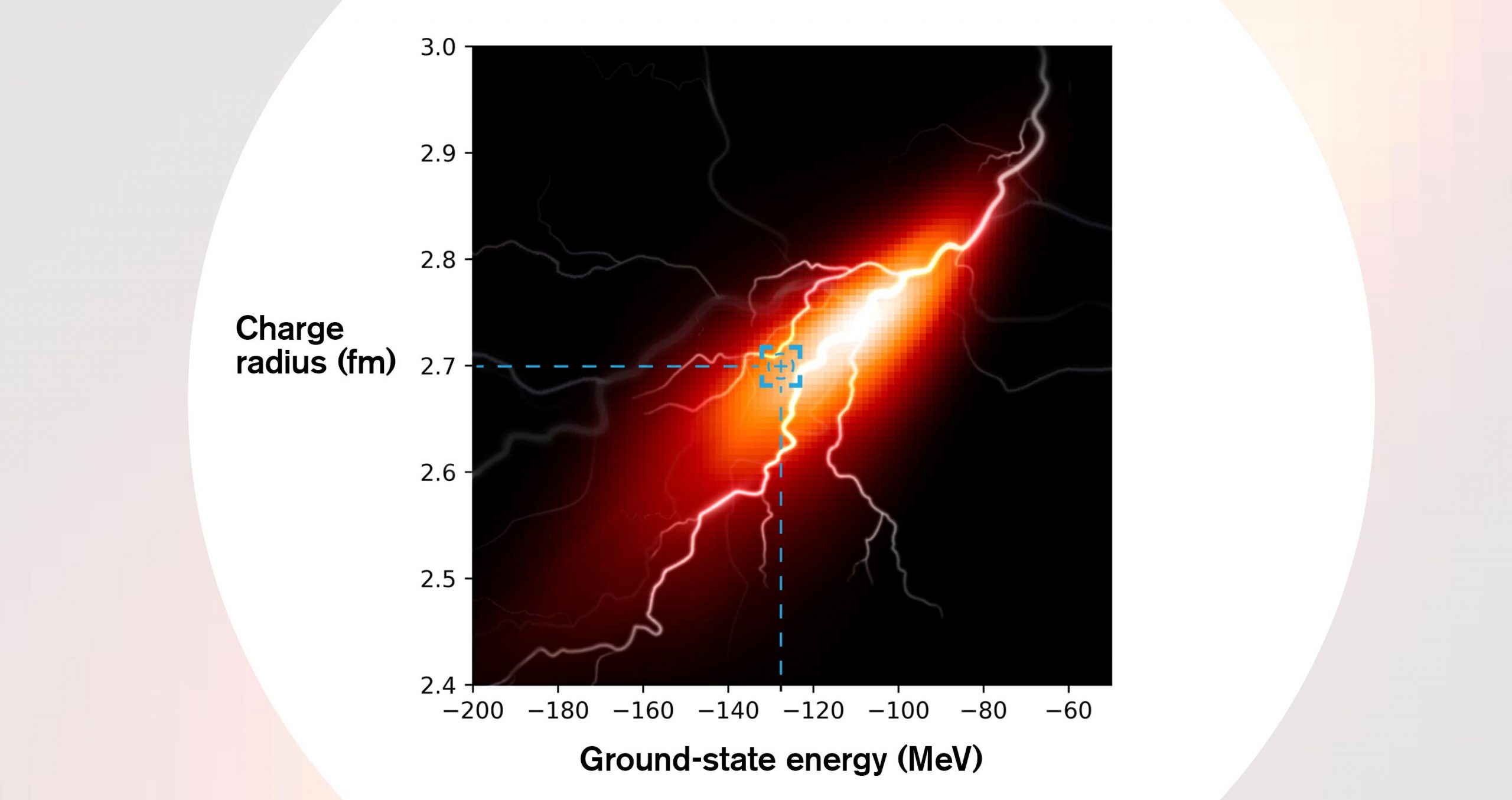
    Parametrisations Strong Nuclear Interaction
    Plot of the energy and radius of the oxygen isotope 16-O for 100,000 different parametrizations of the strong nuclear interaction. Using the new method, the results were generated within a few minutes on a standard laptop. The dashed lines indicate the values of experimental data. Illustration: Andreas Ekström and Yen Strandqvist/Chalmers University of Technology. Credit: Andreas Ekström and Yen Strandqvist/Chalmers University of Technology

    If the emulator works well, it generates solutions that are almost exactly – circa 99 percent – similar to the solutions to the original problem. This is in many ways the same principles used in machine learning, but it is not a neural network or a Gaussian process – a completely new method underpins it. The EVC method for emulation is not limited to atomic nuclei, and the researchers are currently looking further into different types of applications.

    References:

    “Eigenvector continuation as an efficient and accurate emulator for uncertainty quantification” by S. König, A. Ekström, K. Hebeler, D. Lee and A. Schwenk, 30 September 2020, Physics Letters B.
    DOI: 10.1016/j.physletb.2020.135814

    “Global Sensitivity Analysis of Bulk Properties of an Atomic Nucleus” by Andreas Ekström and Gaute Hagen, 20 December 2019, Physical Review Letters.
    DOI: 10.1103/PhysRevLett.123.252501

    Never miss a breakthrough: Join the SciTechDaily newsletter.
    Follow us on Google and Google News.

    Algorithm Chalmers University of Technology Particle Physics Popular
    Share. Facebook Twitter Pinterest LinkedIn Email Reddit

    Related Articles

    A New Way to Search for Dark Matter Particles Reveals Hidden Materials Properties

    Physicists Use Cheap Colliders to Probe for Heavy Photons

    Quantum Interference Shown Experimentally in Larger Molecules

    ICARUS Experiment Claims Neutrinos Aren’t Faster Than Light

    More Data of Elusive Higgs Boson from Defunct US Tevatron Collider

    Evidence of Elusive Majorana Fermions Raises Possibilities for Quantum Computing

    Possible Mistakes Found in Faster Than Light Neutrino Measurement

    Quantum Entanglement of 8 Photons Successfully Accomplished by Physicists

    Higgs Boson Signals Gain Strength at Large Hadron Collider

    1 Comment

    1. Anon on February 1, 2021 11:59 am

      I am proud of them. I wish I could have a chance to test it. But man, if they let people use this. It will be a game-changer.

      Reply
    Leave A Reply Cancel Reply

    • Facebook
    • Twitter
    • Pinterest
    • YouTube

    Don't Miss a Discovery

    Subscribe for the Latest in Science & Tech!

    Trending News

    Millions of People Have Osteopenia Without Realizing It – Here’s What You Need To Know

    Researchers Discover Boosting a Single Protein Helps the Brain Fight Alzheimer’s

    World-First Study Reveals Human Hearts Can Regenerate After a Heart Attack

    Why Your Dreams Feel So Real Sometimes and So Strange Other Times

    This Simple Home Device May Boost Brain Power in Adults Over 40

    Enormous Prehistoric Insects Puzzle Scientists

    Scientists Develop Bioengineered Chewing Gum That Could Help Fight Oral Cancer

    After 37 Years, the World’s Longest-Running Soil Warming Experiment Uncovers a Startling Climate Secret

    Follow SciTechDaily
    • Facebook
    • Twitter
    • YouTube
    • Pinterest
    • Newsletter
    • RSS
    SciTech News
    • Biology News
    • Chemistry News
    • Earth News
    • Health News
    • Physics News
    • Science News
    • Space News
    • Technology News
    Recent Posts
    • The Milky Way Has a Hidden Edge and Scientists Finally Mapped It
    • Scientists Stunned by New Organic Molecules Found on Mars
    • Scientists Discover Evolution’s 120-Million-Year-Old “Cheat Sheet”
    • This New “Sound Laser” Could Measure Gravity With Stunning Precision
    • Quantum Breakthrough: New Algorithm Solves “Impossible” Materials in Seconds
    Copyright © 1998 - 2026 SciTechDaily. All Rights Reserved.
    • Science News
    • About
    • Contact
    • Editorial Board
    • Privacy Policy
    • Terms of Use

    Type above and press Enter to search. Press Esc to cancel.