
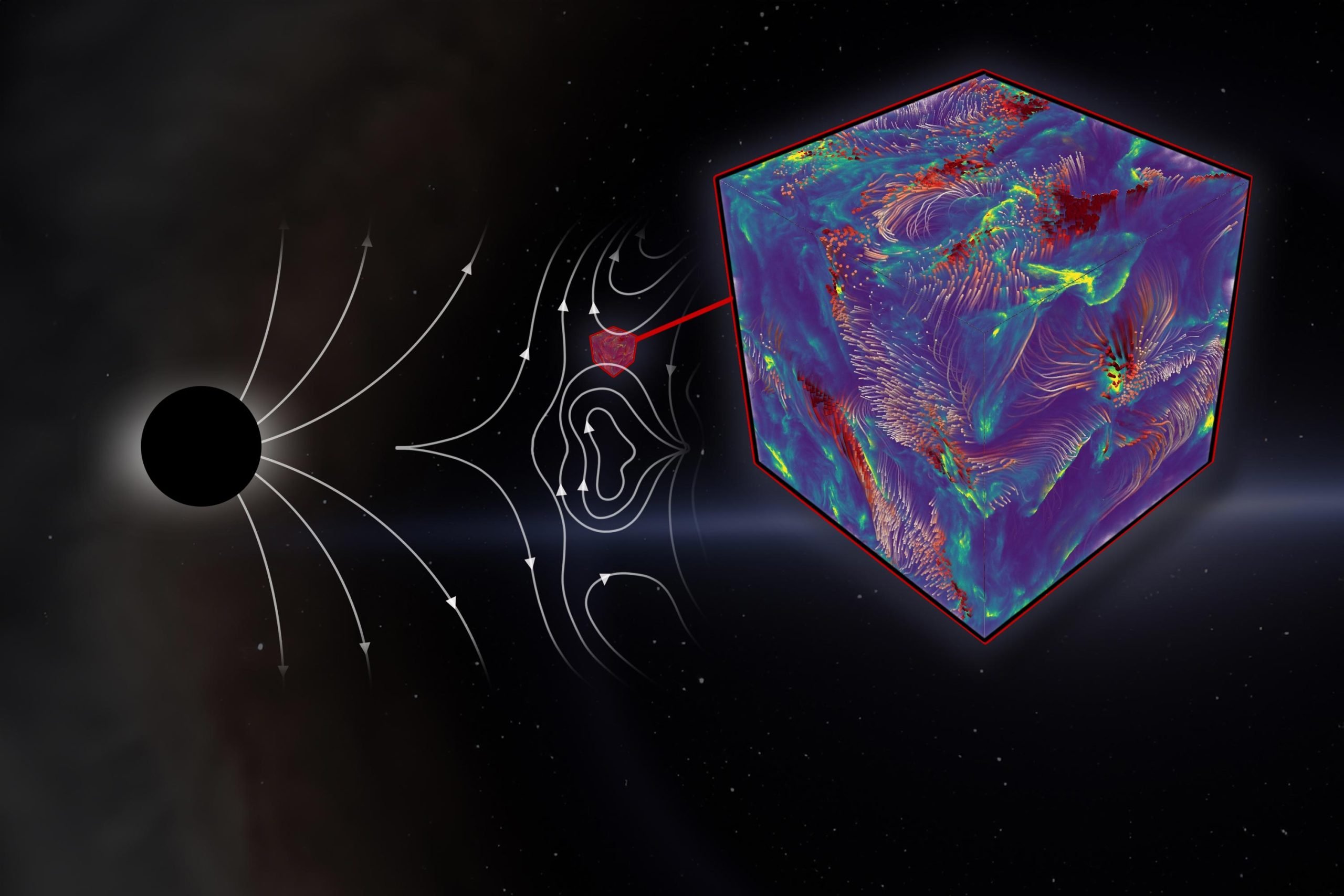
Researchers at the University of Helsinki have advanced our understanding of black holes using supercomputer simulations, revealing how magnetic fields cause turbulence that heats plasma and produces X-ray radiation observable from Earth.
Their groundbreaking study, which included all significant quantum interactions between radiation and plasma, shows that the plasma around black holes can exist in two states, contributing significantly to our knowledge of cosmic phenomena.
Using detailed supercomputer simulations, scientists at the University of Helsinki modeled the interactions between radiation, plasma, and magnetic fields around black holes. It was found that the chaotic movements, or turbulence, caused by the magnetic fields heat the local plasma and make it radiate.
Understanding Black Hole Dynamics
A black hole is created when a large star collapses into such a dense concentration of mass that its gravity prevents even light from escaping its sphere of influence. This is why, instead of direct observation, black holes can only be observed through their indirect effects on the environment.
Most of the observed black holes have a companion star, with which they form a binary star system. In the binary system, the two objects orbit each other, and the matter of the companion star slowly spirals into the black hole. This slowly flowing stream of gas often forms an accretion disk around the black hole, a bright, observable source of X-rays.
Advanced Modeling of Accretion Disks
Since the 1970s, attempts have been made to model the radiation from the accretion flows around the black holes. At the time, X-rays were already thought to be generated through the interaction of the local gas and magnetic fields, similar to how the Sun’s surroundings are heated by its magnetic activity via solar flares.
“The flares in the accretion disks of black holes are like extreme versions of solar flares,” says Associate Professor Joonas Nättilä. Nättilä heads the Computational Plasma Astrophysics research group at the University of Helsinki, which specializes in modeling precisely this kind of extreme plasma.
Quantum Phenomena in Plasma Dynamics
The simulations demonstrated that the turbulence around the black holes is so strong that even quantum effects become important for the plasma dynamics.
In the modeled mixture of electron-positron plasma and photons, the local X-ray radiation can turn into electrons and positrons, which can then annihilate back into radiation, as they come in contact.
Nättilä describes how electrons and positrons, antiparticles to one another, usually do not occur in the same place. However, the extremely energetic surroundings of black holes make even this possible. In general, radiation does not interact with plasma either. However, photons are so energetic around black holes that their interactions are important to plasma, too.
“In everyday life, such quantum phenomena where matter suddenly appears in place of extremely bright light are, of course, not seen, but near black holes, they become crucial,” Nättilä says.
“It took us years to investigate and add to the simulations all quantum phenomena occurring in nature, but ultimately, it was worth it,” he adds.
Insights From Turbulent Plasma and Radiation
The study demonstrated that turbulent plasma naturally produces the kind of X-ray radiation observed from the accretion disks. The simulation also made it possible, for the first time, to see that the plasma around black holes can be in two distinct equilibrium states, depending on the external radiation field. In one state, the plasma is transparent and cold, while in the other, it is opaque and hot.
“The X-ray observations of black hole accretion disks show exactly the same kind of variation between the so-called soft and hard states,” Nättilä points out.
The study was published in the esteemed journal Nature Communications. The simulation used in the study is the first plasma physics model to include all the important quantum interactions between radiation and plasma.
Reference: “Radiative plasma simulations of black hole accretion flow coronae in the hard and soft states” by Joonas Nättilä, 15 August 2024, Nature Communications.
DOI: 10.1038/s41467-024-51257-1
The study is part of a project headed by Nättilä and funded with a €2.2 million Starting Grant from the European Research Council, which aims to understand interactions between plasma and radiation.
Never miss a breakthrough: Join the SciTechDaily newsletter.
Follow us on Google and Google News.
3 Comments
The cavity formed by the liquid to gas phase transition may pull (dark) matter and antimatter into the fabric of spacetime resulting in heat flow into spacetime and +? into the fabric of spacetime while accelerating the dark matter there up and out of the gravity well. The gas to liquid phase transition pulls heat from spacetime into the fabric of spacetime with heat flow out of spacetime and +? out of the fabric of spacetime.
Researchers at the University of Helsinki have advanced our understanding of black holes using supercomputer simulations, revealing how magnetic fields cause turbulence that heats plasma and produces X-ray radiation observable from Earth. The study was published in the journal Nature Communications. Nature Communications is a member of the Nature family journal. The so-called academic journals Nature family firmly believe, at the origin of the Universe, an asymmetry between the amount of created matter and antimatter led to the matter-dominated Universe as we know it today (https://www.nature.com/articles/s41586-024-07823-0).
Ask the Nature magazine.
1. How do scientific experiments simultaneously observe matter and antimatter?
2. How do scientific experiments simultaneously measure matter and antimatter?
3. How can scientific experiments ensure that the things they measure are always matter and antimatter?
4. Does mathematics tell Nature magazine that matter and antimatter are asymmetric?
and so on.
From Physical Review Letters (PRL), to Nature and Science, and even the Proceedings of the National Academy of Sciences (PNAS), the so-called academic journals firmly believe that two high-dimensional spacetime objects (such as two sets of cobalt-60) rotating in opposite directions can be transformed into two objects that mirror each other. Is it scientific? Why does the so-called academic journals (such as Physical Review Letters, Nature, Science, the Proceedings of the National Academy of Sciences, etc.) insist on using CP violations to open the dirtiest and ugliest era in the history of science?
These so-called academic publications have undoubtedly degenerated into malignant tumors that hinder scientific development and progress.
Please ask researchers to think deeply:
1. Where does the magnetic field come from?
2. Where does the electric field come from?
3. Where does the gravitational field come from?
and so on.
Scientific research guided by correct theories can help humanity avoid detours, failures, and pomposity. Please witness the exemplary collaboration between theoretical physicists and experimentalists (https://scitechdaily.com/microscope-spacecrafts-most-precise-test-of-key-component-of-the-theory-of-general-relativity/#comment-854286). Some people in contemporary physics has always lived in a self righteous children’s story world. Whose values have been overturned by such a comical and ridiculous reality?
Space has physical properties of zero viscosity and absolute incompressibility. Zero viscosity and absolute incompressibility are physical characteristics of ideal fluids. The space with ideal fluid physical characteristics forms vortices via topological phase transitions, which is not difficult to understand mathematically. Once the topological vortex is formed, it occupies space and maintains its presence in time. This is the transition from chaos to order via two bidirectional coupled continuous chaotic systems. Topological vortex and its anti-vortex are two objects with identical spatiotemporal structures. In the subsequent interactions, they merge into the vast material world and are absolutely indistinguishable.
Symmetry of topological vortex can be used to explore particle behavior under spatial, temporal, and quantum number reversals, involving quantum gravity, discrete and continuous changes. It underpins the consistency of natural laws and experiment reproducibility.
The perpetually swirling topological vortices defy traditional physics’ expectations potentially unveiling new particles and forces, and can have an heavily influencing to traditional physics theories. In a pivotal discovery, researchers have identified a fundamental link between quantum entanglement and topology (https://scitechdaily.com/quantum-entanglements-new-dimension-a-topological-breakthrough/).
Ask researchers:
1. Is quantum gravity related to the spin of topological vortices?
2. Is quantum entanglement related to the spacetime entanglement of topological vortices?
3. Can low dimensional spacetime matter be a component of high-dimensional spacetime matter?
The physical phenomena observed in physics experiments can never be the natural essence of things. The natural essence of things needs to be extracted and sublimated via mathematical theories based on natural phenomena. The research on X-rays should be conducted in the same way.
From Physical Review Letters (PRL), to Nature, and Science, even the Proceedings of the National Academy of Sciences (PNAS), the so-called academic journals firmly believe that the asymmetry between the amount of created matter and antimatter led to the matter-dominated Universe as we know it today. Does mathematics tell the so-called academic journals that matter and antimatter are asymmetric? When physics no longer believes in mathematics, it is no different from theology.
topological vortices and their anti-vortices are two bidirectional coupled continuous chaotic systems. Matter and antimatter are mainly manifested between topological vortices and their anti-vortices, and it is difficult to manifest between high-dimensional spacetime matter formed by their interactions. CP violation opened the dirtiest and ugliest era in the history of science.