
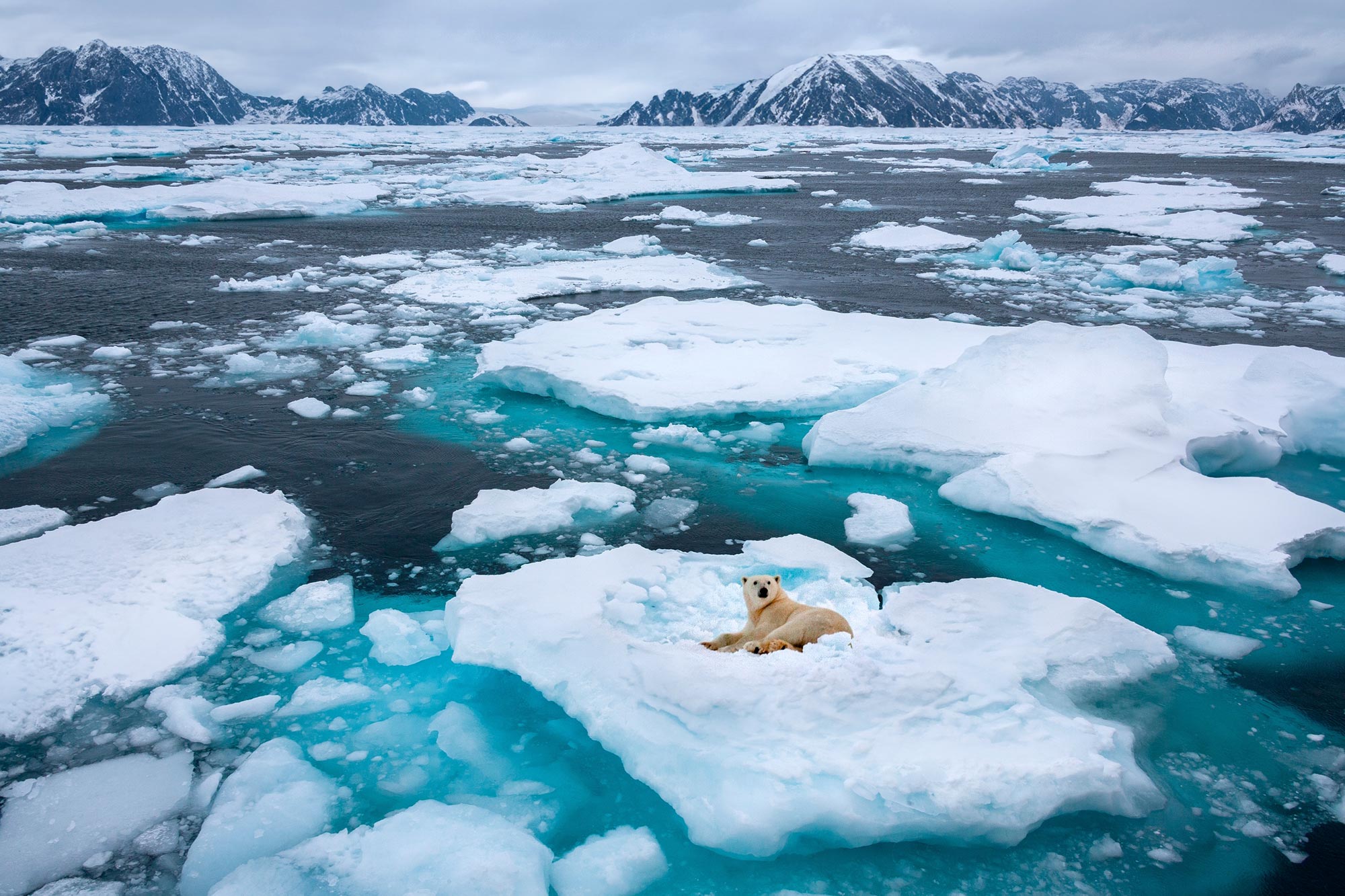
Scientists discovered that Greenland’s ice sheet may be slowly churning deep below the surface, revealing a hidden process shaping its future.
Buried far beneath Greenland’s vast ice sheet, scientists have identified enormous swirling, plume-like formations. These unusual structures have baffled researchers for more than ten years. Now, scientists at the University of Bergen (UiB) believe they have found an explanation by applying mathematical models similar to those used to study how continents slowly separate over time.
Thermal Convection Explains Mysterious Ice Movement
New research suggests these hidden plumes are created by thermal convection, a slow, circulating motion driven by temperature differences between deeper and shallower layers of ice. This type of movement is more commonly associated with the intense heat and flow inside Earth’s mantle.
”We typically think of ice as a solid material, so the discovery that parts of the Greenland ice sheet actually undergo thermal convection, resembling a boiling pot of pasta, is as wild as it is fascinating,” says Andreas Born, professor at the Bjerknes Centre for Climate Research and the Department of Earth Science at UiB.
Born has spent more than 15 years studying ice sheets across the Northern hemisphere and is a co-author of the study.
A Surprising “Freak of Nature” Beneath Kilometers of Ice
The idea that ice can behave this way challenges common expectations, but the underlying physics supports it.

The study has been published in the journal The Cryosphere, where it was selected as a ‘highlight paper’ because of its importance.
According to Born, the findings could improve how scientists model the future of ice sheets and rising sea levels.
“Our discovery could be key to reducing uncertainties in models of future ice sheet mass balance and sea-level rise,” he says.
Softer Ice Does Not Mean Faster Melting
The research indicates that ice deep within northern Greenland may be about ten times softer than previously believed. However, this does not automatically mean that melting will accelerate.

“Improving our understanding of ice physics is a really major way to be more certain about the future,” says Law, “but on its own, softer ice does not necessarily mean that the ice will melt faster or that sea level rise will be higher. We need further studies to fully isolate that.”
Greenland often makes headlines due to mining, geopolitics, and climate concerns. Law emphasizes that these findings do not signal an impending crisis but instead reveal how complex and dynamic the ice sheet truly is.
“Greenland and its nature is truly special. The ice sheet there is over one thousand years old, and it’s the only ice sheet on Earth to have a culture and permanent population at its margins,” he says. “The more we learn about the hidden processes inside the ice, the better prepared we’ll be for the changes coming to coastlines around the world.”
Reference: “Exploring the conditions conducive to convection within the Greenland Ice Sheet” by Robert Law, Andreas Born, Philipp Voigt, Joseph A. MacGregor and Claire Marie Guimond, 13 February 2026, The Cryosphere.
DOI: 10.5194/tc-20-1071-2026
The study was conducted by researchers from the University of Bergen (Department of Earth Sciences and the Bjerknes Centre for Climate Research), working with collaborators from NASA Goddard Space Flight Center, the University of Oxford, and ETH Zurich.
The team explored whether the large plume-like structures deep within the Greenland ice sheet could be explained by thermal convection, and what this might reveal about the softness and movement of the ice.
Their findings indicate that these structures are likely produced by thermal convection, a slow churning process inside the ice driven by temperature differences. The results also suggest that deep ice in northern Greenland could be about ten times softer than previously assumed.
Because softer ice influences how the ice sheet flows, this discovery could help improve predictions of future sea level rise.
Never miss a breakthrough: Join the SciTechDaily newsletter.
Follow us on Google and Google News.
2 Comments
“New research suggests these hidden plumes are created by thermal convection, …”
Strangely, no one seems to be asking the question where the heat energy comes from to drive the convection. Might it be the result of geothermal hot-spots overridden by the ice sheet?
Do we not assume that there are no non-geothermal lateral and vertical temperature gradients with ice-caps? Just a couple of degrees C variation locally would lead to local, although not melodramatic, thermal gradients.