
Close Menu
    Facebook X (Twitter) Instagram
    SciTechDaily
    • Biology
    • Chemistry
    • Earth
    • Health
    • Physics
    • Science
    • Space
    • Technology
    Facebook X (Twitter) Pinterest YouTube RSS
    SciTechDaily
    Home»Space»Space Winds Unleashed: First Map of Outflows From Nearby Quasar I Zwicky 1
    Space

    Space Winds Unleashed: First Map of Outflows From Nearby Quasar I Zwicky 1

    By SRON Netherlands Institute for Space ResearchJune 16, 2024No Comments3 Mins Read
    Facebook Twitter Pinterest Telegram LinkedIn WhatsApp Email Reddit
    Share
    Facebook Twitter LinkedIn Pinterest Telegram Email Reddit
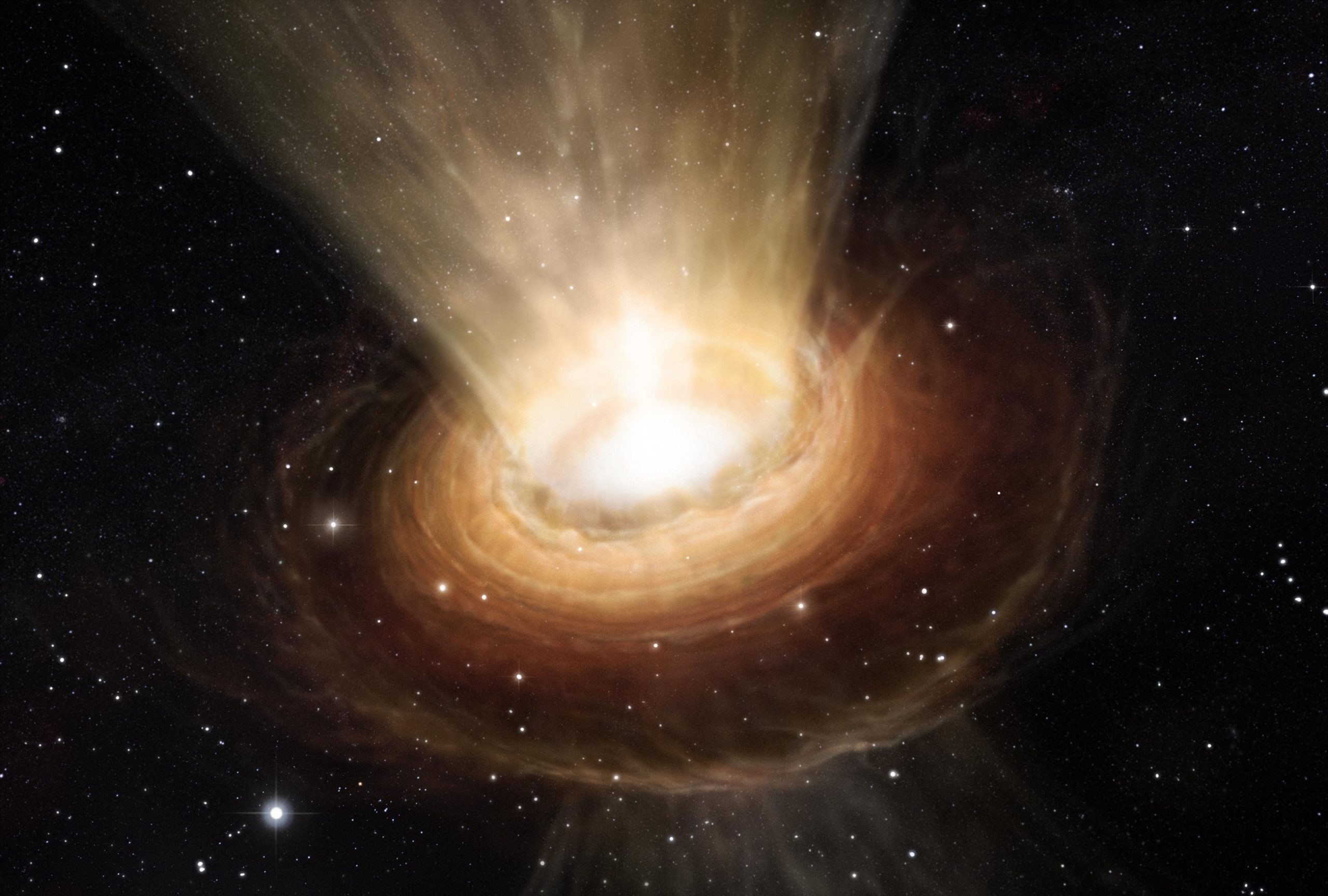
    Supermassive Black Hole in NGC 3783
    This artist’s impression shows the surroundings of the supermassive black hole at the heart of the active galaxy NGC 3783 in the southern constellation of Centaurus (The Centaur). New observations using the Very Large Telescope Interferometer at ESO’s Paranal Observatory in Chile have revealed not only the torus of hot dust around the black hole but also a wind of cool material in the polar regions. Credit: ESO/M. Kornmesser

    For the first time, astronomers mapped the outflows from one of the closest quasars — I Zwicky 1.

    Quasars are bright cores of galaxies powered by the supermassive black hole in their center. The team has probed gas outflows in I Zwicky 1 to map its system of clouds being blown away at tens to thousands of kilometers per second.

    Most galaxies, including our Milky Way, harbor a supermassive black hole in their center. These typically weigh millions of times the mass of our Sun. Many of them keep lurking in the blackness of space, with little to give them away. Some have, however, large deposits of material in their vicinity to feed on. This turns their vicinity into a brilliant beacon, outshining the entire host galaxy. Given their compact size and large distance from Earth, these active galactic nuclei appear as bright dots, like the Milky Way stars. This is also why they were historically classified as quasi-stellar objects (quasars).

    Most quasars reside in the distant, early Universe, but I Zwicky 1 is relatively close at less than a billion lightyears away from Earth. This provides astronomers with a convenient laboratory for studying the extreme conditions in quasars. A team of astronomers led by Anna Juráňová (SRON), including Elisa Costantini (SRON), has now for the first time mapped its outflows. Using the Hubble Space Telescope, they recovered the properties of four outflows of ionized gas clouds, being blown out at speeds of 60, 280, 1950, and 2900 kilometers per second.

    “I Zwicky 1 is very special in its properties,” says Juráňová. “Other quasars have similar outflows, but in this one, everything is just right. Our viewing angle, the width of the lines in the spectrum, and so on. This allows us to dig much deeper into its processes. We have created a global picture of the motions of the ionized gas in a quasar, which is rare.”

    The team found that one of the outflows was trapped in the shadow of another one. This results from the strong radiation from the quasar pushing the clouds out and away from the vicinity of the black hole. Ions of elements such as nitrogen, oxygen, and carbon within the gas clouds absorb the quasar’s ultraviolet light and get pushed away as a consequence. I Zwicky 1 is the nearest quasar offering concrete evidence of this mechanism at play.

    The environment around I Zwicky 1 appears more dynamic than what astronomers often see around nearby supermassive black holes. Juráňová: “Our data suggest that far more gas is being lifted and blown out from the disc around the black hole. Having this insight brings us closer to unraveling the way these supermassive black holes grow and interact with their surroundings.”

    Reference: “The outflowing ionised gas of I Zw 1 observed by HST COS” by A. Juráňová, E. Costantini, G. A. Kriss, M. Mehdipour, W. N. Brandt, L. Di Gesu, A. C. Fabian, L. Gallo, M. Giustini, D. Rogantini and D. R. Wilkins, 11 June 2024, Astronomy & Astrophysics.
    DOI: 10.1051/0004-6361/202449544

    Never miss a breakthrough: Join the SciTechDaily newsletter.
    Follow us on Google and Google News.

    Astronomy Astrophysics Quasars SRON Netherlands Institute for Space Research
    Share. Facebook Twitter Pinterest LinkedIn Email Reddit

    Related Articles

    Seeing Quadruple: Artificial Intelligence Leads to Discovery That Can Help Solve Cosmological Puzzles

    Record-Breaking Jet of Particles Spied From a Supermassive Black Hole in the Early Universe

    Massive X-ray Jet – Extending for 160,000 Light-Years – Spied From Supermassive Black Hole in Early Universe

    Astronomers Have Discovered the Most Distant Source of Radio Emission Ever Known – 13 Billion Light-Years Away

    A Most Distant Signal: Earliest Supermassive Black Hole and Quasar in the Universe Discovered

    Astronomers Discover Evidence for Substance on Liquid-Gas Boundary on Exoplanet WASP-31b

    Puzzling Astrophysics of Quasars in the Early Universe

    Astronomers Discover Earliest Supermassive Black Hole and Quasar in the Universe – 1000x More Luminous Than the Milky Way

    Most Distant Quasar Discovered Sheds Light on How Supermassive Black Holes Grow

    Leave A Reply Cancel Reply

    • Facebook
    • Twitter
    • Pinterest
    • YouTube

    Don't Miss a Discovery

    Subscribe for the Latest in Science & Tech!

    Trending News

    The Universe Is Expanding Too Fast and Scientists Can’t Explain Why

    “Like Liquid Metal”: Scientists Create Strange Shape-Shifting Material

    Early Warning Signals of Esophageal Cancer May Be Hiding in Plain Sight

    Common Blood Pressure Drug Shows Surprising Power Against Deadly Antibiotic-Resistant Superbug

    Scientists Uncover Dangerous Connection Between Serotonin and Heart Valve Disease

    Scientists Discover a “Protector” Protein That Could Help Reverse Hair Loss

    Bone-Strengthening Discovery Could Reverse Osteoporosis

    Scientists Uncover Hidden Trigger Behind Stem Cell Aging

    Follow SciTechDaily
    • Facebook
    • Twitter
    • YouTube
    • Pinterest
    • Newsletter
    • RSS
    SciTech News
    • Biology News
    • Chemistry News
    • Earth News
    • Health News
    • Physics News
    • Science News
    • Space News
    • Technology News
    Recent Posts
    • Scientists Overcome Major Quantum Bottleneck, Potentially Transforming Teleportation and Computing
    • Quantum Physics’ Strangest Problem May Hold the Key to Time Itself
    • Scientists Create “Liquid Gears” That Spin Without Touching
    • The Simple Habit That Could Help Prevent Cancer
    • Forgotten Medicinal Plant Shows Promise in Fighting Dangerous Superbugs
    Copyright © 1998 - 2026 SciTechDaily. All Rights Reserved.
    • Science News
    • About
    • Contact
    • Editorial Board
    • Privacy Policy
    • Terms of Use

    Type above and press Enter to search. Press Esc to cancel.