
Close Menu
    Facebook X (Twitter) Instagram
    SciTechDaily
    • Biology
    • Chemistry
    • Earth
    • Health
    • Physics
    • Science
    • Space
    • Technology
    Facebook X (Twitter) Pinterest YouTube RSS
    SciTechDaily
    Home»Space»Spitzer Views Galaxy Messier 94 and Its “Starburst Ring”
    Space

    Spitzer Views Galaxy Messier 94 and Its “Starburst Ring”

    By Whitney Clavin, Jet Propulsion LaboratoryMay 17, 2013No Comments3 Mins Read
    Facebook Twitter Pinterest Telegram LinkedIn WhatsApp Email Reddit
    Share
    Facebook Twitter LinkedIn Pinterest Telegram Email Reddit
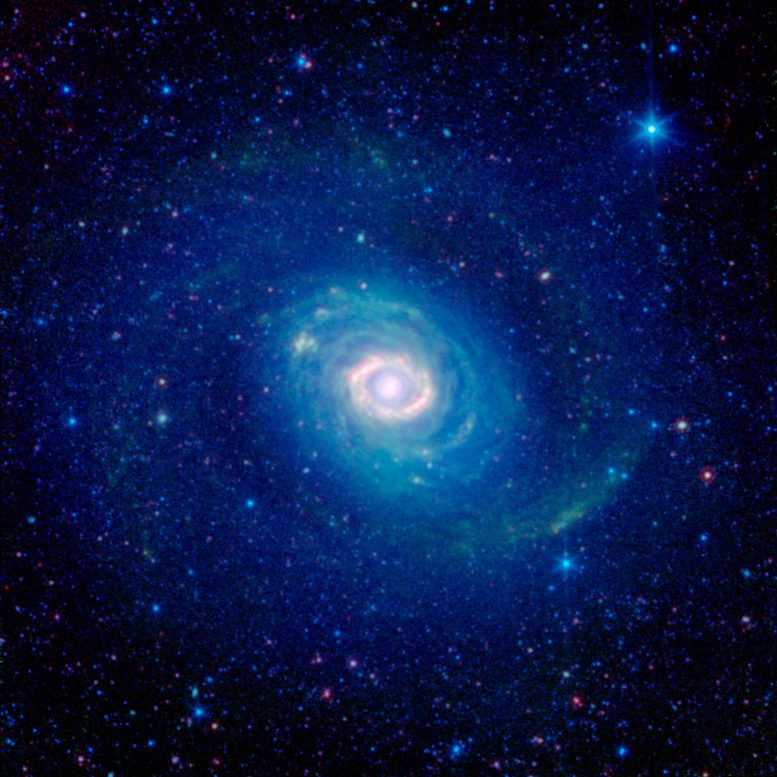
    New Image of the Galaxy Messier 94 also Known as NGC 4736
    New image of Messier 94, also known as NGC 4736. Credit: NASA/JPL-Caltech

    NASA’s Spitzer Space Telescope captured this new image of Messier 94, also known as NGC 4736, which is located about 17 million light-years away.

    How many rings do you see in this new image of the galaxy Messier 94, also known as NGC 4736? While at first glance one might see a number of them, astronomers believe there is just one. This image was captured in infrared light by NASA’s Spitzer Space Telescope.

    Historically, Messier 94 was considered to have two strikingly different rings: a brilliant, compact band encircling the galaxy’s core, and a faint, broad, swath of stars falling outside its main disk.

    Astronomers have recently discovered that the outer ring, seen here in the deep blue glow of starlight, might actually be more of an optical illusion. A 2009 study combined infrared Spitzer observations with those from other telescopes, including ultraviolet data from NASA’s Galaxy Evolution Explorer, now operated by the California Institute of Technology, Pasadena; visible data from the Sloan Digital Sky Survey; and shorter-wavelength infrared light from the Two Micron All Sky Survey (2MASS). This more complete picture of Messier 94 indicates that we are really seeing two separate spiral arms, which, from our perspective, take on the appearance of a single, unbroken ring.

    The bright inner ring of Messier 94 is very real, however. This area is sometimes identified as a “starburst ring” because of the frenetic pace of star formation in the confined area. Starbursts like this can often be triggered by gravitational encounters with other galaxies, but in this case might be caused by the galaxy’s oval shape. Gas in the ring is being converted into hot, young stars, which then warm the dust, causing it to glow with infrared light.

    The outer, faint blue ring around the galaxy might be an optical illusion. Astronomers think that two separate spiral arms appear as a single unbroken ring when viewed from our position in space.

    Tucked in between the inner starburst ring and the outer ring-like arms is the galaxy’s disk, striated with greenish filaments of dust. While these dusty arcs look like a collection of rings, they actually follow tightly wound spiral arcs.

    Infrared light with wavelengths of 3.6 and 4.5 microns is represented in blue/cyan, and primarily shows the glow from starlight. Light of 8 microns is rendered in green, and 24-micron emission is red, tracing the cooler and warmer components of dust, respectively. The image was taken in 2004, before Spitzer ran out of cryogen.

    The 2MASS mission was a joint effort between the California Institute of Technology, Pasadena, California, the University of Massachusetts and NASA’s Jet Propulsion Laboratory, Pasadena, California. Data are archived at the Infrared Processing and Analysis Center at Caltech.

    NASA’s Jet Propulsion Laboratory, Pasadena, California, manages the Spitzer Space Telescope mission for NASA’s Science Mission Directorate, Washington. Science operations are conducted at the Spitzer Science Center at the California Institute of Technology in Pasadena. Data are archived at the Infrared Science Archive housed at the Infrared Processing and Analysis Center at Caltech. Caltech manages JPL for NASA.

    Never miss a breakthrough: Join the SciTechDaily newsletter.
    Follow us on Google and Google News.

    Astronomy JPL NASA Spitzer Space Telescope
    Share. Facebook Twitter Pinterest LinkedIn Email Reddit

    Related Articles

    Baby Star “Burps” Tell Tales of Surprisingly Frantic Feeding – “It’s Literally the Process of Star Creation in Real-Time”

    NASA Discovers Pair of Super-Earths With 1,000-Mile-Deep Oceans

    A Cosmic Tale of Death & Dust Revealed in Orion Constellation

    Godzilla Nebula: A “Monster” Star-Forming Region Spied by NASA’s Spitzer Space Telescope

    Hidden Supernova: Stars Are Exploding in Dusty Galaxies – We Just Can’t Always See Them

    Patterns of Light Appear to be From the First Stars and Galaxies

    Sombrero Galaxy Exhibits Dual Characteristics

    Searching for “Bubbles” in the Milky Way

    NASA’s Spitzer Space Telescope Finds Solid Buckyballs in Space

    Leave A Reply Cancel Reply

    • Facebook
    • Twitter
    • Pinterest
    • YouTube

    Don't Miss a Discovery

    Subscribe for the Latest in Science & Tech!

    Trending News

    Your Blood Pressure Reading Could Be Wrong Because of One Simple Mistake

    Astronomers Stunned by Ancient Galaxy With No Spin

    Physicists May Be on the Verge of Discovering “New Physics” at CERN

    Scientists Solve 320-Million-Year Mystery of Reptile Skin Armor

    Scientists Say This Daily Walking Habit May Be the Secret to Keeping Weight Off After Dieting

    New Therapy Rewires the Brain To Restore Joy in Depression Patients

    Giant Squid Detected off Western Australia in Stunning Deep-Sea Discovery

    Popular Sugar-Free Sweetener Linked to Liver Disease, Study Warns

    Follow SciTechDaily
    • Facebook
    • Twitter
    • YouTube
    • Pinterest
    • Newsletter
    • RSS
    SciTech News
    • Biology News
    • Chemistry News
    • Earth News
    • Health News
    • Physics News
    • Science News
    • Space News
    • Technology News
    Recent Posts
    • Mixing Edible Cannabis and Alcohol May Impair Driving More Than Scientists Expected
    • Scientists Reverse Stroke Damage Using Stem Cells in Breakthrough Study
    • Eating One Egg a Day Could Cut Alzheimer’s Risk by 27%
    • Hidden Warm Water Beneath Antarctica Could Rapidly Raise Global Sea Levels
    • Scientists Revive Ancient Chemistry Trick To Engineer Next-Generation Glass
    Copyright © 1998 - 2026 SciTechDaily. All Rights Reserved.
    • Science News
    • About
    • Contact
    • Editorial Board
    • Privacy Policy
    • Terms of Use

    Type above and press Enter to search. Press Esc to cancel.