
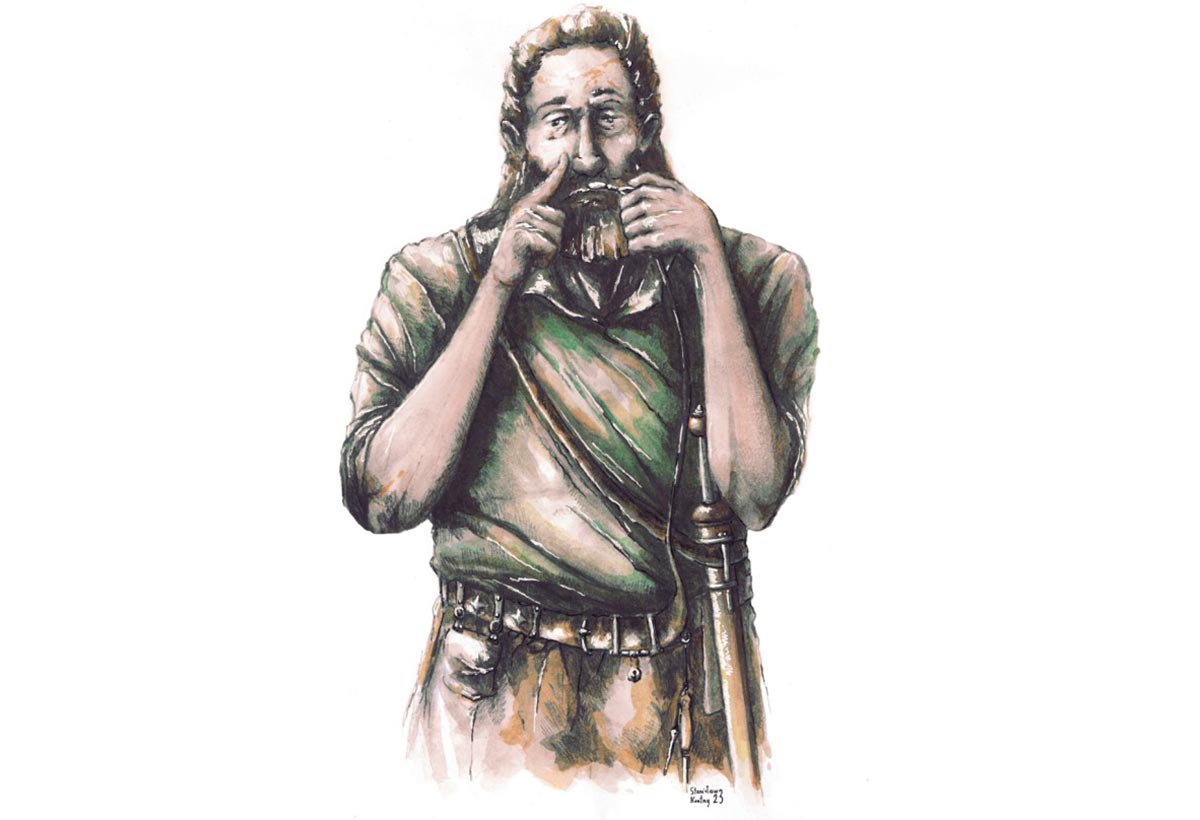
Recent discoveries suggest that small spoon-shaped objects attached to the belts of ancient Northern European warriors might have been used to measure doses of stimulants before battle.
These findings, uncovered through the combined efforts of archaeologists and biologists, propose a widespread use of natural stimulants among the Germanic peoples during the Roman period, challenging the notion that these groups primarily consumed alcohol. The use of such substances could have been crucial not only in warfare but also in medicinal and ritual practices, indicating sophisticated knowledge of natural resources and their applications.
Discovery of Ancient Stimulant Tools
Small, spoon-shaped artifacts found attached to warriors’ belts at archaeological sites across northern Europe may have been used to measure and dispense stimulants before battle, according to a new study in the journal Praehistorische Zeitschrift.
While the use of narcotics like opium in ancient Greece and Rome is well-documented through historical records and archaeological finds, there is little evidence of similar practices among the so-called barbarian peoples living beyond the Roman Empire. Historically, it has been assumed that these groups primarily consumed alcohol and made limited use of other psychoactive substances.
New Insights from Modern Analysis
However, new analyses led by archaeologist Prof. Andrzej Kokowski and biologists from Maria Curie-Skłodowska University in Lublin, Poland, challenge this view, offering fresh insights into the possible use of stimulants among these ancient societies.
The researchers identified and categorized 241 small, spoon-shaped objects found at 116 sites dating from the Roman period, primarily marsh sites and graves in modern-day Scandinavia, Germany, and Poland. The objects have handles, mostly between 40 and 70mm long, and either a concave bowl or flat disk measuring 10 to 20mm across. They were attached to a man’s belt, but played no role in its functioning.
The Role of Stimulants in Ancient Warfare
All of these objects were found together with items used in warfare. Stimulants may have been widely used throughout history to motivate soldiers to increase their exertion and also to reduce the stress and fear caused by warfare. The warriors could have used these objects to measure the right dose to produce the desired effects and to reduce the possibility of an overdose.
Prof. Kokowski and colleagues then surveyed which stimulants could have been available to the Germanic communities of the Roman period, either plants gathered locally or transported in dry form from further afield. They conclude that it was highly likely that Germanic peoples would have had access to a wide range of substances that could function as stimulants including poppy, hops, hemp, henbane, belladonna, and various fungi. These could have been consumed either in liquid form, especially dissolved in alcohol, or in powdered form.
Implications of Stimulant Use in Germanic Societies
The researchers conclude that the use of stimulants by the Germanic peoples of Northern Europe could have been extensive during military conflicts of the Roman period. Moreover, they note that to supply the quantity and type of stimulants needed would have required considerable knowledge and organization.
They further believe that the stimulants were probably also used for purposes other than warfare, such as in medicine and rituals: “It seems that the awareness of the effects of various types of natural preparations on the human body entailed knowledge of their occurrence, methods of application and the desire to consciously use this wealth for medicinal and ritual purposes.”
Reference: “In a narcotic trance, or stimulants in Germanic communities of the Roman period” by Anna Jarosz-Wilkołazka, Andrzej Kokowski and Anna Rysiak, 26 November 2024, Praehistorische Zeitschrift.
DOI: 10.1515/pz-2024-2017
Never miss a breakthrough: Join the SciTechDaily newsletter.
Follow us on Google and Google News.
2 Comments
Drug trances have been associated with the legends and records of berserker military forces. Of course, it could just be their lucky battle teaspoons. It’s a long shot, but mass spectrometry has found chemical residues in ancient amphorae and bowls, leading to resurrecting ancient beer and bread recipes, and and might give clues to the use of the spoons.
Too much coke in the lab?