

Summary: Stanford researchers have developed a breakthrough device called the milli-spinner thrombectomy, which uses compression and shear forces to safely shrink and remove blood clots, significantly improving first-attempt success rates in stroke and clot-related disease treatments.
Stanford’s milli‑spinner compacts clots into small balls for removal, improving clot extraction success. Beyond stroke treatment, it could clear kidney stones and other blockages.
When treating an ischemic stroke, where a blood clot blocks oxygen from reaching the brain, every minute is critical. The faster doctors can remove the clot and restore blood flow, the greater the chance of saving brain cells and improving patient recovery. However, current treatments only succeed in removing clots on the first attempt about 50% of the time, and they fail entirely in roughly 15% of cases.
Researchers at Stanford Engineering have introduced a new method called the milli-spinner thrombectomy, which may greatly improve these outcomes. In a paper published in Nature, the team demonstrated through flow models and animal studies that the milli-spinner performs significantly better than existing technologies, offering a faster, simpler, and more complete way to remove clots.
“For most cases, we’re more than doubling the efficacy of current technology, and for the toughest clots – which we’re only removing about 11% of the time with current devices – we’re getting the artery open on the first try 90% of the time,” said co-author Jeremy Heit, chief of Neuroimaging and Neurointervention at Stanford and an associate professor of radiology. “It’s unbelievable. This is a sea-change technology that will drastically improve our ability to help people.”
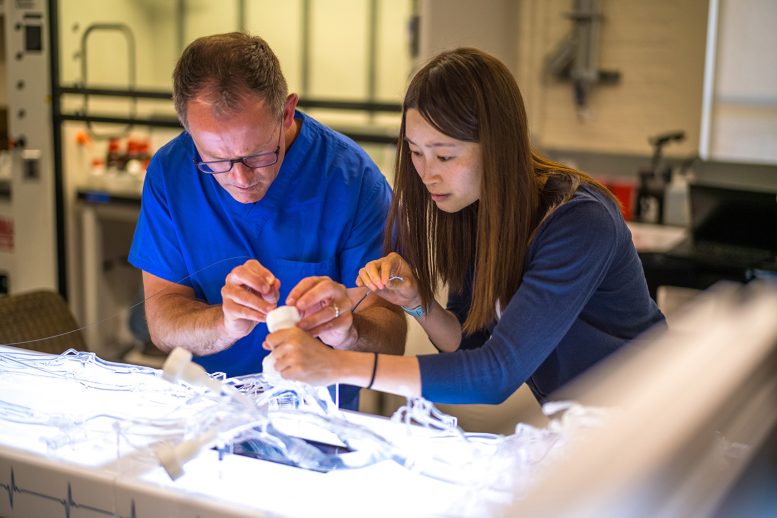
Taking advantage of tangles
Blood clots are bound by tangles of fibrin, a tough, thread-like protein that traps red blood cells and other materials to form a sticky mass. Doctors usually attempt to remove these clots by inserting a catheter into the artery and either vacuuming out the clot or capturing it with a wire mesh. However, these methods are not always effective and can break the fibrin threads, causing fragments of the clot to dislodge and become stuck in new, more difficult-to-reach areas.
“With existing technology, there’s no way to reduce the size of the clot. They rely on deforming and rupturing the clot to remove it,” said Renee Zhao, an assistant professor of mechanical engineering and senior author on the paper. “What’s unique about the milli-spinner is that it applies compression and shear forces to shrink the entire clot, dramatically reducing the volume without causing rupture.”
The milli-spinner, which also reaches the clot through a catheter, is a long, hollow tube that rotates rapidly. It features a series of fins and slits that generate localized suction near the clot. This setup applies two forces—compression and shear—to roll the fibrin threads into a compact ball without breaking them.
Think of a loose ball of cotton fibers, or a handful of hair pulled from a hairbrush. When you press it between your palms (compression) and move your hands in a circular motion (shear), the fibers tangle into a smaller, denser ball. The milli-spinner works the same way on fibrin threads, using suction to press the clot against the end of the tube while spinning rapidly to create the shear.
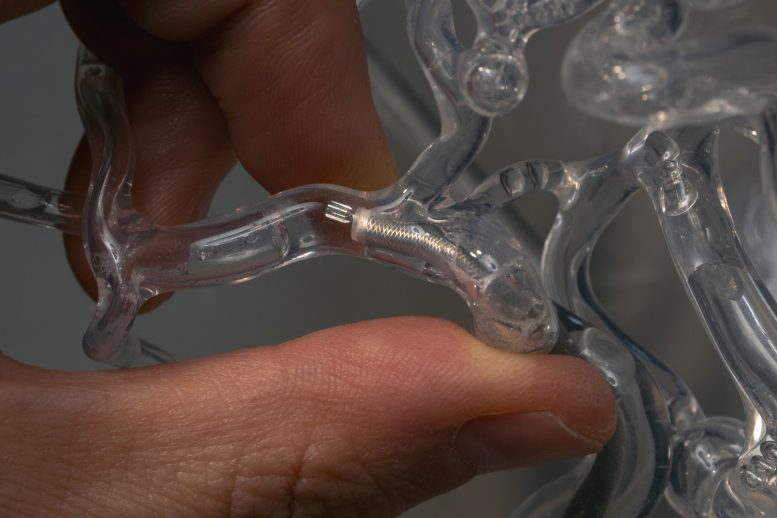
Zhao and her team demonstrated that the milli-spinner could shrink a clot to just 5% of its original size. The process releases the trapped red blood cells, allowing them to flow freely through the body, while the compact fibrin ball is drawn into the millispinner and removed.
“It works so well, for a wide range of clot compositions and sizes,” Zhao said. “Even for tough, fibrin-rich clots, which are impossible to treat with current technologies, our milli-spinner can treat them using this simple yet powerful mechanics concept to densify the fibrin network and shrink the clot.”
A surprising success
The milli-spinner design is an extension of Zhao’s work on millirobots – tiny, origami-based robots built to swim through the body to dispense medicine or assist with diagnostics. The spinning hollow structure with fins and slits was intended as a propulsion mechanism, but when the researchers realized that it was also creating localized suction, they decided to see if it could have other uses as well.
“At first, we simply wondered whether this suction could help remove a blood clot,” Zhao said. “But when we tested the spinner on a clot, we observed a striking clot color change, from red to white, along with a dramatic reduction in volume. Honestly, it felt like magic. We didn’t fully understand the mechanism at the time.”
Intrigued by this unexpected and unprecedented clot response, the researchers set out to uncover the underlying mechanism and then went through hundreds of design iterations to make the milli-spinner as efficient and effective as possible. But they haven’t forgotten about its propulsion possibilities. Zhao and her colleagues are also working on an untethered version of the milli-spinner that could swim freely through blood vessels to target and treat clots.
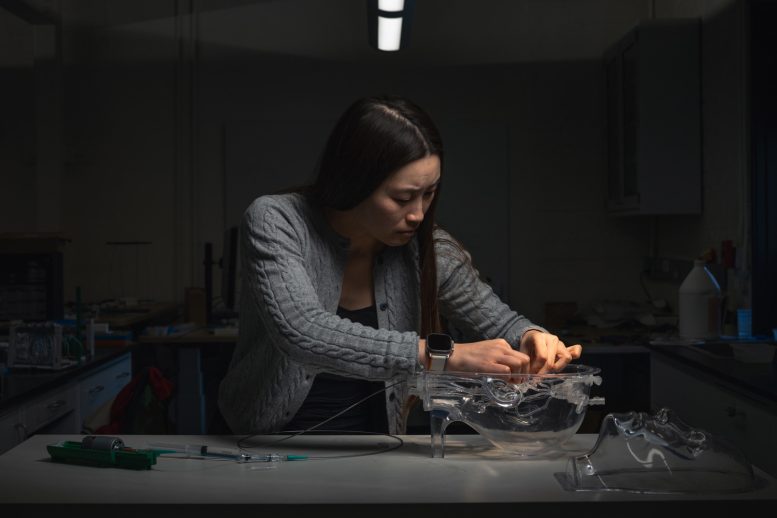
While they have focused on treating blood clots first, there are many other potential uses for the milli-spinner, Zhao said. She and her team are already working on using the milli-spinner’s localized suction to capture and remove kidney stone fragments.
“We’re exploring other biomedical applications for the milli-spinner design, and even possibilities beyond medicine,” Zhao said. “There are some very exciting opportunities ahead.”
Knowing the difference it could make for stroke patients and those with other blood clot-related diseases, Zhao, Heit, and their colleagues are hoping to get the milli-spinner thrombectomy approved for patient use as soon as possible. They have started a new company that licenses the technology from Stanford in order to develop and bring it to market, with clinical trials planned for the near future.
“What makes this technology truly exciting is its unique mechanism to actively reshape and compact clots, rather than just extracting them,” Zhao said. “We’re working to bring this into clinical settings, where it could significantly boost the success rate of thrombectomy procedures and save patients’ lives.”
Reference: “Milli-spinner thrombectomy” by Yilong Chang, Shuai Wu, Qi Li, Benjamin Pulli, Darren Salmi, Paul Yock, Jeremy J. Heit and Ruike Renee Zhao, 4 June 2025, Nature.
DOI: 10.1038/s41586-025-09049-0
Never miss a breakthrough: Join the SciTechDaily newsletter.
Follow us on Google and Google News.
2 Comments
After my stroke, I had to relearn everything—walking, moving, living. It felt like starting over, but I was determined to heal. With faith, support from my husband and family, and the herbal formula from WORLD REHABILITATE CLINIC, I made a natural recovery. Stroke healing starts in the brain through neuroplasticity—the brain’s ability to rewire itself. This formula supported that process, and today, I feel like myself again. Don’t give up. Recovery is possible. There are real, natural options out there. It’s also crucial to learn as much as you can about your diagnosis. Seek options:( worldrehabilitateclinic. com
A few weeks ago I apparently had a few mini strokes, had a seizure, fell, got a concussion and small brain bleed, then no idea what happened for a solid week before a family member came over to check on me. Back in the hospital but doing better. I still can’t remember that whole week and I have lost a number of somewhat recent memories. Talking with people who know me and know what I’ve been up to for the last few months has helped my brain “re-find” a number of I guess “misplaced” memories. It’s so weird to me. It’s like I have no idea I know something, then as soon as someone mentions to me something about it, all the memories I have of it flood back like they were never missing.