
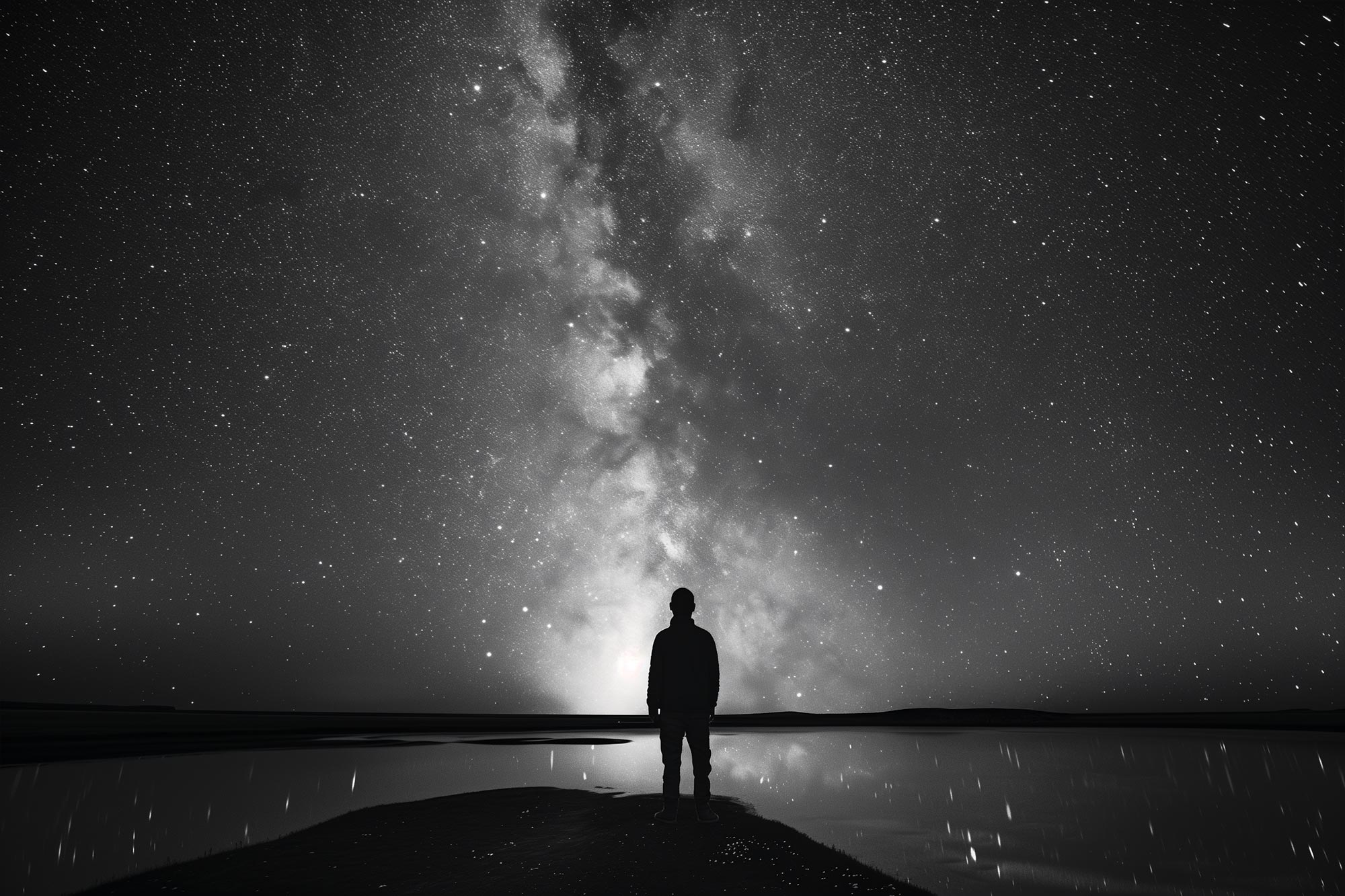
Why is space so dark despite all of the stars in the universe?
The question of why space is dark, even though it is filled with stars, has puzzled people for centuries. In fact, this question has a special name in astronomy: Olbers’ paradox.
Astronomers estimate there are around 200 billion trillion stars in the observable universe. Many of these stars shine as brightly — or even more brightly — than our own sun. So, why isn’t the night sky ablaze with light?
As an astronomer who studies stars and planets, including those beyond our solar system, I explore questions like this to understand the cosmos. The answer to why space is so dark lies in more than just the vast distances between stars and Earth.
At first glance, you might think the darkness is due to the stars being incredibly far away. While it’s true that distance makes stars appear dimmer — a star 10 times farther away looks 100 times dimmer — this explanation doesn’t fully solve the mystery. There’s more to uncover.
Imagine a Bubble
Pretend, for a moment, that the universe is so old that the light from even the farthest stars has had time to reach Earth. In this imaginary scenario, all of the stars in the universe are not moving at all.
Picture a large bubble with the Earth at the center. If the bubble were about 10 light years across, it would contain about a dozen stars. Of course, at several light years away, many of those stars would look pretty dim from Earth.
If you keep enlarging the bubble to 1,000 light-years across, then to 1 million light years, and then 1 billion light years, the farthest stars in the bubble will look even more faint. But there would also be more and more stars inside the bigger and bigger bubble, all of them contributing light. Even though the farthest stars look dimmer and dimmer, there would be a lot more of them, and the whole night sky should look very bright.
It seems I’m back where I started, but I’m actually a little closer to the answer.

Age Matters
In the imaginary bubble illustration, I asked you to imagine that the stars are not moving and that the universe is very old. But the universe is only about 13 billion years old.
Even though that’s an amazingly long time in human terms, it’s short in astronomical terms. It’s short enough that the light from stars more distant than about 13 billion light years hasn’t actually reached Earth yet. And so the actual bubble around Earth that contains all the stars we can see only extends out to about 13 billion light years from Earth.
There just are not enough stars in the bubble to fill every line of sight. Of course, if you look in some directions in the sky, you can see stars. If you look at other bits of the sky, you can’t see any stars. And that’s because, in those dark spots, the stars that could block your line of sight are so far away their light hasn’t reached Earth yet. As time passes, light from these more and more distant stars will have time to reach us.

The Doppler Shift
You might ask whether the night sky will eventually light up completely. But that brings me back to the other thing I told you to imagine: that all of the stars are not moving. The universe is actually expanding, with the most distant galaxies moving away from Earth at nearly the speed of light.
Because the galaxies are moving away so fast, the light from their stars is pushed into colors the human eye can’t see. This effect is called the Doppler shift. So, even if it had enough time to reach you, you still couldn’t see the light from the most distant stars with your eyes. And the night sky would not be completely lit up.
Written by Brian Jackson, Associate Professor of Astronomy, Boise State University.
Adapted from an article originally published in The Conversation.
Never miss a breakthrough: Join the SciTechDaily newsletter.
Follow us on Google and Google News.
6 Comments
Because there is a lot more SPACE! Just shows how puny our tiny planet is in the big scheme of things.
13 billion years seems like a gross underestimation of the age of the universe. I think it’s about to be revised soon.
The multiverse that our universe was birthed from is much older.
The night sky is actually filled with light. The light just happens to be in microwave spectrum due to expansion of the universe.
You forgot to mention the inverse square law of radiation. As AG3 mentioned the sky is filled with energy, it’s just that our eyes can’t see most of it.
The far distant bit of the universe is expanding so rapidly that light just can’t get here; the expansion is faster than the speed of light………Hubbelian logic at work. Now about the speed of light being the universal speed limit set by God who exploded in a Big Bang……..