

Diagnoses Increased 65% in Urban Areas
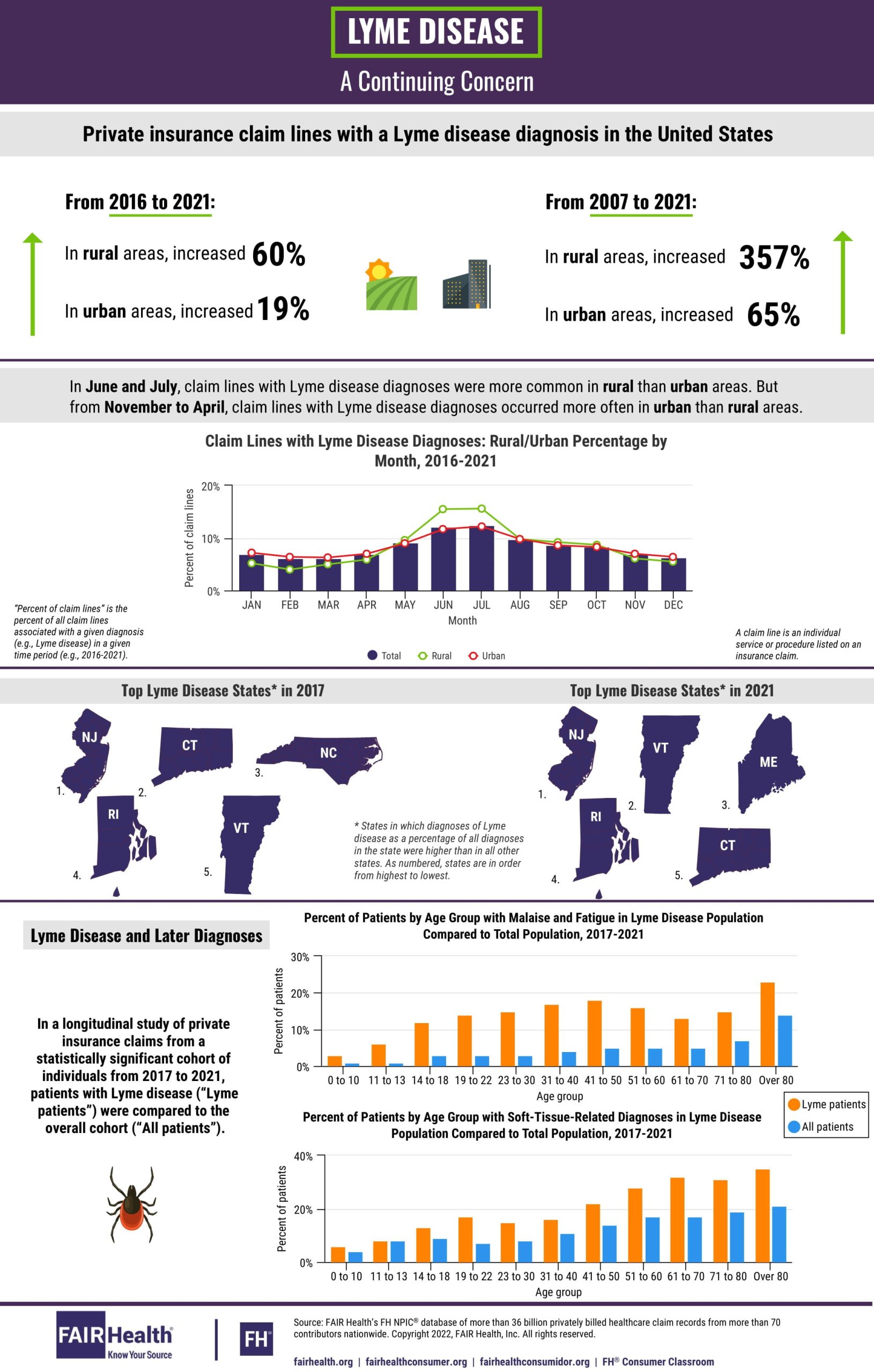
Over the last 15 years, Lyme disease has seen a noticeable increase in the United States, and as a consequence, it has elevated to a problem of rising national concern. Private insurance claim lines for Lyme disease diagnosis increased 357 percent in rural regions and 65 percent in urban areas between 2007 and 2021. These and other discoveries on this bacterial illness spread by ticks are shown in an infographic recently published by FAIR Health.
The 15-year analysis of Lyme disease was conducted by the national, independent nonprofit using its database of over 36 billion privately billed healthcare claims; this research expands upon a previous FAIR Health infographic that looked at 10 years’ worth of Lyme disease data.
The Difference Between Urban and Rural Areas
The infographic reveals important differences in the prevalence of Lyme disease when comparing rural and urban locations. Between 2016 and 2021, the number of claim lines with Lyme disease diagnoses climbed by 60% in rural regions and 19% in urban areas, with diagnoses peaking nationwide in June and July of each year. Rural locations showed a higher percentage of claim lines related to Lyme disease diagnoses than urban areas throughout the summer months. However, from November through April, claim lines with Lyme disease diagnoses were more common in urban than rural areas.
Geographic Distribution
In 2017, the states with the greatest proportion of claim lines with Lyme disease diagnoses as a percentage of all diagnoses in the state, from highest to lowest, were New Jersey, Connecticut, North Carolina, Rhode Island, and Vermont. Given that Lyme disease has been historically associated with the Northeast and upper Midwest, the status of North Carolina as the state with the third highest percentage of Lyme disease claim lines in 2017 suggested marked expansion to a new region. By 2021, however, North Carolina had dropped from the list.
The top states in 2021, from highest to lowest, were New Jersey, Vermont, Maine, Rhode Island, and Connecticut. Maine, which was not previously on the list of top five states for Lyme disease claim lines, assumed third place in 2021, suggesting a growing presence of the tick-borne illness in the state. Connecticut and Vermont switched places, with Vermont emerging as number two and Connecticut dropping to number five.
Later Diagnoses
Although Lyme disease is treatable with antibiotics, some Lyme patients later develop conditions with long-term symptoms, such as fatigue, muscle and joint pain and cognitive issues. Such conditions have been linked to post-treatment Lyme disease syndrome, sometimes called chronic Lyme disease.
To identify later diagnoses associated with Lyme disease, FAIR Health examined a statistically significant cohort of individuals in its private insurance claims database from 2017 to 2021, comparing the prevalence of certain diagnoses among Lyme patients to all patients in the cohort. The analysis found that diagnoses such as malaise and fatigue and soft-tissue-related issues were more common among Lyme patients than among the total patient population. Across all age groups, patients with Lyme disease were generally more likely to have these apparently associated diagnoses than all patients in the cohort.
FAIR Health President Robin Gelburd stated, “Lyme disease remains a growing public health concern. FAIR Health will continue to use its repository of claims data to provide actionable and relevant insights to healthcare stakeholders seeking to better understand the ongoing rise of Lyme disease cases.”
This is the third study FAIR Health has conducted on Lyme disease, the first appearing in an infographic released in 2017 and the second in a white paper published in 2019.
Never miss a breakthrough: Join the SciTechDaily newsletter.
Follow us on Google and Google News.
3 Comments
Lyme Disease epidemiology is now the result of analyzing insurance claim forms? Seriously? Some guy gets monkey pox and the whole world lights up, but, millions of normal people suffering pain, blindness, aching bodies, et cetera are left to suffer with even getting an accurate diagnosis let alone “treatment” with anti-biotics – which has a poor track record. But let’s keep sounding the alarm for monkey pox – disgusting.
I had Lyme for 3years. It was terrible. I found a Doctor in Annapolis that completely cured me. Insurance wouldn’t pay a dime. The cure he uses isn’t recognized by the FDA, but it works. It saved my life.
The word “deer” does not appear in any of what is
included in these reports. “Tick-borne” is the
preferred explanation for the spread of chronic Lyme disease. The ticks are on the deer, and the deer are
virtually everywhere. The two cannot be separated
by just thinking about it. There has to be some action taken. Why isn’t this being done?