
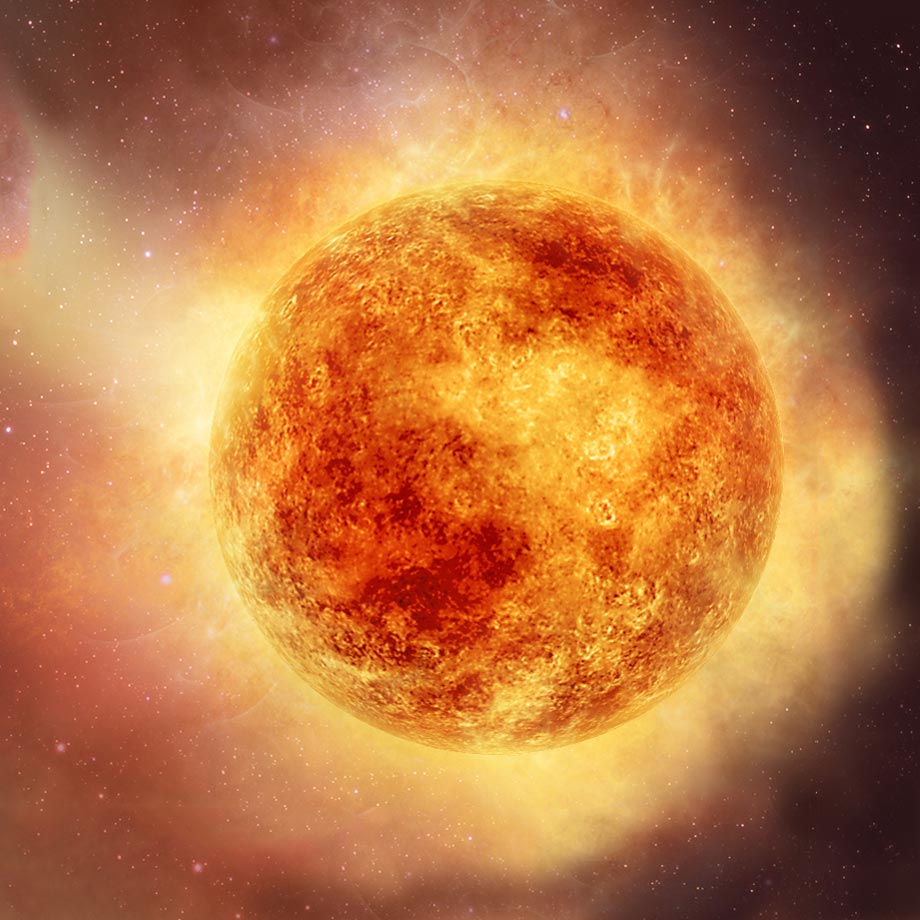
It may be another 100,000 years until the giant red star Betelgeuse dies in a fiery explosion, according to a new study by an international team of researchers.
The study, led by Dr. Meridith Joyce from The Australian National University (ANU), not only gives Betelgeuse a new lease on life, but shows it is both smaller and closer to Earth than previously thought.
Dr. Joyce says the supergiant — which is part of the Orion constellation — has long fascinated scientists. But lately, it’s been behaving strangely.
“It’s normally one of the brightest stars in the sky, but we’ve observed two drops in the brightness of Betelgeuse since late 2019,” Dr. Joyce said.
“This prompted speculation it could be about to explode. But our study offers a different explanation.
“We know the first dimming event involved a dust cloud. We found the second smaller event was likely due to the pulsations of the star.”
The researchers were able to use hydrodynamic and seismic modeling to learn more about the physics driving these pulsations — and get a clearer idea of what phase of its life Betelgeuse is in.
According to co-author Dr. Shing-Chi Leung from The University of Tokyo, the analysis “confirmed that pressure waves — essentially, sound waves-were the cause of Betelgeuse’s pulsation.”
“It’s burning helium in its core at the moment, which means it’s nowhere near exploding,” Dr. Joyce said.
“We could be looking at around 100,000 years before an explosion happens.”
Co-author Dr. László Molnár from the Konkoly Observatory?in Budapest says the study also revealed how big Betelgeuse is, and its distance from Earth.
“The actual physical size of Betelgeuse has been a bit of a mystery — earlier studies suggested it could be bigger than the orbit of Jupiter. Our results say Betelgeuse only extends out to two-thirds of that, with a radius 750 times the radius of the sun,” Dr. Molnár said.
“Once we had the physical size of the star, we were able to determine the distance from Earth. Our results show it’s a mere 530 light-years from us — 25 percent closer than previously thought.”
The good news is Betelgeuse is still too far from Earth for the eventual explosion to have a significant impact here.
“It’s still a really big deal when a supernova goes off. And this is our closest candidate. It gives us a rare opportunity to study what happens to stars like this before they explode,” Dr. Joyce said.
The study was funded by The Kavli Institute for the Physics and Mathematics of the Universe (WPI), The University of Tokyo, and facilitated by the ANU Distinguished Visitor’s program. It involved researchers from the United States, Hungary, Hong Kong, and the United Kingdom, as well as Australia and Japan.
The study has been published in The Astrophysical Journal.
Reference: “Standing on the Shoulders of Giants: New Mass and Distance Estimates for Betelgeuse through Combined Evolutionary, Asteroseismic, and Hydrodynamic Simulations with MESA” by Meridith Joyce, Shing-Chi Leung, László Molnár, Michael Ireland, Chiaki Kobayashi and Ken’ichi Nomoto, 13 October 2020, The Astrophysical Journal.
DOI: 10.3847/1538-4357/abb8db
Never miss a breakthrough: Join the SciTechDaily newsletter.
Follow us on Google and Google News.
20 Comments
A big explosion in only 1oo,ooo years! I’ll try to stick around for that.
“It’s still a really big deal when a supernova goes off. And this is our closest candidate. It gives us a rare opportunity to study what happens to stars like this before they explode,” …“We could be looking at around 100,000 years before an explosion happens.”… I’m marking my calendar …
great jumpen-gee-hosipfat!!!!!!!-get OLSEN
I wonder if humanity will still be around in 100,000 years to witness this cataclysmic event.
Yay! That’s how to cut them down to size!
The battle of man against nature has reach a new and exciting stage.
If you see it explode in the near future, that means it exploded in 1480 or 1490. About the time Columbus discovered America. If it has another hundred thousand years…we will never know it.
Columbus did NOT “discover” America. He never set foot on NA and there is real evidence for earlier Viking landings. And he was not Italian since there was no official Italy until 1860, 400 years after his sailing.
I believe this to be an historical event in staying with the theory of objects in the rear-view mirror.
A 25% error in the distance calculation? The young earth fundamentalists are gonna have a field day with that one!
@Richard Alexandrowich: Most likely. Mammal species evolve at an average species lifetime of 1 million years – H. erectus became twice that age – and our species is just 0.3 million years old.
“Columbus did NOT “discover” America. He never set foot on NA and there is real evidence for earlier Viking landings. And he was not Italian since there was no official Italy until 1860, 400 years after his sailing.”
Yes, there is such evidence, but that discovery was buried in myth and not globally accepted. And of course that wasn’t the first discovery either, we have it from both fossil and genomic evidence that Americas was discovered by humans about 20,000 years ago (through Beringia – c.f. “Ancient DNA Reveals Complex Story of Human Migration Between Siberia and North America”, Smithsonian Magazine). In fact, one can make a good argument that we should accept that after the fact, despite that it wasn’t global knowledge – what was, 20,000 years ago – since that and not the later dicsoveries always left a genetic imprint (the Viking one didn’t, say).
“dicsoveries” – discoveries.
Nope, nope. You’re stuck with dicks ovaries.
Some things can’t be undone.
Hey Larsson
What’s your hang up w/Columbus
He probly grew up in toledo
No one is stuck with such anatomy, or even the spelling error (already corrected).
But you may be stuck with a flakey handle. 👹
I am not the one that was hung up on Columbus. Or Vikings (though I could have been, “it’s in my genes” 🤡).
I admit to have some fondness for population genetics and hence population migration (gene flow).
Very Interesting.
Even more interesting Comments!
From a future Risk Management Perspective, it may be interesting to determine when all the Stars in our neighbourhood will go supernova/have gone supernova and its likely impact on the “Third Rock from the Sun” the Star Closest to us – i.e the Sun.
We certainly can develop technologies in a 100,000 years or even much faster —and the time it will take to reach the effect of various stars going supernova on our home planet currently/ or past such events. Bechmarking these may become important.
Time spans are relative. Currently we are mortals with limited time spans for life. This does not mean that our life spans cannot increase in the future as medical technologies improve. If I recall correctly most of our ancestors had much shorter life spans and lived a short brutish life in the recent past!
However, there are tales in various ancient texts that Human Life Spans were much longer in earlier times. Do not not know what was the time span used by these ancient astronmers to draw up their calendars and for calclulating a year! Guess when the Gregorian Calendar was invented?
Data does NOT lie. Genetic and Scientific Data is the basis on which we need to draw conclusions in Science. An exploration and comparision of other ancient calendars and various historical events reported from ancient times may give us some clues when the last Supernova event Occurred in our neighbourhood and when the impact of the same was/ or will be felt on Planet Earth and prepare for the same.
Knowledge is the path to real enlightenment. Not Blind faith. This does not mean that all scientists need to become Atheists. The Puny nature of Humans in comparision to the fury of Mother Nature is becoming increasingly visible. The hope for survival of Humankind is rapid development of technologies and a understanding of Science and Progress of Knowledge. This cannothappen without global co-operation.
If Humanity learns to value the creation of Knowledge for the benefit of all creatures who inhabit planet earth, rather than “lucre”, we may still survive for a much longer time as a species.
Opinions expressed are personal.
1 it’s not about it “burning” helium that causes it to burst, Its whether or not it has started producing iron at its core that causes a star to explode. The thing about betelguise is this,
Sure, it’s far enough away to cause no damage to the earth with its energy wave. However, it will disrupt the port cloud on a cataclysmic scale one nudge is all it takes to create a comet so if they’re all nudged, then were all judged. The other is that its shrinking rapidly which us a sign that it is has begun to produce iron. It absorbs heat and energy unlike steel which reflects energy. Eventually the iron becomes so energized that bang! Like a sausage in the microwave. Why is iron so important simple, and this will also explain skin color and give future astronauts a better space lining than water…. go barefoot to the nearest curb at sundown put one foot on the cement and one on the asphalt at first the asphalt will be very hot but quickly it will cool down unlike the cement which retains heat. This is why people and animals that live closer to the equator are darker complexion, more northern native creatures and people are lighter skin retaining heat longer if the sub set at 6pm at 7pm the cement would be warmer than the asphalt. In the matter of stars the iron which is black and why our blood with no oxygen is also black (veins are blue) so imagine that chunk of asphalt if it were in the microwave for 50-75 minutes things that are black will continue to absorb energy but with no place to vent will pop. Even in the sun an african descendant man and European descendant man the african American man will cool faster giving him more endurance while the lighter European man isnt as cold in 50 degree weather. In everything from hippopatumus rhinos polar bears and artic fox share this commonality… so I believe whole heartedly we have a supernova in the summer triangle to observe followed by betelguise … furthermore I’d like to point out that the neutrinos drifting to us from that direction may indicate that the star has already popped and that kinetic energy going from betelguise to. Earth is traveling faster than light as the medium in which it travels through is more dense than ambient space and so like water and sound waves, kinetic energy may carry energy faster remember that desk toy its not the rate in which the balls are moving its the rate in which they react to eachother one is pushed and the other. I am sure the ring will fill the northern crux night sky before this. Ring me king me. but watch it explode in the next 30 years this comment make headlines and even still if the neutrinos should go still look up. Eat it elon musk, Eric alion mlamberg Kings ley in the housienda… throw me a bone I’ll give you faster space travel.
… yeah, sometime what is done is done but it can be undone, and sometimes it can’t be undone…
… Like a graph, with direction you have way, but it doesn’t mean you can always go back…