
Close Menu
    Facebook X (Twitter) Instagram
    SciTechDaily
    • Biology
    • Chemistry
    • Earth
    • Health
    • Physics
    • Science
    • Space
    • Technology
    Facebook X (Twitter) Pinterest YouTube RSS
    SciTechDaily
    Home»Science»Stress Doesn’t Always Cause Depression – Here’s Why
    Science

    Stress Doesn’t Always Cause Depression – Here’s Why

    By Society for NeuroscienceJanuary 20, 2020No Comments2 Mins Read
    Facebook Twitter Pinterest Telegram LinkedIn WhatsApp Email Reddit
    Share
    Facebook Twitter LinkedIn Pinterest Telegram Email Reddit
    Stress Doesn't Always Cause Depression
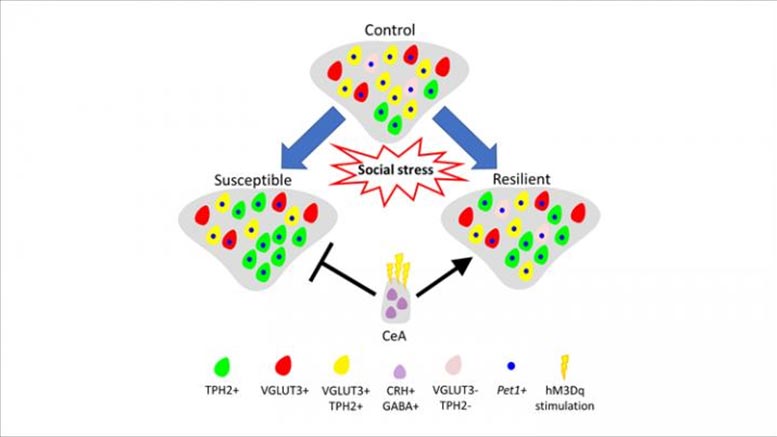
    Model of neurotransmitter plasticity in the ventral dorsal raphe in response to chronic social stress. Credit: Prakash et al., JNeurosci 2019

    Changes in neurotransmission may explain intrinsic immunity to depression.

    Rats susceptible to anhedonia, a core symptom of depression, possess more serotonin neurons after being exposed to chronic stress, but the effect can be reversed through amygdala activation, according to new research in JNeurosci.

    Some people are resistant to depression and anhedonia, or lack of pleasure, even when exposed to chronic stress. To measure susceptibility to anhedonia, Prakash et al. trained rats to activate an electrode that stimulated reward circuits in their brain, causing feelings of pleasure. The rats experienced social stress once a day and then were given access to self-stimulation fifteen minutes later. In rats susceptible to anhedonia, the stress dramatically increased the intensity of stimulation needed to feel pleasure, while it had little effect on the resilient rats.

    Compared to the resilient rats, the susceptible rats had more serotonin neurons in the ventral part of their dorsal raphe nucleus, an area of the brain involved in regulating stress and reward. This increase is due to the recruitment of non-serotonin signaling neurons. When the researchers activated neurons in the central amygdala to prevent the increase in serotonin signaling, the rats experienced reduced effects from social stress.

    Understanding the molecular thumbprint of depression susceptibility could lead to treatments that induce resilience in the face of chronic stress.

    Reference: “Serotonergic Plasticity in the Dorsal Raphe Nucleus Characterizes Susceptibility and Resilience to Anhedonia” by Nandkishore Prakash, Christiana J. Stark, Maria N. Keisler, Lily Luo, Andre Der-Avakian and Davide Dulcis, 15 January 2020, JNeurosci.
    DOI: 10.1523/JNEUROSCI.1802-19.2019

    Never miss a breakthrough: Join the SciTechDaily newsletter.
    Follow us on Google and Google News.

    Depression Society for Neuroscience Stress
    Share. Facebook Twitter Pinterest LinkedIn Email Reddit

    Related Articles

    Study Finds That Playing the Piano Boosts Brain Processing Power and Reduces Depression, Stress, and Anxiety

    3 Issues Are Causing Americans Significant Stress – Here’s the Breakdown

    Groundbreaking Research Into the Value of “Thoughts and Prayers”

    Watching Music Move Through the Brain

    New Genome-Wide Analysis Links Marijuana Dependence and Major Depression

    Artificially Reactivating Positive Memories Can Reverse Depression

    Homer-1 Could Be a Key to the Treatment of Stress-Induced Cognitive Deficits

    Depression Is the Top Disability Among US & Canadian Teens

    Multiple Media Use Linked to Depression & Anxiety

    Leave A Reply Cancel Reply

    • Facebook
    • Twitter
    • Pinterest
    • YouTube

    Don't Miss a Discovery

    Subscribe for the Latest in Science & Tech!

    Trending News

    Your Blood Pressure Reading Could Be Wrong Because of One Simple Mistake

    Astronomers Stunned by Ancient Galaxy With No Spin

    Physicists May Be on the Verge of Discovering “New Physics” at CERN

    Scientists Solve 320-Million-Year Mystery of Reptile Skin Armor

    Scientists Say This Daily Walking Habit May Be the Secret to Keeping Weight Off After Dieting

    New Therapy Rewires the Brain To Restore Joy in Depression Patients

    Giant Squid Detected off Western Australia in Stunning Deep-Sea Discovery

    Popular Sugar-Free Sweetener Linked to Liver Disease, Study Warns

    Follow SciTechDaily
    • Facebook
    • Twitter
    • YouTube
    • Pinterest
    • Newsletter
    • RSS
    SciTech News
    • Biology News
    • Chemistry News
    • Earth News
    • Health News
    • Physics News
    • Science News
    • Space News
    • Technology News
    Recent Posts
    • Scientists Reverse Stroke Damage Using Stem Cells in Breakthrough Study
    • Eating One Egg a Day Could Cut Alzheimer’s Risk by 27%
    • Hidden Warm Water Beneath Antarctica Could Rapidly Raise Global Sea Levels
    • Scientists Revive Ancient Chemistry Trick To Engineer Next-Generation Glass
    • Scientists Use AI To Supercharge Ultrafast Laser Simulations by More Than 250x
    Copyright © 1998 - 2026 SciTechDaily. All Rights Reserved.
    • Science News
    • About
    • Contact
    • Editorial Board
    • Privacy Policy
    • Terms of Use

    Type above and press Enter to search. Press Esc to cancel.