

Close Menu
    Facebook X (Twitter) Instagram
    SciTechDaily
    • Biology
    • Chemistry
    • Earth
    • Health
    • Physics
    • Science
    • Space
    • Technology
    Facebook X (Twitter) Pinterest YouTube RSS
    SciTechDaily
    Home»Health»Study Challenges Long-Held Belief About Parkinson’s Tremors
    Health

    Study Challenges Long-Held Belief About Parkinson’s Tremors

    By University of TurkuMarch 23, 2026No Comments3 Mins Read
    Facebook Twitter Pinterest Telegram LinkedIn WhatsApp Email Reddit
    Share
    Facebook Twitter LinkedIn Pinterest Telegram Email Reddit
    Grey Haired Man Parkinson Syndrome Tremor in Hands
    Tremor in Parkinson’s may follow a different biological pathway than previously thought, suggesting a more intricate disease process than dopamine loss alone can explain. Credit: Shutterstock

    New imaging research challenges a long-standing assumption about Parkinson’s disease.

    A clinical imaging study from Finland suggests that rest tremor in Parkinson’s disease is not caused by greater dopamine loss. Instead, tremor appears to be linked to relatively preserved dopamine function.

    Researchers at the University of Turku and Turku University Hospital analyzed clinical records along with dopamine transporter (DAT) imaging from 414 patients in Finland. These individuals were evaluated in routine care for unclear cases of parkinsonism or tremor, which makes the results highly relevant to everyday clinical practice. The findings were published in Neurology, the journal of the American Academy of Neurology.

    Parkinson’s disease is defined by three main motor symptoms: slowed movement (bradykinesia), muscle stiffness (rigidity), and rest tremor. Bradykinesia and rigidity are known to result from the loss of dopamine-producing neurons. Because many brain pathways cross, this damage is usually seen in the striatum on the side opposite the symptoms. However, the biological basis of rest tremor has remained unclear.

    Unexpected Imaging Findings

    The researchers identified a consistent pattern. Patients with rest tremor showed higher dopamine transporter binding in the striatum on the same side as the tremor. In contrast, other key motor symptoms followed the expected pattern and were linked to dopamine loss in the opposite hemisphere.

    “These results show that more severe rest tremor is not simply a marker of more advanced damage to the dopamine system,” says the lead author, Neurologist Kalle Niemi, MD, PhD. “Tremor appears to involve a partly distinct neurobiological mechanism.”
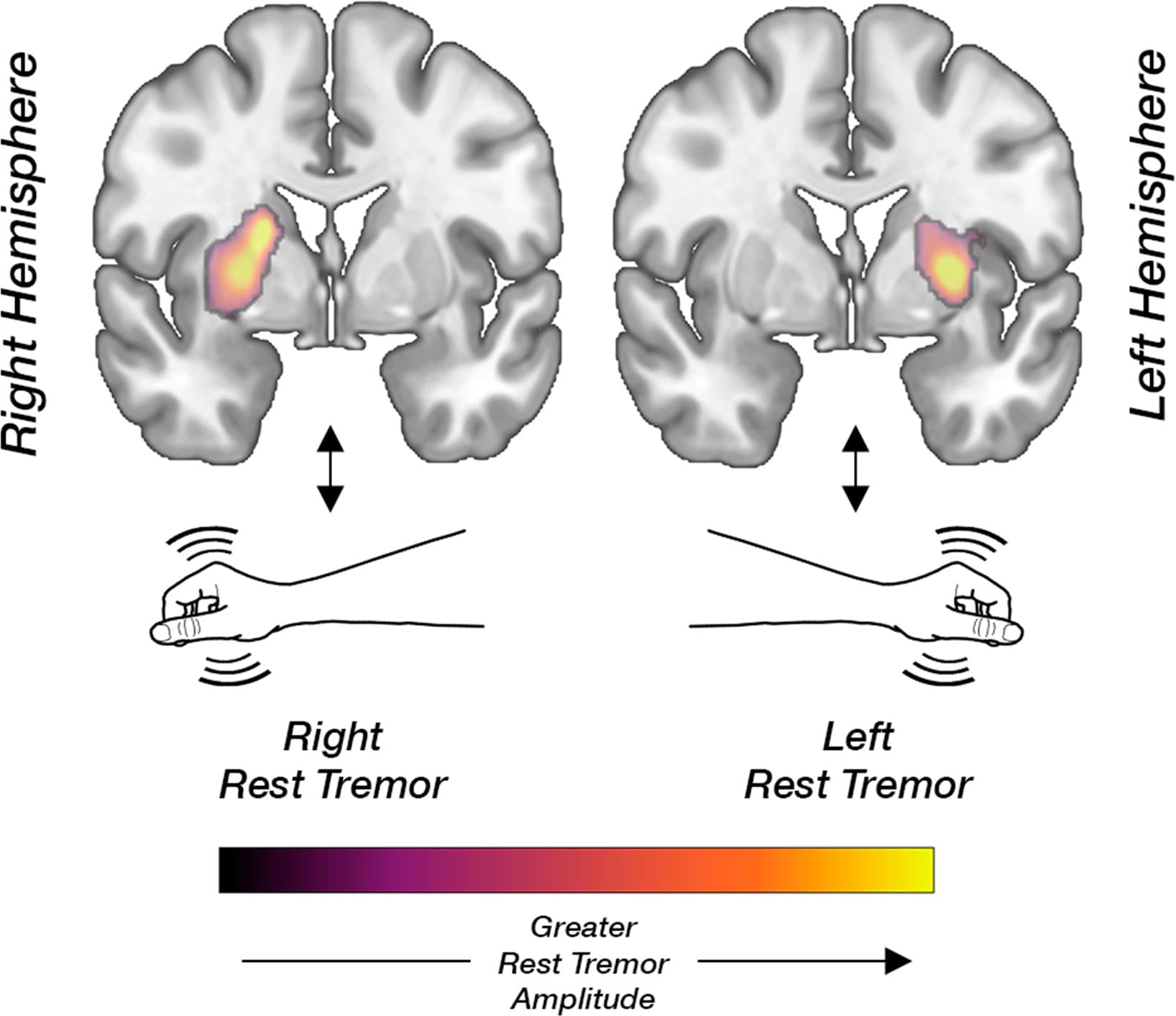
    Illustration of the Association Between Rest Tremor and Brain Dopamine Function
    Illustration of the association between rest tremor and brain dopamine function. Credit: Clinical Neurosciences, University of Turku

    The results also support earlier findings from the team based on data from the international Parkinson’s Progression Markers Initiative (PPMI). That earlier work introduced a new imaging analysis method developed by the researchers. Reproducing the same results in a separate, clinically representative group strengthens confidence in the findings.

    “Our findings support the view that different symptoms of Parkinson’s disease may be driven by partly distinct neural network and neurotransmitter mechanisms,” Niemi explains. “This may help explain why tremor behaves differently from symptoms such as bradykinesia.”

    Beyond Motor Symptoms

    Using the same approach, the researchers also found that several non-motor symptoms of Parkinson’s disease, including depression, anxiety, and REM sleep behavior disorder, are mainly associated with monoaminergic systems other than dopamine.

    Overall, the study highlights Parkinson’s disease as a complex brain disorder that involves multiple neural networks and neurotransmitter systems.

    A clearer understanding of how different symptoms arise could eventually lead to more targeted and personalized treatments.

    Reference: “Striatal Dopamine Transporter and Rest Tremor in Parkinson DiseaseA Clinical Validation” by Kalle J. Niemi, Elina Jaakkola, Elina Maaria Myller, Mikael R.E. Eklund, Simo Nuuttila, Tuomas Mertsalmi, Kirsi-Marja Murtomäki, Reeta Levo, Tomm Noponen, Toni Ihalainen, Filip Scheperjans, Juho Joutsa and Valtteri Kaasinen, 19 March 2026, Neurology.
    DOI: 10.1212/WNL.0000000000214811

    Never miss a breakthrough: Join the SciTechDaily newsletter.
    Follow us on Google and Google News.

    Brain Neurology Parkinson's Disease University of Turku
    Share. Facebook Twitter Pinterest LinkedIn Email Reddit

    Related Articles

    Scientists May Have Solved the “Mystery Density” Behind Alzheimer’s and Parkinson’s

    Study: Diabetes Drug May Cut Risk of Alzheimer’s and Parkinson’s by 20%

    How a Simple Worm May Hold the Key to Stopping Parkinson’s and Alzheimer’s

    Groundbreaking Study Challenges Key Theory on Parkinson’s Disease Protein Aggregation

    Scientists Propose “Radically Different” New Way of Looking at Parkinson’s Disease

    Scientists Find Way To Detect Parkinson’s Disease 30 Years Before Symptoms

    Neurological Warning: Groundbreaking Study Reveals That Air Pollution Could Increase Your Risk of Parkinson’s by 56%

    Beyond the Brain: Unveiling the Unexpected Origins of Parkinson’s Disease

    Unexpected Discovery: Vascular Defects Appear to Underlie the Progression of Parkinson’s Disease

    Leave A Reply Cancel Reply

    • Facebook
    • Twitter
    • Pinterest
    • YouTube

    Don't Miss a Discovery

    Subscribe for the Latest in Science & Tech!

    Trending News

    New Study Reveals Why Ozempic Works Better for Some People Than Others

    Climate Change Is Altering a Key Greenhouse Gas in a Way Scientists Didn’t Expect

    New Study Suggests Gravitational Waves May Have Created Dark Matter

    Scientists Discover Why the Brain Gets Stuck in Schizophrenia

    Scientists Engineer “Tumor-Eating” Bacteria That Devour Cancer From Within

    Even “Failed” Diets May Deliver Long-Term Health Gains, Study Finds

    NIH Scientists Discover Powerful New Opioid That Relieves Pain Without Dangerous Side Effects

    Collapsing Plasma May Hold the Key to Cosmic Magnetism

    Follow SciTechDaily
    • Facebook
    • Twitter
    • YouTube
    • Pinterest
    • Newsletter
    • RSS
    SciTech News
    • Biology News
    • Chemistry News
    • Earth News
    • Health News
    • Physics News
    • Science News
    • Space News
    • Technology News
    Recent Posts
    • JWST Reveals a “Forbidden” Planet With a Baffling Composition
    • New Research Challenges 30-Year-Old Theory of Eye Development
    • The Protein “Sabotaging” Aging Muscle Recovery Could Be Key to Surviving Aging
    • This Diet–Gut Interaction Could Transform Fat Into a Calorie-Burning Machine
    • Why Some People Reach 100: New Study Reveals Key Biological Differences
    Copyright © 1998 - 2026 SciTechDaily. All Rights Reserved.
    • Science News
    • About
    • Contact
    • Editorial Board
    • Privacy Policy
    • Terms of Use

    Type above and press Enter to search. Press Esc to cancel.