
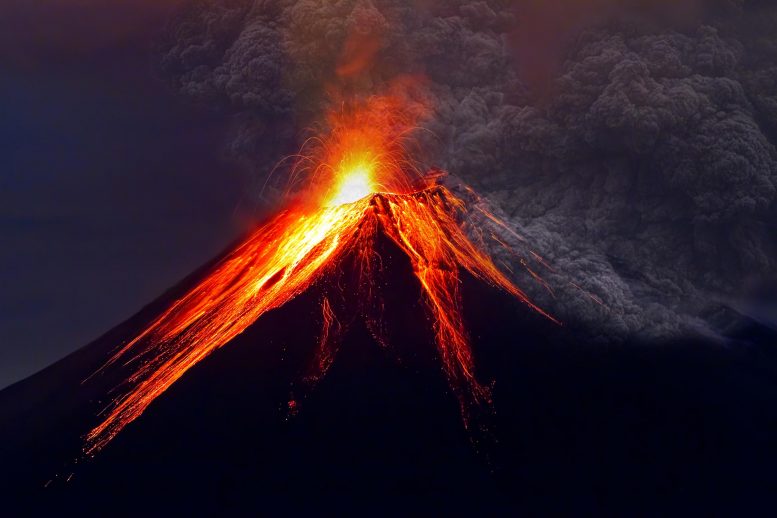
A new study has estimated for the first time how the eruption of Mount Tambora changed the probability of the cold and wet European ‘year without a summer’ of 1816.
It found that the observed cold conditions were almost impossible without the eruption, and the wet conditions would have been less likely.
1816 recorded exceptionally low global temperatures, with central and Western Europe seeing a particularly cold and wet summer that led to widespread agricultural failures and famines.
The 1815 eruption of Mount Tambora in Indonesia has long been assumed to have been the cause, with a link made as early as 1913. Now, using historical data and modern modeling techniques, researchers led by the University of Edinburgh, UK, have estimated just how important the eruption was.
They publish their findings tomorrow (September 18, 2019) in Environmental Research Letters.
The study’s lead author, Dr Andrew Schurer, from the University of Edinburgh, said: “The eruption of Mount Tambora in April 1815 was among the most explosive of the last millennium. It had an enormous impact locally, devastating the island of Sumbawa. The eruption injected a huge amount of sulfur dioxide (SO2) into the stratosphere, which would have quickly spread across the world, oxidizing to form sulfate aerosols.
“These volcanic aerosols reduce net shortwave radiation causing widespread, long-lasting surface cooling. They also lead to a reduction in global rainfall, while wettening some dry regions, and causing dynamic changes in the large-scale circulation of both ocean and atmosphere.”
The research team used early instrumental data, combined with new climate simulations from two different models, to conduct an event attribution analysis. Their aim was to determine if, and by how much, the volcanic forcing affected the probability of cold and wet conditions in this ‘year without a summer’.
Their results, from summers with similar sea-level-pressure patterns to 1816, using both observations and unperturbed climate model simulations, show that the circulation state can reproduce the precipitation anomaly without external forcing, but only explains about a quarter of the anomalously cold conditions.
Dr Schurer said: “Including volcanic forcing in climate models can account for the cooling, and we estimate it increases the likelihood of the extremely cold temperatures by up to 100 times.
“Although the observed sea-level pressure pattern can account for much of the observed anomalously wet conditions, even without volcanic forcing, there is strong evidence in the model simulations that the volcanic eruption increases the chance of such a wet summer over Central Europe, by about 1.5 to three times.
“Mount Tambora played a dominant role in causing the observed cold conditions, and probably also contributed to the anomalously wet conditions. Without volcanic forcing, it is less likely to have been as wet and highly unlikely to have been as cold.”
Reference: “Disentangling the causes of the 1816 European year without a summer” by Andrew P Schurer1, Gabriele C Hegerl1, Jürg Luterbacher2, Stefan Brönnimann3, Tim Cowan1,4, Simon F B Tett1, Davide Zanchettin5 and Claudia Timmreck, 18 September 2019, Environmental Research Letters.
DOI: 10.1088/1748-9326/ab3a10
Never miss a breakthrough: Join the SciTechDaily newsletter.
Follow us on Google and Google News.