
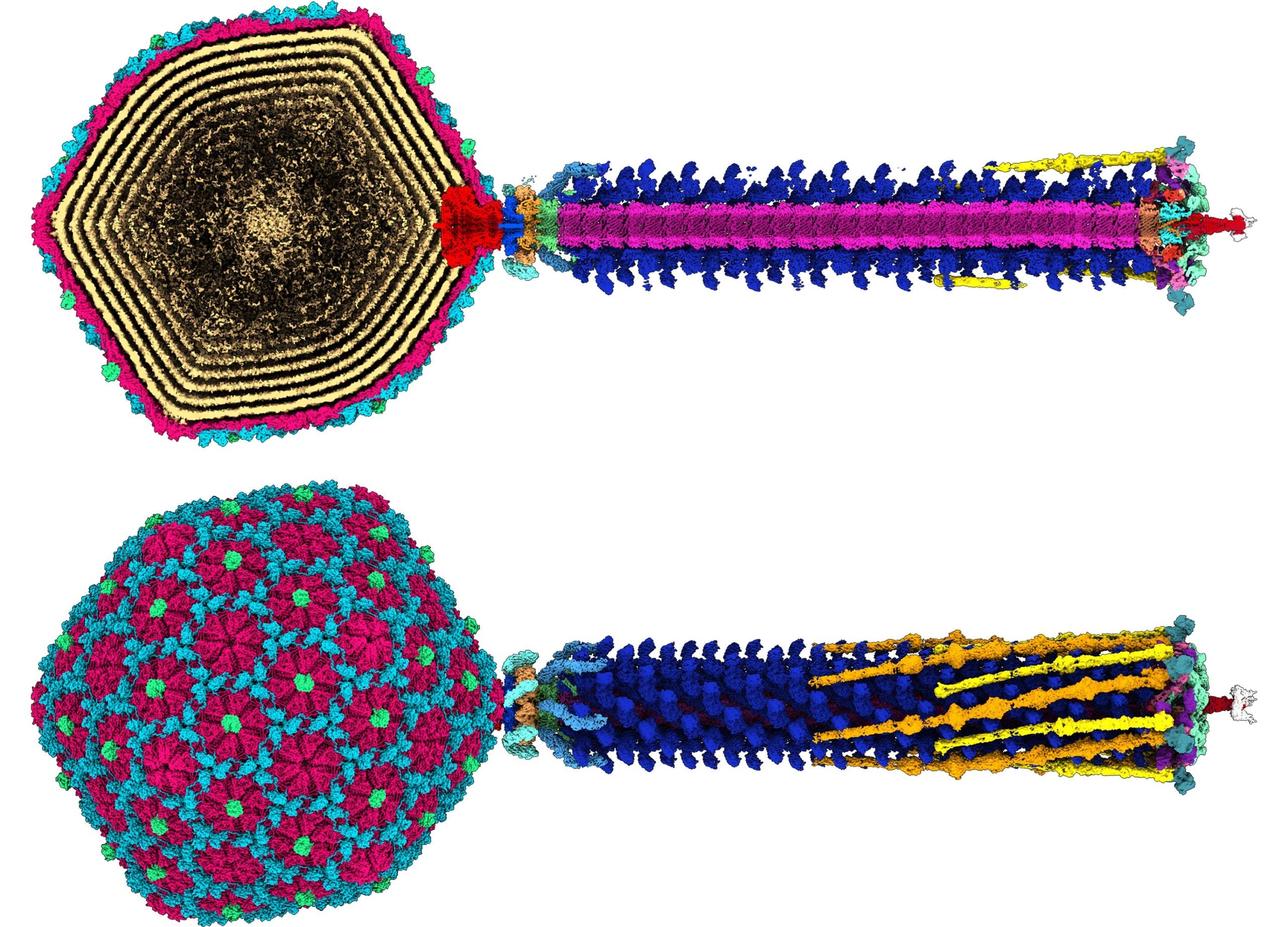
A detailed 3D map of a bacteria-hunting virus reveals ancient origins and new promise against superbugs.
A research team led by the University of Otago – Ōtākou Whakaihu Waka has created a highly detailed structural blueprint of a bacteriophage, a type of virus that infects bacteria. The work strengthens the potential of these viruses as a tool to combat bacteria that no longer respond to antibiotics.
Lead author Dr. James Hodgkinson-Bean, who completed his PhD in the Department of Microbiology and Immunology, says bacteriophages are attracting growing interest as scientists look for alternatives to traditional antibiotics amid the rising threat of antimicrobial resistance.
“Bacteriophage viruses are non-harmful to all multi-cellular life and able to very selectively target and kill a target bacterium. Due to this, they are increasingly being researched and applied in ‘phage therapy’ to treat highly drug-resistant bacteria,” he says.
He describes bacteriophages as “exquisitely intricate viruses” that infect bacteria using large mechanical structures known as ‘tails’.
3D Study Reveals How an E. coli Virus Infects Bacteria
The research, published in Science Advances, brought together scientists from Otago and the Okinawa Institute of Science and Technology. The team closely examined the molecular structure of Bas63, a virus that infects E. coli, to better understand how its tail functions during the infection process.
“This kind of research is important for understanding how we can select the optimal bacteriophages for therapies, and to understand the differences in infectious behavior we see in the lab,” Dr. Hodgkinson-Bean says.
Senior author Associate Professor Mihnea Bostina, also from Otago’s Department of Microbiology and Immunology, says bacteriophages are becoming increasingly valuable as antibiotic resistance grows and plant diseases continue to threaten global food supplies.
“Our detailed blueprint of a bacteriophage advances rational design for medical, agricultural, and industrial applications, from treating infections to combating biofilms in food processing and water systems.
“Beyond science, the 3D data – which shows the virus’ rare whisker-collar connections, hexamer decoration proteins, and diverse tail fibers – may inspire artists, animators, and educators.”
Virus Structure Offers Clues to Ancient Evolution
Dr. Hodgkinson-Bean says analyzing viral structure can also reveal important information about how viruses evolved.
“While DNA generally serves as the best evolutionary marker in humans, the 3-dimensional structure of a virus is more informative of its distant evolutionary relationships with other viruses,” he says.
The researchers identified structural features that had previously only been seen in viruses that are distantly related. This discovery revealed evolutionary connections that were not known before.
“We know through structural studies that bacteriophages are related to Herpes viruses – this relationship is thought to extend back billions of years to before the emergence of multi-cellular life. For this reason, when we look at bacteriophage structure, we are looking at living fossils, primordial ancient beings.
“There is something truly beautiful about that.”
Building on Earlier Virus Structure Discoveries
The newly described viral structure represents the second discovery of this kind by the same research group. It follows an earlier study focused on pathogens that cause disease in potatoes, which was recently published in Nature Communications.
Reference: “Cryo-EM structure of bacteriophage Bas63 reveals structural conservation and diversity in the Felixounavirus genus” by James Hodgkinson-Bean, Rafael Ayala, Klemens McJarrow-Keller, Léna Cassin, Georgia L. Rutter, Alexander J.M. Crowe, Matthias Wolf and Mihnea Bostina, 12 November 2025, Science Advances.
DOI: 10.1126/sciadv.adx0790
Never miss a breakthrough: Join the SciTechDaily newsletter.
Follow us on Google and Google News.