
Close Menu
    Facebook X (Twitter) Instagram
    SciTechDaily
    • Biology
    • Chemistry
    • Earth
    • Health
    • Physics
    • Science
    • Space
    • Technology
    Facebook X (Twitter) Pinterest YouTube RSS
    SciTechDaily
    Home»Space»Stunning Hubble Image Reveals Fresh Star Formation in Phantom Galaxy
    Space

    Stunning Hubble Image Reveals Fresh Star Formation in Phantom Galaxy

    By ESA/HubbleAugust 29, 2022No Comments2 Mins Read
    Facebook Twitter Pinterest Telegram LinkedIn WhatsApp Email Reddit
    Share
    Facebook Twitter LinkedIn Pinterest Telegram Email Reddit
    Spiral Galaxy M74
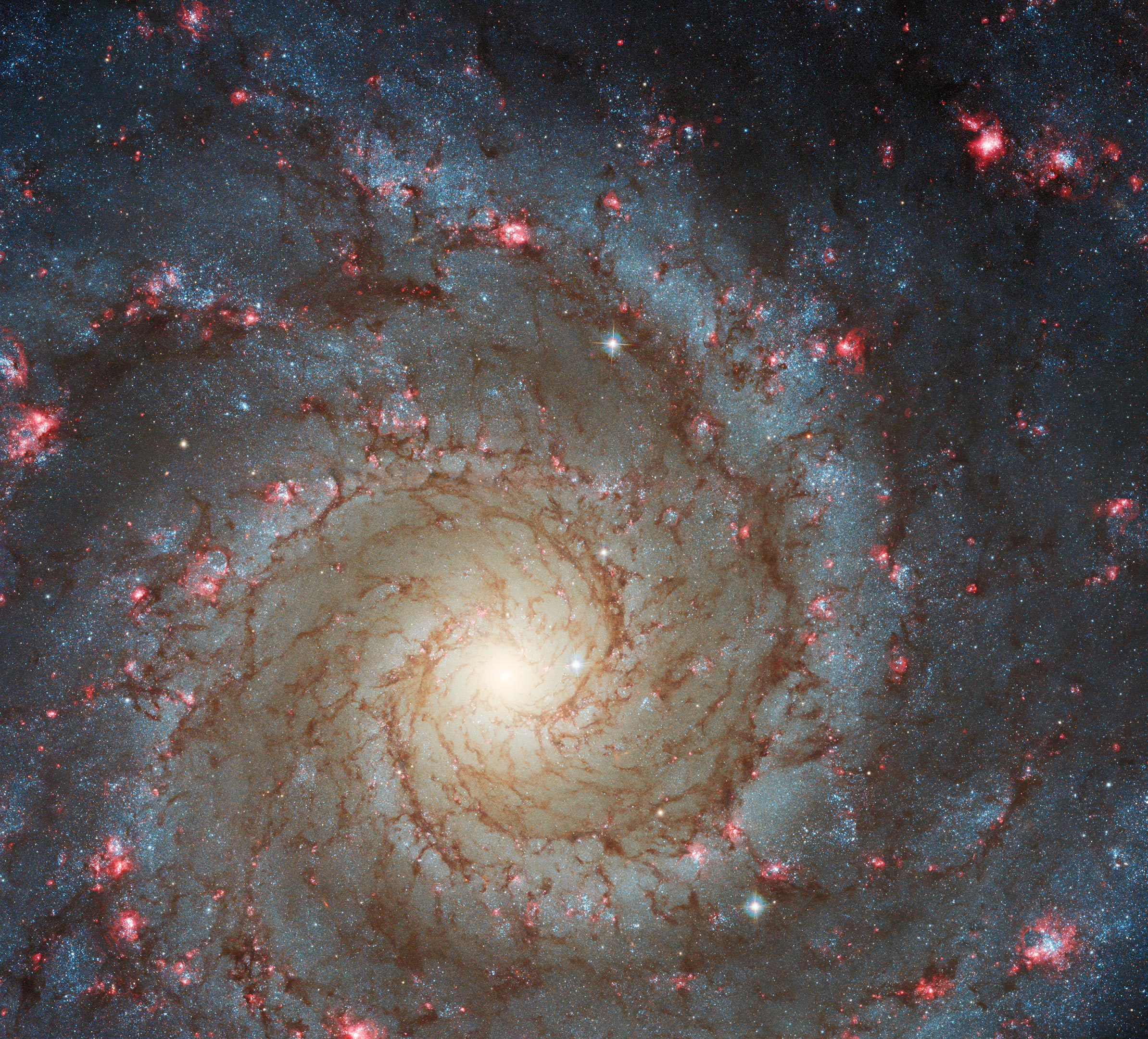
    The arms of the spiral galaxy M74, studded with rosy pink regions of fresh star formation, are showcased in this Hubble Space Telescope image. Credit: ESA/Hubble & NASA, R. Chandar

    This stunning image from the NASA/ESA Hubble Space Telescope shows the arms of the spiral galaxy M74 studded with rosy pink regions of fresh star formation. M74 — also known as the Phantom Galaxy — lies around 32 million light-years away from Earth in the constellation Pisces. It is a familiar sight for Hubble.

    The beautiful reddish blooms that spread throughout M74 are actually huge clouds of hydrogen gas. They are made to glow by the ultraviolet radiation from hot, young stars embedded within them. These regions — which astronomers refer to as H II regions — mark the location of recent star formation and are an important target for both space- and ground-based telescopes. Hubble’s Advanced Camera for Surveys, which collected the data in this image, even has a filter specially tailored to pick out only this specific red wavelength of light!

    A set of observations exploring the evolution of local spiral galaxies such as M74 supplied the data for this image. This exploration aims to gain insights into the history of star formation in these spirals. To do this, astronomers analyzed star clusters to date the different parts of spiral galaxies, enabling them to understand how the galaxies assembled over time. Additionally, they explored the distribution of dust in spiral galaxies. This dust is visible in this image as the dark threads winding along the spiral arms of M74.

    Aside from their quest to understand the history of spiral galaxies, astronomers also observed M74 to complement observations from other telescopes. Combining observations of the same object from different telescopes across the electromagnetic spectrum provides far more insight to astronomers than observations from a single telescope would. Hubble’s observations also paved the way for future instruments; M74 was one of the first targets of the powerful new NASA/ESA/CSA James Webb Space Telescope.

    Never miss a breakthrough: Join the SciTechDaily newsletter.
    Follow us on Google and Google News.

    Astronomy European Space Agency Hubble Space Telescope Popular
    Share. Facebook Twitter Pinterest LinkedIn Email Reddit

    Related Articles

    NASA’s Hubble Accidentally Witnesses a Comet Shattering in Space

    Hubble’s Newest Discovery Isn’t a Star, It’s a Window Into the Dark Universe

    Hubble Captures the Best Ever Image of the Antennae Galaxies

    Hubble Captures Face-On Image of Messier 61

    Hubble Views an Ongoing Cosmic Collision

    Hubble Views Newborn Stars in Galaxy IC 5052

    New XDF Image, The Deepest-Ever View of the Universe

    Hubble Zooms in on the Center of M4

    Hubble Image of Peculiar Galaxy Pair Arp 116

    Leave A Reply Cancel Reply

    • Facebook
    • Twitter
    • Pinterest
    • YouTube

    Don't Miss a Discovery

    Subscribe for the Latest in Science & Tech!

    Trending News

    Invisible Black Holes Could Be Triggering Supernovae

    Scientists Discover the First Contagious Cancer in a Freshwater Animal

    THC-CBD Treatment Dramatically Reduces Agitation in Dementia Trial

    Scientists Say Love Follows Mathematical Patterns

    “Zombie Cells” Reveal a Hidden Weakness That Could Help Fight Aging

    Alien Signals May Be Hiding in a Radio Band SETI Has Barely Explored

    Earth’s Hidden Thermostat Has Regulated Climate for 60 Million Years

    This 518-Million-Year-Old Creature Reveals How Spiders Got Their Bite

    Follow SciTechDaily
    • Facebook
    • Twitter
    • YouTube
    • Pinterest
    • Newsletter
    • RSS
    SciTech News
    • Biology News
    • Chemistry News
    • Earth News
    • Health News
    • Physics News
    • Science News
    • Space News
    • Technology News
    Recent Posts
    • Tiny Divers Challenge a Major Theory About Ocean Insects
    • More Than 1,500 Ships Could Carry a Marine Crisis Around the World
    • New Compound Could Help Aging Muscles Repair Themselves
    • Exercise Helps Hip Arthritis but the Relief May Be Hard to Notice
    • Rare Bourbon Virus Confirmed in New York for the First Time
    Copyright © 1998 - 2026 SciTechDaily. All Rights Reserved.
    • Science News
    • About
    • Contact
    • Editorial Board
    • Privacy Policy
    • Terms of Use

    Type above and press Enter to search. Press Esc to cancel.