
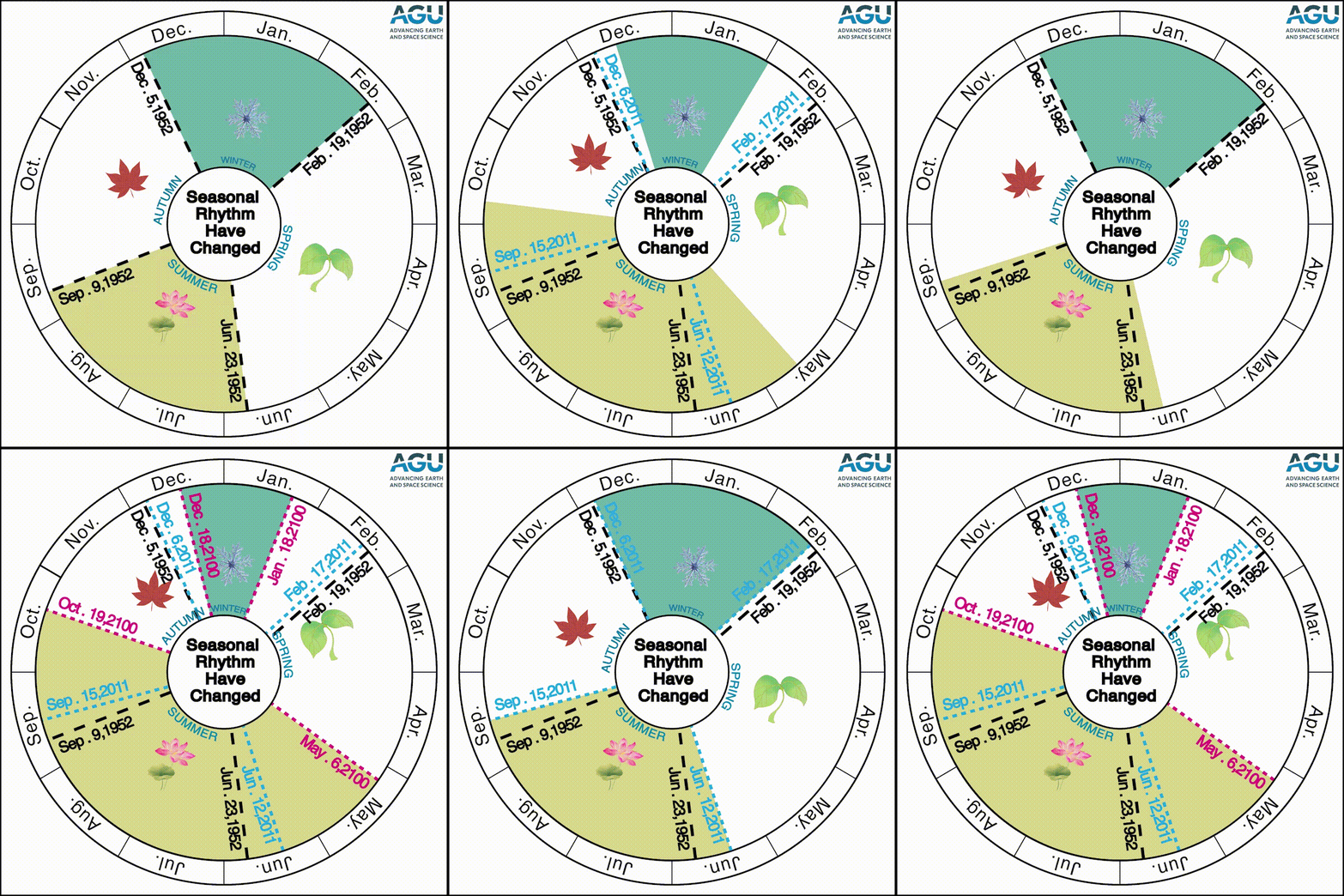
Without efforts to mitigate climate change, summers spanning nearly six months may become the new normal by 2100 in the Northern Hemisphere, according to a new study. The change would likely have far-reaching impacts on agriculture, human health and the environment, according to the study authors.
In the 1950s in the Northern Hemisphere, the four seasons arrived in a predictable and fairly even pattern. But climate change is now driving dramatic and irregular changes to the length and start dates of the seasons, which may become more extreme in the future under a business-as-usual climate scenario.
“Summers are getting longer and hotter while winters shorter and warmer due to global warming,” said Yuping Guan, a physical oceanographer at the State Key Laboratory of Tropical Oceanography, South China Sea Institute of Oceanology, Chinese Academy of Sciences, and lead author of the new study in Geophysical Research Letters, AGU’s journal for high-impact, short-format reports with immediate implications spanning all Earth and space sciences.
Guan was inspired to investigate changes to the seasonal cycle while mentoring an undergraduate student, co-author Jiamin Wang. “More often, I read some unseasonable weather reports, for example, false spring, or May snow, and the like,” Guan said.
The researchers used historical daily climate data from 1952 to 2011 to measure changes in the four seasons’ length and onset in the Northern Hemisphere. They defined the start of summer as the onset of temperatures in the hottest 25% during that time period, while winter began with temperatures in the coldest 25%. Next, the team used established climate change models to predict how seasons will shift in the future.
The new study found that, on average, summer grew from 78 to 95 days between 1952 to 2011, while winter shrank from 76 to 73 days. Spring and autumn also contracted from 124 to 115 days, and 87 to 82 days, respectively. Accordingly, spring and summer began earlier, while autumn and winter started later. The Mediterranean region and the Tibetan Plateau experienced the greatest changes to their seasonal cycles.
If these trends continue without any effort to mitigate climate change, the researchers predict that by 2100, winter will last less than two months, and the transitional spring and autumn seasons will shrink further as well.
“Numerous studies have already shown that the changing seasons cause significant environmental and health risks,” Guan said. For example, birds are shifting their migration patterns and plants are emerging and flowering at different times. These phenological changes can create mismatches between animals and their food sources, disrupting ecological communities.
Seasonal changes can also wreak havoc on agriculture, especially when false springs or late snowstorms damage budding plants. And with longer growing seasons, humans will breathe in more allergy-causing pollen, and disease-carrying mosquitoes can expand their range northward.
Going to Extremes
This shift in the seasons may result in more severe weather events, said Congwen Zhu, a monsoon researcher at the State Key Laboratory of Severe Weather and Institute of Climate System, Chinese Academy of Meteorological Sciences, Beijing, who was not involved in the new study.
“A hotter and longer summer will suffer more frequent and intensified high-temperature events – heatwaves and wildfires,” Zhu said. Additionally, warmer, shorter winters may cause instability that leads to cold surges and winter storms, much like the recent snowstorms in Texas and Israel, he said.
“This is a good overarching starting point for understanding the implications of seasonal change,” said Scott Sheridan, a climate scientist at Kent State University who was not part of the new study.
It is difficult to conceptualize a 2- or 5-degree average temperature increase, he said, but “I think realizing that these changes will force potentially dramatic shifts in seasons probably has a much greater impact on how you perceive what climate change is doing.”
Reference: “Changing Lengths of the Four Seasons by Global Warming” by Jiamin Wang, Yuping Guan, Lixin Wu, Xiaodan Guan, Wenju Cai, Jianping Huang, Wenjie Dong and Banglin Zhang, 19 February 2021, Geophysical Research Letters.
DOI: 10.1029/2020GL091753
Never miss a breakthrough: Join the SciTechDaily newsletter.
Follow us on Google and Google News.
5 Comments
These guys predicted this Endless Summer way back in 74
https://www.youtube.com/watch?v=xp874EIDeaY
First of all, this is nonsense. The sun entered a solar minimum in 2017. If anything, we’ll see winters lasting 6 months in coming years.
Education yourselves.
https://solarcycle24com.proboards.com/thread/2413/global-cooling-forecast-basics-astrometeorology
Lol the solar cycles impact solar storm activity. It reached solar maximum like two years ago and will reach solar minimum again in 6-7 years. It has absolutely no impact on our weather on earth or the seasons within it.
So……. basically……… what you’re saying is…………………….. The growing season will increase AND more land will be freed up in the far north for agriculture? This sounds like an absolute WIN for food production, since the population is still increasing. YAY!
Yeah as completely discouraging as it is, lot of people do not think this a big deal because most people (living in the northern hemisphere in urban areas) have access to air conditioning and are far removed from the impacts of wildfires. Not to mention in that same culture, summers are thought of as a good thing more than anything is.
I think these studies should definitely explain why these issues are a big deal (which they do) but bring the focus to impacts that are more relevant to the privileged folk that actually have influence over the system. Talk about how climate change may increase insurance fees or how people will have to spend more to maintain the same lifestyles. We need to appeal to rich/privileged people, not to the people that already care and know about the impact a forest fire has on the surrounding ecosystems. Visit our website greatofreview.com