
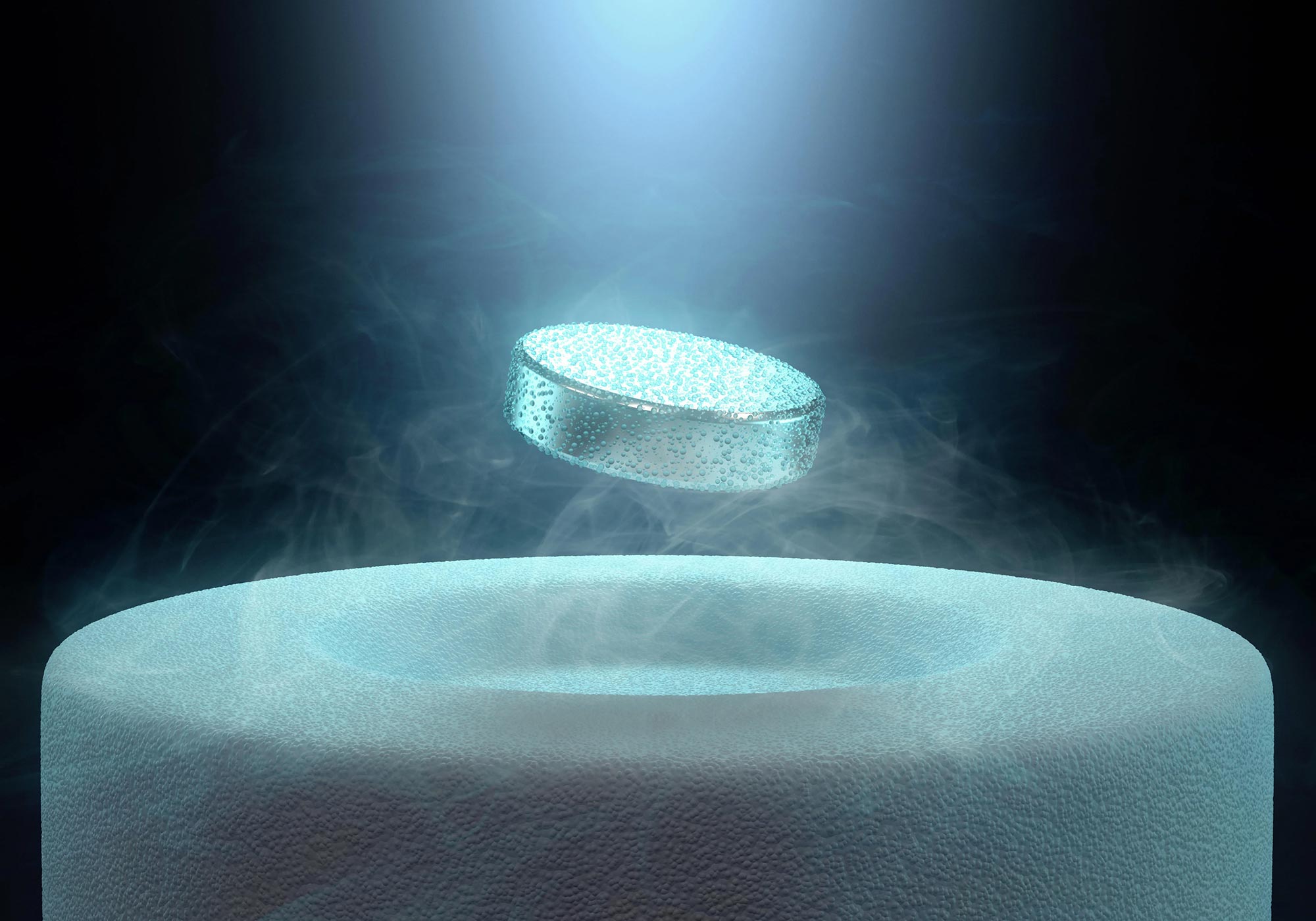
Scientists are pioneering new material designs that may bring the dream of room-temperature superconductivity closer to reality.
Superconductors typically require extremely low temperatures to function, but these new designs could operate at much higher, even ambient, temperatures, significantly broadening their practical applications.
Pioneering Materials for Room-Temperature Superconductivity
New materials designed by a University of Illinois Chicago graduate student may help scientists meet one of today’s biggest challenges: building superconductors that operate at normal temperatures and pressures.
Superconductors are used widely in everyday applications from MRI machines to power transmission. But to work, they must be cooled to extremely low temperatures, which limits their potential. Scientists worldwide are pursuing materials that could show superconductivity at “very high” temperatures — in this context, closer to room temperature — without requiring super-cooling.
Promising New Designs for Superconductors
In a paper for the Proceedings of the National Academy of Sciences, Adam Denchfield and a team of UIC scientists proposed three promising new designs for superconducting materials. In computer simulations, the designs demonstrate some of the properties needed for very high-temperature superconductivity.
Hyowon Park, associate professor of physics, and Russell Hemley, professor of physics and chemistry, co-authored the paper with Denchfield, a PhD candidate in physics at UIC.
For decades, scientists have looked for materials that could make superconductivity — the lossless transmission of electricity — possible at higher temperatures, such as room temperature. That would allow the use of superconductors for advanced power grids, more efficient electric motors, and more advanced magnetically levitated trains.

The Lutetium-Based Controversy and Inspiration
In 2023, a group of scientists published a controversial paper on a superconducting material containing a rare earth element called lutetium that works at close to ambient temperature and air pressure. The controversy inspired Denchfield to explore past literature on the type of material they described, called rare earth trihydrides.
“I looked at the results, and I was just as skeptical as many others in the field,” Denchfield said. “So I set out to look into the literature to seek alternate explanations and found studies from the late 1960s studying rare earth trihydrides.”
These older studies showed very strange changes in the electrical conductivity of the materials when cooled that are still not fully understood. Denchfield found that special arrangements of the lutetium atoms in combination with hydrogen and nitrogen can cause the material to exhibit intriguing properties including high-temperature superconductivity.
His research eventually led to a paper on a promising lutetium-hydrogen-nitrogen compound and experimental results that were consistent with superconductivity. The work by Hemley’s group was covered in the New York Times.
Expanding Beyond Lutetium: New Potential Structures
But Denchfield didn’t stop there. He started to explore whether other rare earth hydride combinations and structures, such as replacing lutetium with its periodic-table cousins yttrium and scandium, could work even better. With the goal of increasing the superconducting temperature as much as possible, he landed on three types of cubic structures that could produce the desired properties in simulations.
“We basically put forward three template structures of increasing complexity that we want other people to be able to take and mess with, plug and play different elements,” Denchfield said. “I would describe this as an exploratory paper, a motivational and inspirational work that should inspire the search for a whole new class of structures that could be very high-temperature superconductors.”
Material designs described in the paper achieve critical temperature — the point where superconductive properties appear — above 200 degrees Kelvin, roughly equivalent to -100 degrees Fahrenheit. Denchfield said some designs could achieve the “holy grail” of superconductivity at ambient pressure and room temperatures. To verify the predictions, materials with the new designs will have to be synthesized in the laboratory and tested.
The Road Ahead for Room-Temperature Superconductivity
“The new study led by Adam builds on the previous milestones of our group: the discovery of the first near-room-temperature superconductor in another rare earth hydride under pressure, then the tantalizing evidence for similar high-temperature superconductivity in the lutetium-based material,” Hemley said. “The prospects for new classes of related materials with different compositions is the latest chapter in our exciting efforts to discover and create new materials that could one day revolutionize energy technologies.”
Reference: “Designing multicomponent hydrides with potential high Tc superconductivity” by Adam Denchfield, Hyowon Park and Russell J. Hemley, 1 November 2024, Proceedings of the National Academy of Sciences.
DOI: 10.1073/pnas.2413096121
Never miss a breakthrough: Join the SciTechDaily newsletter.
Follow us on Google and Google News.
3 Comments
Ah, but what will make the groundbreaking materials possible?
To Boba … What, you ask, will make these materials possible?
Why, more research, testing, confirmation by other groups, publication of results, investment of capital to bring the technology (if proven) to market and THEN, the public gets to pay for the advancements that these scientists have brought to us. [p.s. – note that ‘investment of capital’ – meaning someone or some group with bunches of money will need to see the vision of what can be and put their money at risk to see it come from the laboratory to market. Then says a socialist/communist/libertard; “Capitalism! Bah! Humbug!” But, that’s the way it works. Almost every time.]
Date: 18-November-2024 (mon.)
Good news this is !, If this Lutetium hydride compound can be truly become room temperature superconductor under pressure or not, therefore the era of this elusive phenomenon can help achieve many wonderful practical and technical applications from toys to industrial and power equipment such as superconducting motor and transformer and SMES and others by saving and conserving energy inputs expenses. TY !, by FMSJR.